Especially if you’ve been doubting the idea that common stocks are useful as an asset class for healthy long-term returns. Judging from many comments in the media and individual investors that doubt this construct to be real, I am presenting a chart extracted from a headline article in MarketWatch (the on-line service of the Wall Street Journal). Kudos to the MarketWatch and author, Paul Merriman, for “Eight lessons from 80 years of market history.”
Although Merriman provides very compelling data (as you’ll see in the chart below), nobody seems to care. Mind you, this was a headline story this morning in MarketWatch (11/19/2014), yet it never trended in the “top Five” articles accessed by s subscribers. I guess the title wasn’t sexy enough (unlike the eye-catcher I penned for this post). Who wants to learn about history anyway…BORING.
I’m not afraid of being boring and I think history is important. And, I think the table below, while it may not blow your mind, might give you some confidence in down times that there may be a tomorrow and it could be pretty bright. Please take note of the two ten year periods after the last secular bear market (1966-1982–16 years below 1000 on the Dow Jones Industrials). Though the 1980s numbers were great, they were followed by another great decade in the 90s. As to those who are looking at the last 5 years and saying it cannot last, these two decades are a strong counterpoint. Again, this does not preclude sharp and scary (even violent) corrections. We had one in 1987 after the market had run from Dow 1000 in 1982 to Dow 2700 in 1987 (up 170% in 5 years). We lost 1000 of those 2700 points within a few months of that peak. Interestingly, though, we’re only up 33% after the 13-year secular bear market that ended in 2013. Ergo, based on the 1980’s /1990’s example, we may have further to go.
Past performance is no guarantee of future results
But, this is pretty compelling stuff
DECADE RETURNS 1930 THROUGH 2009
The following are 10-year annualized percentage returns for the S&P 500 Index, U.S. Large Cap Value, U.S. Small Cap and U.S. Small Cap Value. Returns are in %s.
Asset Class:
30-39
40-49
50-59
60-69
70-79
80-89
90-99
00-09
1930-2013
S&P 500 Index
-.1
9.2
19.4
7.8
5.9
17.5
18.2
-.9
9.7
Large-Cap Value
-5.7
12.7
18.4
9.4
12.9
20.6
16.8
4.1
11.2
Small-Cap
2.3
14.9
19.2
13.0
9.2
16.8
15.5
9.0
12.7
Small-Cap Value
-2.6
19.8
19.6
14.4
14.4
20.1
16.2
12.8
14.4
Includes reinvestment of dividends. Source: Dimensional Fund Advisors.
PLEASE READ ENTIRE ARTICLE, “8 Lessons from 80 years… “. There’s lots more on risk taking and asset allocation.
One Caveat
If you happen to be so unfortunate as to buy into the market at a generational top (1929, 1966 or 2000), you might need some patience to realize your dreams. It took 23 years for the market to completely right itself and move to new highs after 1929.In the case of 1966 and 2000 it took 16 years and 13 years respectively. The good news is we are only 14 yeas past the 2000 top. With any luck the next one will be the next generation’s problem.
If this hasn’t quite blown your mind, I hope, at least, it gave some food for thought.
What did you think?
The information presented in kortsessions.com represents my own opinions and does not contain recommendations for any particular investment or securities. I may, from time to time, mention certain securities for illustrative purpose, names where I personally hold positions. These are not meant to be construed as recommendations to BUY or SELL. All investments and strategies should be undertaken only after careful consideration of suitability based on the risks, tolerance for risk and personal financial situation.
That is my fervent prayer. But it seems like the media has other plans. Today’s special coverage on CNBC and MarketWatch gives me the feeling, in fact, the much-maligned Quantitative Easing isn’t going to get a rest, even though its long past its prime as a topic. I’m not certain why this is. Maybe it’s because they have nothing else to worry us with; like no new cases of Ebola in the “Big Apple.” To capture the hyperbole today I quote Australian stunner, co-anchor Mandy Drury, who summed up her segment today by saying, “We had a very big day today–the end of Q.E., history in the making.” I’m not sure what she was talking about (it’s not about what she says anyway). At one point after the Fed minutes were released we were down on the Dow about 100 points (less than one percent), finishing down only 32 points.
the Australian stnner
OMG!!! Things are getting better!
This is not bad, considering the negative feeding frenzy the media went into on a small change in tone taken in the Fed’s message about the economy. OMG! They were more positive on their outlook for the economy. Things are getting better out there! And, you know what that means–the Fed will run rates up and ruin everything. I’m not sure this argument really washes, but this a topic for a future post as we approach that awful day of reckoning. But, I digress. To show you how ridiculous this emphasis on the negative aspects of the withdrawal of Q.E. is, a little history lesson might be in order. Up until January 2014, the Fed had been buying a total of 85 billion dollars worth of long-dated Treasuries and agency mortgage-backed securities each month, about four billion per day. As a result of the “dreaded taper” that daily buy was running at the paltry sum of $600 million daily this month. This versus markets that trade, on average, at least (sometime much more) $150 billion daily. As Q.E. ended, the Fed was a tiny overbid in the market place. Also, the statement indicated no immediate plans to shrink the Fed balance sheet that Q.E. expanded. Since the beginning of the ‘taper” in January of this year, interest rates which peaked a tad over 3% on the UST 10-year, have been as low as 2.15% (mid October 2014); and, today, the 10-year went out at 2.32%. Nobody, including me, saw this as a potential outcome of tapering and closing out Quantitative Easing.
The information presented in kortsessions.com represents my own opinions and does not contain recommendations for any particular investment or securities. I may, from time to time, mention certain securities for illustrative purpose, names where I personally hold positions. These are not meant to be construed as recommendations to BUY or SELL. All investments and strategies should be undertaken only after careful consideration of suitability based on the risks, tolerance for risk and personal financial situation.
As you may have surmised by my lack of posting, I’ve been away for a few days. Before leaving for Europe October 11, I posted Session 129, “House of Pain.” The market was down big and in a tizzy about Europe and fear that recent signs of weakness there (especially in Germany) presaged their shallow recovery being undone. Of course, there was Ebola and ISIS weaving their negative magic in the background. This reversed immediately, as soon my wife, Regina (a one-woman economic stimulus program) hit the ground in Italy. Voila! Europe is saved and the market is on a tear. It would be unfair to give Regina all the credit. In truth, Venice, Firenze and the Amalfi coast were teeming with touristas spending money.
But, let’s not pop the corks on the champagne just yet.
Irrational Exuberance!
There’s that pesky Ebola that just keeps rearing its ugly head and the financial media is trying very hard to make it the new fear story (‘if it bleeds, it leads’). This is not to demean the fact that this horrible virus is an important story; only to say, at this point, it should not be a market mover … the new pandemic.
Importantly, Ebola is hard to catch. It is reported widely that you have to be in direct contact with bodily fluids emanating from a person manifesting symptoms to catch it. All of the U.S. cases were, in fact, in people who worked around the disease and had multiple opportunities for exposure. A second point I would make is that the world is finally beginning to take the disease seriously and resources are starting to flow (albeit in a not-too-timely fashion) to knock down this most recent West African flare.
Where’s the grief?
Real Grief
Well, it is mostly in the minds of the media (main-stream and financial), which deserves credit for getting the story out there, but not for stoking irrational fears. If you are in the market and you get your news from MarketWatch (an on-line service of The Wall Street Journal) or CNBC, you might get the impression every snippet of Ebola news could potentially blow up the market. Here are a few samples from the pre-opening headlines, Friday, October 24th:
From MarketWatch–“Wall Street set to open lower after New York Ebola news”
Now, I bookmarked all the stories attached to these headlines. Interestingly, only the CNBC stories were recoverable. The MarketWatch headline had been replaced by another story, “S & P 500 posts biggest weekly gain of 2014.” Oh, the things you can do and say on the internet!
All I can say is, thank you Regina (and all your countless like-minded minions) for the big week in the market. Between Italy and my portfolio’s snap back, I more than broke even.
How did your portfolio do last week?
The information presented in kortsessions.com represents my own opinions and does not contain recommendations for any particular investment or securities. I may, from time to time, mention certain securities for illustrative purpose, names where I personally hold positions. These are not meant to be construed as recommendations to BUY or SELL. All investments and strategies should be undertaken only after careful consideration of suitability based on the risks, tolerance for risk and personal financial situation.
What is the ‘death cross” and why should we care? I’m not quite sure, but the media is fascinated by them … in particular the ‘death cross’ just completed on the Russell 2000, small cap index.
A death cross is technical/stock-charting parlance for the point where an index (or stock price) sees its 50-day moving average price cross below its longer-term 200-day moving average price.
Technicians view this as a significant loss of momentum for the security or index in question…a harbinger of bad things to come. As we approached the ‘cross’ on the Russell 2000 yesterday, MarketWatch presented two articles on the topic: one, “Small caps may be in trouble…” positing the bull market may be over for a significant portion of the market (i.e. small caps), and the other, more balanced, “Time to worry? Russell 2000 ‘death cross’ looms.” In “Time to worry?…”a technical analyst/blogger, Ryan Detrick mentions that there have been 19 Russell 2000 “death crosses’ since 1988.
“He notes that an investor who shorted the index after the last death cross in 2011 would have been down 19% by the time it had reversed, while someone who shorted all 19 signals would have lost an average of 5.55% and made money only four times. The bottom line, Detrick says, is that while the death cross could mark the start of a big downtrend, it’s not a “clear-cut bearish signal.”
The CNBC crew gets it right for a change
CNBC “Fast Money” contributor, Josh Brown, CEO, Ridholtz Wealth Management, did a number on the facts about death crosses in the video segment,“Decoding the death cross.” Brown is a CNBC minion that gets it right. Non-the-less, within 30 minutes of this piece, there was another CNBC minion pointing out the dangerous omen that the ‘death cross’ held for the market … all of this beyond my comprehension.
How about yours?
The information presented in kortsessions.com represents my own opinions and does not contain recommendations for any particular investment or securities. I may, from time to time, mention certain securities for illustrative purpose, names where I personally hold positions. These are not meant to be construed as recommendations to BUY or SELL. All investments and strategies should be undertaken only after careful consideration of suitability based on the risks, tolerance for risk and personal financial situation.
I have raised elements of Craig’s argument in past kortsession posts (session-8 and session-20 to name two). It has been a theme of mine: and, as I have said before, I love it when people agree with me!
Here is a sampling from Howard Gold’s MarketWatch article on Johnson’s long-term market views:
If Johnson is right, stocks will rally for a long time. He thinks we’re in the kind of secular (extreme long-term) bull market we saw in both the 1950s and the 1980s. Each of those runs lasted much longer than a decade.
“The secular bull market began in March of 2009 and was finally confirmed when we went through the 2000 and 2007 highs,” Johnson explained.
That “confirmation” occurred in March 2013, when the S&P 500 broke above 1550, its previous all-time peak.
“When you break out of big bases, the market accelerates,” he explained, and indeed, the S&P has gained as much as 28% since hitting that magic number.Comparing that with 1952 and 1982, when the market also surpassed its previous high (in price only, not including dividends), Johnson said, “If history does rhyme, [this bull market] would last 10 years from 2013.”
“Investors made five times their money” after 1952 and 15 times their money from 1982 to 2000, he said.
As a footnote to Johnson’s remarks, I think it might be constructive to consider what a “long base” looks like. The 1929 Crash built an extraordinarily long base, 23 years (from peak in 1929 381.71 to a 1932 low of 41.22, the Dow Industrial broke out definitively to new all-time highs in 1952). The 1966 bear took 16 years to break out definitively to new all-time highs. The 2000 bear built a 13-year base before breaking out to new all-time highs in 2013. The reason the ’29 market based for so long was, in large part, due non-response by the Federal Government (zero fiscal stimulus until 4 years after the crisis began) and a faulty Fed response to the crisis (tightening credit, instead of loosening it). 2008 could have turned out the same way without enlightened leadership on the part of both the Bush and Obama administrations, and the Bernanke Fed. We were very lucky.
CAVEAT!
It is important to recognize the fact that during both these runs there were significant, scary corrections; in particular 1987, when the Dow Jones Industrial Average plunged 36% inside of three months. Those who stayed the course saw almost a seven-fold increase to the January 14, 2000 peak of 11,612.53.
What’s your take on this thought process?
The information presented in kortsessions.com represents my own opinions and does not contain recommendations for any particular investment or securities. I may, from time to time, mention certain securities for illustrative purpose, names where I personally hold positions. These are not meant to be construed as recommendations to BUY or SELL. All investments and strategies should be undertaken only after careful consideration of suitability based on the risks, tolerance for risk and personal financial situation.
It’s September for Pete’s sake! And, the pundits are feasting on seasonality and the fact the that bad things have happened in past Septembers and Octobers. Just because the market has had a few bad experiences in these months (like September of 1929 and October of 1987), the “nattering nabobs of negativism” are out to nail the coffin shut on this bull market. Long-term stats would also support September as being a bit troublesome for the market. According to data compiled by Mark Hulbert(“Here’s what history says about the stock market in September” MarketWatch,8/29/14) in the last 100 years the average September has produced a loss of 0.8%. However, the other 11 months averaged gains of 0.8%. In and of itself, these statistics really would argue in a compelling way for a buy and hold approach.
September and October could be horrible
This is far beyond my ability to forecast. What is important is the fact that we have gone for a long time without a real meaningful correction. When the ‘big one’ comes, it will be a complete surprise (even though it should not be), scary and completely normal. Now, if you are anxious about the possibility, amidst the constant chirping from the ‘nabobs’, you might consider the following:
1) It is all about comfort, your comfort. It is no disgrace to take some chips off the table, especially after the run we’ve seen in the market.
2) If you own individual stocks, comfort comes with knowing what you own and why you own it.
3) Finally, if it is any comfort, 1929 and 2008 were what Wade Slome (Investing Caffeine) has referred too as “100 Year Floods.” The likelihood of a recurrence after 5 years would seem to be a major long-shot, despite what you read in the papers/blogs and hear on the wireless and telly.
How comfortable are you?
The information presented in kortsessions.com represents my own opinions and does not contain recommendations for any particular investment or securities. I may, from time to time, mention certain securities for illustrative purpose, names where I personally hold positions. These are not meant to be construed as recommendations to BUY or SELL. All investments and strategies should be undertaken only after careful consideration of suitability based on the risks, tolerance for risk and personal financial situation.
It would be nice if someone would create an app for PCs, mobile electronic devices and televisions that would flash a large‘RedBS‘ (mid-screen) every time the media went overboard or off the track on a news item. The downside for those who watch CNBC would be the screen flashing red all the time.
I was immediately reminded of the above quote from session 64 (“The Killer App”) when I read a post from a former client, Wade Slome, Founder and President of Newport Beach, CA, based Sidoxia Capital Management.LLC. Wade is a kindred spirit when it comes to the media and investing. In Sidoxia’s August Monthly investment letter, “Psst…Do you want to join the club?” (The Successful Investors Club), Wade offered to two rules for admittance:
By way of background, I met Wade in the late 1990’s when he was working as an equity analyst with the American Century Funds in Kansas City. Subsequently he rose to the position of senior portfolio manager on the team that managed the $20 billion American Century Ultra Fund, at the time one of the largest ‘large-cap’ growth funds in the country. He left American Century in 2007 to return to his home turf in California and build his own firm.
I reconnected with him through some favorable articles that he wrote about one of my personal holdings for the web site “Seeking Alpha.” Of course, anyone who likes one of my stocks is an outright genius!
I thought it would be interesting to get his take on the sentiment of his clients in the current market environment…what kind of issues are they raising with him, their concerns? Are they ebullient or fearful? Here is my Q & A with Wade Slome:
KS-Today, when you recommend a client take on, or increase equity exposure, what are the most common push-backs that you get? Have these changed in the past few years? If so, could you explain?
WS –Given the events that have transpired over the last 15 years, I expect to receive a healthy dosage of pushback. Many investors have naturally been scarred from the 2008-2009 Financial Crisis, so convincing certain people that the 100-year flood will not occur every 100 days can be challenging. Regardless of the skepticism I receive, I feel it’s my duty to provide the best possible advice I can to existing clients and prospective clients. I can lead a horse to water, but I believe it’s not my job to force clients into a single investment option. At Sidoxia, we customize investment plans that meet clients’ risk tolerances, time horizons, and overall objectives. With regard to sentiment changes in recent years, it is true that the tripling in equity market values since early 2009 has changed investor moods. Risk appetites have definitely increased. Nevertheless, cynicism is still rampant. Surveys done by Gallup show that stock ownership is near 15-year lows and despite stocks at or near record highs, ICI fund flow data shows money fleeing U.S. stock funds in 2014. With generational low interest rates, I see many long-term investors being too imprudently conservative. However, on the other hand, my responsibility is to also prevent other clients from taking on too much risk, especially if they have shorter investment time horizons or have limited funds in retirement.
KS – When you speak with clients today, what are prominent worries do they have about their investments: The general level of the market, valuation, the economic backdrop, U.S. political issues or geopolitical concerns (all of the above)? Could you rank or tell me which concerns seem to be paramount?
WS –In this 24-hour news cycle society we live in, an avalanche of real-time data gets crammed down our throats daily through our smartphones and Twitter-Facebook pages. As a result, the overwhelming barrage of news gets disseminated instantaneously, which in turn spreads fear like wildfire by word of mouth. In this type of environment it comes as no surprise to me that the general public is on edge. Every molehill is made into a mountain by media outlets for a simple reason…fear sells! Before the internet 20 years ago, virtually no one could find the location of Cyprus, Syria, Ukraine, or Gaza on a map – now we have Google and Wikipedia to show us or the Twitter feed scrolling at the bottom of our television sets reminds us. As far as concerns go, it’s tough to rank which ones are paramount. One day it’s the elections or Iran, and then the other day it’s the stock market crashing or the Ebola virus. Eventually the emotional pendulum will swing from fear and pessimism to optimism and euphoria, it always does. Like a lot of different professions, one of best strengths to have as an investment manager is the experience in knowing what noise to filter out and the ability to identify the relevant factors that drive outperformance.
KS – Could you share the short-form responses that you might give to your clients when addressing the aforementioned issues?
WS –The best advice I can give investors is to ignore the headlines. This principle is just as true today as it was a century or two ago. Mark Twain famously said, “If you don’t read the newspaper, you are uninformed. If you do read the newspaper, you are misinformed.” This is obviously presented a little tongue-in-cheek, but the main point being is headlines should not drive your investment decisions. It’s perfectly fine to be informed about the economy and politics, but people must realize the stock market often moves independently and in contrarian directions to prevailing media stories. Rather than emotionally react to news flow, it is much more important to create an objective, long-term investment plan that takes advantage of market noise, hype, and volatility.
KS – Finally, this is a little bit of a leading question that I hope you might run with (as it is the second rule of entrance to “the club”). Do you find any useful purpose being served by the financial, general or political media that might aid an individual’s investment process?
In my view of the financial markets, there are a few underlying principles that drive stock prices over the long-term, and they include such basic factors as earnings, valuations, interest rates, and market psychology. What I would objectively try to argue is that the financial, general, or political media have little to no impact on the first three factors and only modest influence on the last one (market psychology). Part of the reason I have been so constructive on the markets on my Investing Caffeine blog over the last five years is because all these factors have generally pointed in the right direction. I will become nervous when earnings decline, valuations get stretched, interest rates spike, and/or psychology turns euphoric. Right now, I don’t think we are seeing any of that occurring. With that said, I do believe there are exceptions to the rule that “media is evil.” If you have the time, interest, and patience to walk through the endless desert of financial media, you can find a few rare flowers. Although I do consume mass amounts of media, 99% of it goes in the trash. I do my best to reserve my media consumption to those successful investors that have lived through multiple market cycles and have a track record to back it up. You can find sage investment bloggers, Warren Buffett interviews on CNBC, or newspaper interviews of winning venture capitalists, if you properly filter your media diet. What should generally be avoided at all costs are rants from economists, journalists, analysts, commentators, and talking heads. No matter how eloquent or articulate they may sound, the vast majority of the people you see on television have not invested a professional dime in their careers, so all you are getting from them are worthless, vacillating opinions. I stick to commentary from the tried and true investment veterans.
Actually, from my point of view, Wade’s Rule #2 should be Rule #1, and Rule #2 should be don’t forget Rule #1.
Thank you Mr. Slome!
Wade Slome Sidoxia Capital Management, LLC
The most wonderful feature of my 42-year career in the investment business were the good and talented people (both on the BUY side and SELL side) that I had the opportunity to meet and work with. I have been truly blessed.
So, what about a Killer App #2?
killer app
Like Killer App #1, Killer App #2 has not been created yet. But, rather than using app #1 (The Red Flashing BS), maybe someone could create an APP that operates thus: when an investor moves to access any dubious media source on any electronic conveyance, that device would impart a non-lethal electric shock to the user. After being shocked several times, the investor will not go there anymore. They would be happier, sleep better and be smarter: not to mention the potential for better investment results.
Would you buy this APP and how much would you pay?
The information presented in kortsessions.com represents my own opinions and does not contain recommendations for any particular investment or securities. I may, from time to time, mention certain securities for illustrative purpose, names where I personally hold positions. These are not meant to be construed as recommendations to BUY or SELL. All investments and strategies should be undertaken only after careful consideration of suitability based on the risks, tolerance for risk and personal financial situation.
It is but a sample of what seems to be a barrage recently of ‘bubble talk’. One article cites data that indicates large doses of ‘bubble talk’ may be a predictor of bad times ahead; or, at a minimum potentially create a self-fulfilling prophecy (“Use of the word ‘bubble’ reaches worrying levels”–CNBC on line, Markets, 7/29/14). We have had these discussions about bubbles and ‘bubble talk’ before. My opinion has been, and continues to be, that it is the punditry corps fighting the last battle of the last war, looking backward, not forward. This is typical and positive, as it continues to be strong evidence of extreme skepticism over the underpinnings of the current bull market. In my world, fear and skepticism are good things to have working in a rising market.
Do not confuse my positive tilt on ‘Bubble Talk’ with the concept of minimal risk!
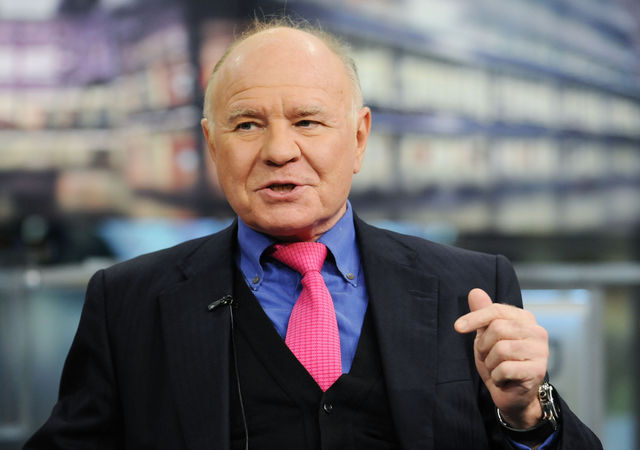
With the market tripling over the past five years, absent any recent significant correction, there is considerable short-term risk. A whopper of a correction (normal, predictable and not the end of the world) could be in the offing vis-a-vis Mark Faber’s most recent commentary (“Marc Faber predicts 20 to 30% drop in stocks–CNBC on line, 7/28/2014). Of course, Faber has been right about twice in the last 15 years, about the same number of times John Hussman has been right.
Why are they still viewed as credible sources?
Marc Faber
Hussman has been another ‘stopped clock’ since the lows of 2009. This economist, turned fund manager, says (back to the ‘bubble talk’), “Make no mistake–this is an equity bubble and a highly advanced one. On most historically reliable measures, it is easily beyond 1972 (The ‘Nifty Fifty’ bubble) and 1987, beyond 1929 and 2007, and now is within 15% of 2000.” (MarketWatch, The Tell, July 27, 2014).
John Hussman and how NOT to pick a money manager
Hussman was a legend after successfully avoiding the ‘Tech Implosion’ and 9/11 rout of 2000-2002 and posting gains. He was only down 9% in 2008 vs. the S&P down 37%. Investors flocked to his fund after that–for the exact wrong reason at the exact wrong time. Of course, things immediately fell apart, as Hussman failed to embrace the bull market that began in 2009.
After five years of being dead wrong I’m sure it is hard for Mr. Hussman to change his tune, as evidenced by our MarketWatch piece. Anyway, if he persists, he will eventually, as my broken clock, be right. There will be a substantial give-back, maybe sooner maybe later. Will it be a disaster? Who knows? What I do know is that in the last 200 or so years of our history, when addressing the wiles of the stock market, more importantly investing, it has generally paid to proceed with a positive bias.
What’s your perspective?
The information presented in kortsessions.com represents my own opinions and does not contain recommendations for any particular investment or securities. I may, from time to time, mention certain securities for illustrative purpose, names where I personally hold positions. These are not meant to be construed as recommendations to BUY or SELL. All investments and strategies should be undertaken only after careful consideration of suitability based on the risks, tolerance for risk and personal financial situation.
Whether you bought into the negative financial and political media rhetoric that accompanied our forty-fourth President into office or whether you did not, will, in large part determine your answer to this question. “2000 Days of Obama: How have stocks fared?…” (MarketWatch, July 14, 2014), answers this question and more…like how have stocks done under Democratic administrations vs. Republican administrations. I’m certain the Right will not be pleased with the answer to this question. But, even this article, which really gives a positive answer to the question, spins a negative into the title by adding, “President ranks high among peers, but standing may not last.”
Lest we forget
According to former Republican House Speaker, Newt Gingrich, ‘[Obama] is in the great tradition of Edison, Ford, the Wright Brothers, Bill Gates — he saw his opportunity and he took it,” Gingrich says. Will Gingrich take it (the Presidency) back in 2012? “The American people may take it back, in which case I may or may not be the recipient of that, but I have zero doubt that the American people will take it back. Unlike Ford, the Wright Brothers, et cetera, this guy’s invention did not work’ (National Review On Line, “the Corner,” by Bob Costa–9/10/2010). How can we forget the charges that the President was the most liberal in the history. He was a Socialist (or even a closet Communist). Even worse, he had been a community organizer. He does not understand business or the economy. He is anti-buisness.
OMG,SELL EVERYTHING!
The Face of Fear
This rhetoric and criticism continues today, in the face of incontrovertible evidence to the contrary. Even if you do not like the president and his other policies, if your are in the market via direct stock investment, mutual funds, ETFs, a 401k or pension, the five-year bull market is proof that much of the media rant on his economic policies has been totally misguided and wrong. Were you swayed to the sidelines? This is a cardinal example of how paying attention to the media can be harmful to your investment health. In a nutshell, the media has done real harm. Now, I try not to be political in the posts; but, If you are in the market, a careful reading of “2000 Days of Obama…” might just turn you into a card-carrying Democrat.
Are we having fun yet?
Your comment?
The information presented in kortsessions.com represents my own opinions and does not contain recommendations for any particular investment or securities. I may, from time to time, mention certain securities for illustrative purpose, names where I personally hold positions. These are not meant to be construed as recommendations to BUY or SELL. All investments and strategies should be undertaken only after careful consideration of suitability based on the risks, tolerance for risk and personal financial situation.
We’ve had some good news in the last couple of days and it was met with a decent selloff today (6/24/14). Now the commentators are falling all over themselves trying to figure out why yesterday’s “flash PMI”:Markit, showing manufacturing expanding at the fastest rate in four years, was met with such disdain. Then there was another bad bit, er, I mean good report this morning showing new home sales hitting a six year high in May.
Also, there were reports that the Syrian Air Force was flying combat missions in Western Iraq vs. ISIS. I would have thought that might have been considered by most to be a good thing, as it might take pressure off the United States to intervene. But, the boys and girls on CNBC were having none of that, as they opined that this might be the reason for the market’s swoon.
Enter “The Hawk”, Charles Plosser
Since Philly Fed President, Plosser is always a hawk on rates, the media gave short shrift to his comments on moving rates upward in the “not-to-distant future” (due to a broader, stronger economy). I have to think that this was what was bugging the market today, and may continue to do so if stronger numbers persist. We may even get a decent correction. Regardless, stronger numbers are, in fact, good news! But, the media, when it gets the drift, will play this negative. Stronger numbers are bad, because the Fed will tighten and we will slide into recession.
What to do?
Zilch, if you own good stocks, they will continue to open their doors every morning, do business and grow, over the long term. Chances are the economy really won’t be blasting off to the moon. The current strength that we are experiencing may also be just a snap-back from the winter-weakened stats of the first quarter. Ergo, the period of more rapid growth may be short-lived. But, when the media gets on this, they will be delighted to have something to chatter about.
Energy, a final subtext to the weak market
A Gusher
Energy, which had been one of the strongest sectors of the market in recent weeks, buckled today. Oil prices did not. What is interesting is that for the first time in over forty years, the U.S. government is going to permit the export of oil. Good news is we must have ample domestic supplies in order to do this. I guess the bad news for the domestic producers that got cracked today is that we have ample supplies. Again, as of this writing (PM June 24, 2014), oil prices have not cracked.
Are you ready for your exam on “Good news is bad news?” Or, are you completely confused?
The information presented in kortsessions.com represents my own opinions and does not contain recommendations for any particular investment or securities. I may, from time to time, mention certain securities for illustrative purpose, names where I personally hold positions. These are not meant to be construed as recommendations to BUY or SELL. All investments and strategies should be undertaken only after careful consideration of suitability based on the risks, tolerance for risk and personal financial situation.
 Especially if you’ve been doubting the idea that common stocks are useful as an asset class for healthy long-term returns. Judging from many comments in the media and individual investors that doubt this construct to be real, I am presenting a chart extracted from a headline article in MarketWatch (the on-line service of the Wall Street Journal). Kudos to the MarketWatch and author, Paul Merriman, for “Eight lessons from 80 years of market history.”