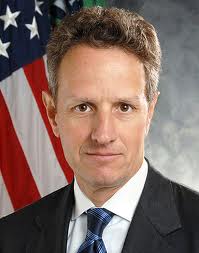
Although I have yet to read former Treasury Secretary, Timothy Geithner’s book, “Stress Test: Reflections on a financial crises,” by virtue of the significant publicity generated and in-depth interviews conducted with Mr. Geithner (Charlie Rose), I do feel competent to comment on issues raised about the book and a persistent critique to the effect that the bailouts did everything to benefit Wall Street with little at all trickling down to Main Street.
Let the banks fail!

As a working institutional broker at the time, I can attest to the severity of the situation and, really how close we were to a “China Syndrome” melt down of our (and the world’s) financial system. It was an extraordinary time, calling for extraordinary measures. I believe the measures taken by Paulson, Bernanke and Geithner were absolutely necessary and proper. They successfully brought us through the eye of the storm avoiding “Great Depression” number two. However, then, as is the case now there are those, both on the Right and the Left, who believe that these interventions were an overreach. “Let the banks fail…recalibrate. We need a good purge. All will be well in the end.” There are also those who point to the bailouts (TARP et.al.) as only beneficial to the ‘fat cat’ bankers with little or no help for the little guy. Neil Barofsky is one of those guys.
Who is Neil Barofsky and why is he misguided?

Neil Barofsky is a Geithner critic, former Special Inspector General for the Troubled Asset Relief Program (TARP), who had two years of oversight responsibility for that $700 billion dollar program. In the end, Barofsky felt that the program was terribly mismanaged and wrote a book about it “Bailout: An Inside Account of How Washington Abandoned Main Street While Rescuing Wall Street.” Unfortunately, no where in Mr. Barofsky’s thought process does he consider the idea that stabilizing a financial system that was spinning out of control to be the equivalent of rescuing Main Street. This is plumb stupid.
Just a modicum of sophistication and knowledge of economic history would have probably made a difference in Barofsky’s conclusion. If he’d just remembered that they did not bail out those sinister banks that failed by the droves in the early 1930s. The result was the “The Great Depression.” And, if you lived on Main Street back then you had a one in four chance of being unemployed (vs. one in ten in 2009). Also, you had a really good chance of having your life savings wiped out by one of those bank failures. Oh yes, chances are you would have stayed unemployed for a much longer time with NO benefits.
BTW, The $700 billion bailout has been completely repaid with interest. See, now that wasn’t so painful. Was it?
Please, don’t tell me tarp was no help to Main Street!
This is a fantasy harbored only by the economically ignorant, or those politically motivated to denigrate the accomplishments of both the Bush and Obama administrations in dealing with the crisis. The concept is ludicrous.
Regrettably, there remains a chorus of naysayers, who in the presence of overwhelming evidence, continue to deny the efficacy of these measures…The “world is flat crowd.”
Finally, there is much indignation about the fact that none of the captains of finance that perpetrated this disaster went to jail. We have to separate that from the reality of saving the economy. On that account Geithner and Co made the right moves. Regarding the perps going before the bar of justice?–They should have. But, then, as in post-World War II Germany, who would have been left to keep the trains running on time.
What do you think?
The information presented in kortsessions.com represents my own opinions and does not contain recommendations for any particular investment or securities. I may, from time to time, mention certain securities for illustrative purpose, names where I personally hold positions. These are not meant to be construed as recommendations to BUY or SELL. All investments and strategies should be undertaken only after careful consideration of suitability based on the risks, tolerance for risk and personal financial situation.