Categories
Financial, Stock Investment

Session 106–What’s up with the ten-year U.S Treasury Note?

BillWell, for one thing, the price is up.  Conversely, the yield is down.  As of 9:30 PM CDT, 5/8/14 the yield stood at 2.61%, down from 3% at the end of 2013.  This, according to the media wonks and pundits, was not supposed to happen.  Rates were supposed to go up as people fled the safety of bonds on the tapering of Quantitative Easing (QE).  I mean QE was why rates had gotten so low, right? Not so fast, it may be just as much about fear… the fear of a double-dip recession two years ago, Europe imploding, a Chinese bust and geopolitical concerns (Session 53–“Hyper Low Interest Rates: Was it QE or just plain fear?”).  And, now of course, the ever-present fears; we have gone too far, too fast, the economy is weaker than we imagined and that we have created another bubble on the verge of bursting.  Recent market action correcting the bubblet (a mini-bubble) in tech, social media, biotech and a score of momentum plays, has reinforced this fear. Although the precipitous drops in some of these names are very scary, it is important to note that it is not the whole market being kicked to the curb, just a small (and maybe deserving) subset.

The Dow Jones Industrial and S & P 500 continue near record highs

This fact also scares a lot of people who watched the meteoric rise off the lows of 2009.  And, many think this, too, will end badly (a crushing bear market).  I might point out to the fearful that the first time the S & P 500 approached the 1550 level was in March of 2000.  It briefly broke through that level closing at 1565.15 , October 9, 2007.  In 2013 it finally broke out to new all-time highs in the 1885 area. We closed on May 9th at 1875, up 325 points in 14 years (compounding, ex-dividends at a whopping 1.37%). What may to some look like a bubble off the bottom in ’09, looks to me like severe/ below-trend-line performance in the last 14 years.  Oh yes, the index PE is 40% below the March 2000 peak and the dividend yield has almost doubled vs. a ten-year yield that has more than halved.

The Media piles on the fear fest

Maria Bartiromo reuters

Here are a few examples from yesterday (5/8/2014):

1)  From our friends at Fox Business Channel and that legendary, groundbreaking broadcaster, Maria Bartiromo (A.K.A “The Money Honey”), we give you an interview with one-shot-wonder, Nouriel Roubini–“We are at the very beginning of a great bubble.”  Roubini called for a market collapse several years before the 2008 blow-up, but never got positive as we moved out of the crisis.

Nouriel Roubini
Nouriel Roubini

2)  From MarketWatch Paul Farrell presented us with this headline–“Ten peaking mega-bubbles signal impending stock market crash,”which for a large part of yesterday was the #1 most popular story sourced on their website. It remains in the top 5 today. This shows you where people’s heads are.

Paul Farrell
Paul Farrell

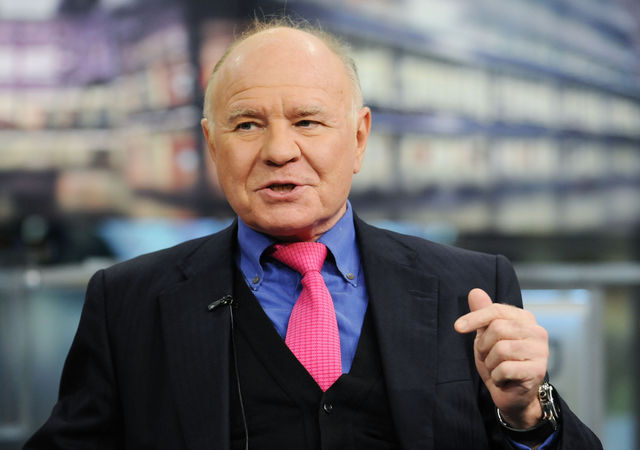
3)  Finally, from CNBC, perma-bear, Marc Faber, provided this: “I’m worried about a crisis bigger than 2008.“
Marc Faber
Marc Faber

You never see the bubble that takes you down

A Bubble
A Bubble

Ergo, all of the above may not be helpful guides to the next big disaster.  Rest assured there will be a next big disaster.  There always is.  I would temper this by saying 2008 and 1929 were financial panics and panics like this are few and far between.  Bear markets will happen and they will be scary, but they won’t be near-death experiences such as we just went through.

On a lighter note

Mark Hulbert in MarketWatch (May 7, 2014) gives us a ray of hope–-“Investors get bearish, suggesting stocks will rise. ” Hulbert contends that contrarian analysis of sentiment would suggest an upturn might be eminent.”

In the final analysis the strong 10-year points me to the idea that a healthy fear and skepticism exists in the market and that is a good thing.

What do you think?

The information presented in kortsessions.com represents my own opinions and does not contain recommendations for any particular investment or securities.  I may,  from time to time, mention certain securities for illustrative purpose, names where I personally hold positions.  These are not meant to be construed as recommendations to BUY or SELL.  All investments and strategies should be undertaken only after careful consideration of suitability based on the risks, tolerance for risk and personal financial situation.   

Categories
Financial, Stock Investment

Session 74–“Buying Stocks at Record Highs: Will You Be Sorry?”

Did you see this front page story in Saturday’s Wall Street Journal (11/23/2013)Bill?  The article posits: “…whether stocks are overvalued or fairly valued isn’t the question investors should be asking.  Instead, what you need to answer is this: how much can I stand to lose before I bail out?”  This is very cautionary stuff, considering the fact we have just just finished two all-time high days for the S&P 500 and Dow Jones Industrial Average (after breaking out of a thirteen year trading range). This is something that should be creating some excitement, but it is being met with total distrust.  It was not just the WSJ.  Here is a sampling from several other outlets:

–This Saturday’s (11/23/13) Headline on MarketWatch read: “If  Bubbles Are Out There These 10 Sages Will Warn Us.”

J.P. Morgan as Bubble-Blowing Bull

(note the above cartoon, dating from 1901, points out the never-ending propensity of bankers to ‘step in it’, create bubbles.  This has been the case long before John Pierpont Morgan walked this earth and will be the case for future generations.) 

IMPORTANTLY, this was the lead and there was no mention of the breakout to new highs, just more ‘bubble’ talk.

–The “Sunday Business” section of the New York Times contained NO mention of these market milestones.

–Sunday’s Barron’s also contained no headline mentioning the new highs, but we were treated to the following in a prominent position on the front page.–

“A Turning Point for Stocks”—“U.S. stocks are starting to look expensive, especially given Corporate America’s meager profit growth, but investors are still drinking from the punch bowl the Federal Reserve has spiked with easy money.” 

Punch Bowl of Easy Money


–CNBC did mention the New All-Time Highs Saturday in the number eight position on its headline menu.  In a more prominent position we found, “Stocks enter the holiday season with a tailwind .”  Reading further in the piece, it becomes clear the author may have meant “headwind” as he then reeled off the negatives.

The media continues to do what it does best, spin fear and reinforce the idea that investing at this time is dangerous. They have be doing this since the lows of 2008/2009!

What is really important is none of this remotely resembles “Irrational exuberance.”

Should we correct? Yup.

Can we correct? Sure.

Is a Bear Market right around the corner? At the moment the prevailing caution, the ‘wall of worry’ would not indicate that to be the case.

What is your take?

In Memoriam

Maria Bartiromo reuters

Farewell, adios, adieu, auf Wiedersehen Maria Bartiromo.  The “Money Honey” as she was known early in her broadcast career is leaving the world of CNBC to join the FOX network.  Maria’s misinformed opinions, editorial comments and the asking & answering of her own questions will not be missed.  It is my fervent hope that CNBC will not be able to find a replacement and that she will add as much credibility to FOX as she did to her last employer.

The information presented in kortsessions.com represents my own opinions and does not contain recommendations for any particular investment or securities.  I may, from time to time, mention certain securities for illustrative purpose, names where I personally hold positions.  These are not meant to be construed as recommendations to BUY or SELL.  All investments and strategies should be undertaken only after careful consideration of suitability based on the risks, tolerance for risk and personal financial situation.


Categories
Financial, Stock Investment

Session 48–A Battle of Wits Between Three Unarmed Opponents

BillThe question asked and debated in the attached clip is;  “Is distrust in Wall Street hurting the market?“  (see link at the end of this post)  A better question might have been, “Is distrust in Wall Street and the market a positive or negative sign, vis-a-vis where we are in the current market cycle?”  To the second question my answer is emphatic.  It is positive!   I will explain later in this post. Before we get to the “main event,”  a little set-up may be in order.  It is my feeling that the three combatants had a chance to make a constructive contribution to investor thinking.  They blew it due to a lack of knowledge and historical perspective on the part of two of the players and a third participant who had the knowledge, but sacrificed it to talk his own book.

The Combatants

–Maria Bartiromo, the most pushy (pushy to the point of being obnoxious) and least perceptive anchor on CNBC, was the moderator. –Jeff Cox (a.k.a. “The Bad News Bearer”).  Jeff reminds me of the little tot on the old cereal commercial “Mikey.”  Remember, “Let Mikey try it.  He doesn’t like anything.”  We should all be thankful we are not Jeff Cox.  It seems he doesn’t like anything and comes across as a spiteful, negative, unhappy person.  Based on recent experience (i.e. his many wrong calls), he may have  reason to be this way.

–Mark Martiak is the third-party in this missed opportunity.  Mr. Martiak is a vice president of Premier Financial Advisors/First Allied Securities (a financial planner / advisor type). Martiak made a good point in the clip about the public shying away from stocks.  Essentially, he said the trauma of 2008 was hard for many to get past (i.e. once burned, twice shy).  Then he makes a self-serving comment about ‘clients needing to trust their advisors (…hand-holding and counsel)’ that got both Maria and Jeff in a snit.

At this point in the discussion Maria confused Martiak’s ‘advisors’ (the personal financial kind) and their advice with money managers and their performance stats. Cox continued ranting on the evils of high frequency trading, the “Flash Crash” and Fed policy (his main culprits for this lack of trust).  The entire discussion went off the tracks. The  blown “teachable moment” was that after the horrendous bear markets of the past it took many years to again peak the public’s interest in common stocks.

For example,  in the bear market that began in 1966, bottomed in 1974 and finally broke out to new highs in 1982, a whole generation was lost to stock investing.  That generation had an alternative in which to invest; very high interest rates, like 15%, long-term treasury securities.  Even so, the stock market over the next 20 years still provided a much better return (ten times your principal plus the dividends on the Dow vs. three times your principal on the bond and your principal back).  Today’s investor does not have the luxury of decent fixed income alternatives.

Interestingly, according to the Gallup Poll quoted in the clip,  that period of 67% of Americans owning some interests in common stocks came 20 years after the Dow’s definitive break-out above 1000.  The year was 2002 and the Dow had risen ten-fold in those two decades.  No wonder everybody wanted to own stocks back then.  Today that number has dropped to about 52%. Most importantly, based on market history, it is a perfectly normal and positive development when individual investors become distrustful and skeptical about stocks and the markets after major market breaks.  And, it is not just individual investors who are guilty of this.  Just check out the musings of the media and many so-called professional investors over the past five years.

This current distrust gives us strong evidence that we are no where near the long-term top of this bull. Martiak was right to assert that we may just be in the “middle innings’ of this run. He was never given the chance (or he blew the chance by getting the “advisor” discussion rolling) to explain the positive correlation between the distrust, “that wall of worries,” and good stock performance. Now there is a corollary to all of this and it is that you should probably be pulling in your “investment horns” the next time you see surveys with 67% of Americans owning some sort of interest in common stocks. Finally, as it pertains to the clip,  you may now see that the Gallup Poll results gave us a teachable moment, not something to worry about, and why I titled this post “A Battle of Wits Between Three Unarmed Opponents.” Take a look at the clip I have been referring to.—” Is distrust in Wall Street hurting the market?”

What do you think?

The information presented in kortsessions.com represents my own opinions and does not contain recommendations for any particular investment or securities.  I may,  from time to time, mention certain securities for illustrative purpose, names where I personally hold positions.  These are not meant to be construed as recommendations to BUY or SELL.  All investments and strategies should be undertaken only after careful consideration of suitability based on the risks, tolerance for risk and personal financial situation.