— Media fright fest … This week they turned up the volume on old news, sawing sawdust again.
— Inflation … Should it really be making us and the market crazy?
— War in Eastern Europe … What’s the impact on iPhone demand?
Media Fright fest
If I were the head of a major media empire last week I would have told myself that, finally, I have reached a state of perfect happiness, nirvana. What could be better … blow-out CPI numbers and concomitant fear of the Fed, the dogs of war about to be released in Eastern Europe and the continuing nagging concern about a pandemic going endemic. Bad news sells!
The news seemed to grab everyone’s attention Friday with the bond market taking the US Treasury 10-year yield up to 2.063% after a so-called hot CPI number (up 7.5% year-over-year). Then there were reports of the the United States, UK and Israel warning their citizenry to leave the Ukraine immediately in fear of an imminent Russian invasion.
Everybody wanted to get into the act, especially on the inflation front. Two well-know economists, Joy Reid and Tucker Carlson gave us the bad news. Reid’s take, “prices will keep going higher and higher until the consumer says ‘enough!’” She also blames corporate greed. Carlson’s point of view is “the reality of inflation is much worse than the Consumer Price Index suggests.” He lays the blame at the feet of a certain political party. Of course, all of the above is opinion and not necessarily based on a strong grasp of (or desire to state) the underlying causes of our current inflation dilemma.
Should inflation really be making us and the market crazy?
No … it should not. I’ve discussed this many times before in kortsessions.com. We are coming out of a secular period of low inflation driven by globalization (moving production to lower cost markets) into a period of increasing inflation driven by newly-minted consumer classes around the world, shifting of supply chains to more secure venues, underinvestment in commodity production and significant money printing. This is also likely to be secular.
However, the current spike in prices comes from a different source supply chain disruptions caused by the pandemic that are still not resolved. One of my favoritereads is the work of Steve Wells (aka–The Fear and Greed Trader). Steve sees the problem differently than many who advocate for tightening on the part of the Fed. He believes and I think correctly,
Another really good source that I have used over the years is Scott Grannis (aka Califia Beach Pundit), chief economist 1979-2007 at Western Asset Management (Wamco). Scott’s take may give you the opportunity to breath a little easier after last week’s broadside of negativity. He believes that a “Fed tightening is not a near-term threat.”
When considering market impact on hefty issues like this I like to ask myself “What’s the worst thing that can happen with the Russo-Ukrainian conflict?” The worst case is that it boils down to a nuclear conflagration. If that’s the case, it will not matter if you pull money off the table now or later. Either way the money will be of little use in the aftermath. In terms of the worst thing that could happen to Vladimir Putin, he could end up like “Le Petit Corporal”(Napoleon) or the “Bohemian corporal” (Adolph Hitler). My sense is that the Ukrainians (backed by Western arms and sanctions) will not make the Russians army or the Russian people feel very comfortable.
My question to investors is how will this impact the sale of iPhones, Ford F150s or Boeing (supplier to many militaries of the tools of the trade)? There are about 7.8 billion potential customers for these goods on planet Earth. The entire population of both Russia and Ukraine would represent only 2% of this total. Can we grow and prosper while they are at each other? Methinks yes.
Friday afternoon the market seemed to disagree with the above assessment on news that the Brits and Israelis were warning their nationals to leave Ukraine. The S&P 500 was down 1.9% and Nasdaq off nearly 2.7%. The bond market went into flight-to-safety mode as the yield on the 10-year UST, seen as high as 2.06% earlier in the day (on inflation fears), closed with the note yielding 1.918%, down 11 basis points on day (with a peak to trough swing of 15 basis points). I am still not sure what any of this has to do with iPhone demand. Apple closed down 2%.
Final thoughts
If I did not make myself clear above, much of the 7.5% year-over-year inflation we have experienced is due to supply chain disruption. Auto prices were the largest component in last year’s inflation rate. New car prices were up 12.2%. Because new vehicles were in short supply due to chip shortages, used vehicles went through the roof, up 40.5% year-over-year. When people were using the word “transient” to describe the spike it was thought these disruptions would have left us by now. They have not. Ford just closed their F150 production line in Kansas City due to chip shortages.
Ford is not alone in its supply issues. Importantly, this has been a big part of the 2021 inflation picture. This does not mean that we are heading back to pre-pandemic inflation numbers. We will still have to deal with wage inflation, which I believe to be a positive and not going away, and commodity inflation. The numbers just won’t be as alarming or eye-popping. The media and pundits continue to do the impossible, sawing sawdust, repackaging the same old stories and marketing them as new information. Don’t let them scare you out of your stocks.
What do you think?
The information presented in kortsessions.com represents my own opinions and does not contain recommendations for any particular investment or securities. I may, from time to time, mention certain securities for illustrative purpose, names where I personally hold positions. These are not meant to be construed as recommendations to BUY or SELL. All investments and strategies should be undertaken only after careful consideration of suitability based on the risks, tolerance for risk and personal financial situation.
Actually, the full quote is, “Strange ‘disconnect’ in the market is raising a red flag for one market watcher.” The watcher is Matt Maley, equity strategist at Miller Tabak + Co, LLC. The quote comes from a report early this morning on CNBC, renowned oracle of Wall Street. Maley’s issue with the the market and the disconnect is that while stock prices have moved to record highs, bonds prices and the dollar have move sideways. With the market very overbought Maley (or maybe CNBC, ALWAYS LOOKING ON THE DARKSIDE) suggests if this ‘disconnect’ continues in the new year it could spell trouble for stocks.
It is not uncommon for CNBC to use negative headlines such as this to grab eyeballs when, in fact, the actual comment is pretty innocuous. Importantly, there should be a divergence develop between the bond market and the stock market if the new tax cuts stimulate greater growth in the economy. Bond prices should move lower with yields moving higher. Higher US rates should attract demand for dollars but there is no guarantee of that since globally many economies are on the rise, creating a concomitant increase in their rates and demand for their currencies.
So, to put things in perspective, higher rates are probably coming as a result of the tax cuts. This would be normal (to be expected) and the higher rates may give way to a significant correction in stocks … after which the secular bull market resumes.
The Next Big Thing (worry about higher rates)
However, the media will not take higher rates as a normal reaction to stronger numbers from the economy. To them it will be the beginning of the end (The Next Big Thing) — excuse me, the end of economic and stock market life as we know it. Higher rates will presage higher inflation which will beget further higher rates — the death spiral into recession and ruin.
Of course nothing could be further from the truth (at least in the short-run). For the past eight years there has been a persistent worry about deflation (deflation on a worldwide basis) in the minds of many observers, that with all the money-printing that went on all around the world we could not stimulate more growth. Make no mistake, inflation is a long-term concern. However, in the grander scheme of things, a little more inflation is a good thing.
One of the reasons for the lethargic recovery we have experienced in earnings is the lack of pricing power that the current low-inflation environment has levied on corporations. In a normal environment corporations can raise prices from time to time to compensate for higher costs. Often those price increases cover more than rising costs. When coupled with unit growth and cost efficiencies you have a much more robust earnings growth climate, which, if moderate inflation returns (2.5 to 3%), could provide earnings surprises. Importantly, moderate inflation is not a bad thing for stocks.
Reformed Chief Economist
With the tax cut on top of an already-improving economy rates have already begun to tick up a bit. This is not surprising and, as we move forward, we should expect and welcome higher rates as a sign of better economic times to come. Check out this piece from one of my favorite sources, Scott Grannis(“The Bond Market Begins To Figure Out Things”). Guaranteed, higher rates as a positive will not be the media’s take. Forewarned is forearmed!
What do you think?
I think, for my part, I’ve said enough this year. Thank you so much for your readership, comments and questions. I look forward to taking up the cause afresh in the New Year. In the meantime, have a wonderful holiday season and a happy, healthy and prosperous new year.
Bill Kort
The information presented in kortsessions.com represents my own opinions and does not contain recommendations for any particular investment strategies or securities. I may, from time to time, mention certain securities for illustrative purpose, names where I personally hold positions. These are not meant to be construed as recommendations to BUY or SELL. All investments and strategies should be undertaken only after careful consideration of suitability based on the risks, tolerance for risk and personal financial situation.
Interesting concept, but why not worry about both? It makes for much better TV.
The last week (2/27/14 to 3/6/14) has been particularly difficult to write about. On the one hand we had been inundated by scary headlines on geopolitical events and weakening economic statistics. On the other hand, given close scrutiny, it has been hard to call any of this life-threatening to the markets. The combination may be creating a credibility issue, as even in the face of these negatives, I find it very difficult to back off the positive stance on equities I’ve held since we posted kortsession number one a year ago.
Signs of Stupid
Yes, a sharp correction is warranted as signs of stupid are emerging. Howard Gold–No Nonsense Investing, covers this in“Have investors learned anything? Opinion: When greed eclipses fear, it’s time to watch out.”Stupid is a day-trader quoted in the article, thinking about quitting his day job to trade full time. You may recall that I have said in the past ‘trading is tough, definitely not for everyone’. Fortunately, these animal spirits seem to be fairly well contained. Were they widespread, I would be worried.
Going into last week, the punditry was worried about China (a lot). Check out Randall Forsyth’s Barron’s articl(if they let you in on the link provided), “Hopeless,but not serious.” Forsyth cuts to ribbons concerns about Russia and the Ukraine, as well as geopolitical risk in general; but, true to form, Forsyth leaves us with a negative conclusion, vis-a-vis China. He concludes “Go party like it’s 1999, and don’t worry (about) what’s in the rest of the world, except China…”
My “1999 Indicator” would be those inane, man-on-the-street interviews we were confronted with on the nightly news, where investors(?) boldly proclaimed that in the face of a runaway bull market ‘they were not afraid.’ They were in it for a the long term. ‘I mean where else can you get 10% (or more) on your money?’
Regarding China
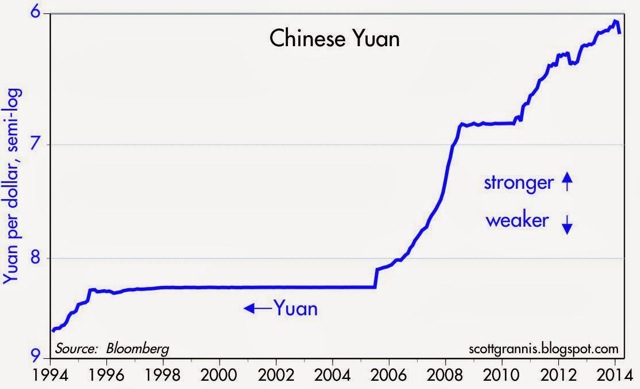
Up until Thursday, February 27, I had no idea that China and the Yuan were in such trouble. I soon found out I was either misinformed or uninformed. I was speaking to a business group and drew a question from a member of the audience on the weakening Chinese currency. He asked, did I “think there was going to be a currency war?” This took me aback, as I did not believe the Yuan had been that weak.
Checking the media later in the day it turns out the Yuan had been dropping fractionally from its recent highs. Fractions to currency traders are a big deal. In the stock market fractions in currency may not be such a big deal. My inquisitor turned this into a “currency war.” Wonder what media outlet he was listening to?
Chart of the Day
Here is a 20 year history of the Dollar/Yuan relationship. Note the Yuan has spent most of that time strengthening against the Dollar. Scott Granniss (my source), former chief economist at Western Asset Management, gives perspective in “China does not have a problem.”
What do you think?
The information presented in kortsessions.com represents my own opinions and does not contain recommendations for any particular investment or securities. I may, from time to time, mention certain securities for illustrative purpose, names where I personally hold positions. These are not meant to be construed as recommendations to BUY or SELL. All investments and strategies should be undertaken only after careful consideration of suitability based on the risks, tolerance for risk and personal financial situation.