Categories
Financial, Stock Investment

“Stocks Hover Near Their Highs. Main Street Doesn’t Care.”

— What’s wrong with this headline? I believe a lot.

— A quintessential example of the media turning a silk purse into a sow’s ear

— Most of America should be celebrating the economy. If they are not it is because the media is telling them things are bad.

What is wrong with my title headline?

Randall Forsyth

Barron’s columnist, Randall Forsyth, has given kortsessions a wealth of material to counter over the years. For this I am deeply grateful. He did it for me again this weekend. The basic theory behind “Stocks Hover Near  Their highs … ” is that the fat cats invested in the market have reaped a huge gain so far this year, up “$9.7 trillion –some 23.7%–in the year through Friday, according to the FT Wilshire 5000 Total Market Index.” It hasn’t trickled down to Main Street. This is evidenced by the University of Michigan confidence index showing that their confidence in the economic outlook is the lowest in a decade.

Why the dichotomy? I believe the blame resides with the media, media with a total lack of understanding in economic matters, media with a political agenda and media that knows bad news sells, both right and left leaning. On the right is the message of “we told you so.”  We told you ‘give the Dems the reins of power and we would be in for trouble’. INFLATION is that trouble and it is all their fault. On the Left it is worry about increased INFLATION and how this issue (a major opposition  talking point) will play with voters at election time.

I will not go into the cause and effect issues that seem to be totally cast aside in this debate. Suffice it to say both parties share in inflation’s making. 

The quintessential example: Silk Purse into Sow’s Ear

The Proverbial Silk Purse

There is a silver lining to this story. You hear about it every day but the media never really connects the dots. The silver lining is that the $7.35/ hr minimum wage now seems gone, a relic of the distant past. Millions of low wage workers have received tremendous hourly wage increases in the past year. We are talking easily 50% to 100%. This may not have lifted them totally out of poverty. Nonetheless I would imagine in their shoes this type of raise would be somewhat life-changing. It would certainly offset the 6.2% consumer price index increase year-over-year in October. The labor market  to their benefit remains tight … our ‘silk purse’. But for some reason all you hear is the ‘sow’s ear’: “That’s because they know, regardless of what the numbers say, that their incomes are declining in real terms. Employment is up, (aggregate) wages are up, but not as much as prices.” The guy who just took a job flipping burgers at $22/hr probably thinks he’s died and gone heaven. In my opinion every dime he or she makes will be heading right back into the economy’s growth. It will not be saved. Importantly, this wage gain was not legislated.

Main Street Should Be Celebrating the Economy and Job Market

According to Forsyth’s article. “the U.S. practically is at full employment, even though the official jobless rate is 4.6%. But some five million people have left the labor force since the pandemic started, with most of them over the age of 55, according to Goldman Sachs economists, resulting from early (1.5 million) or regular (one million) retirements.”

“The strength of the labor market can be seen in the latest Job Openings and Labor Turnover Survey, which showed 10.44 million openings at the end of September and a record 3% quit rate.” If Americans lack confidence in the economy, why is the quit rate at a record high? None of this is positively portrayed in the media.

In my mind when you take into consideration the unprecedented (coming out of the 2008-2009 financial crisis we only received $700 billion in stimulus) combination of the $2 trillion unfunded tax cut we got in 2018, $5 trillion plus in covid stimulus and the upcoming $1.2 trillion infrastructure package just passed by Congress, the United States has a pretty good runway to boom times in the next few years. Yes, inflation will likely be with us at a much higher rate and for a much longer time than transient camp is calling for. It will probably not be as bad as the media seems to be contemplating because bottlenecks will clear and new supplies will come on to meet the higher prices.  Yes, this great bull market will end badly. The long history of financial markets tells us that. I cannot predict the cause or timing, but I’m not ready to hang crepe just yet. I believe we have further to go. 

What do you think?

The information presented in kortsessions.com represents my own opinions and does not contain recommendations for any particular investment or securities.  I may,  from time to time, mention certain securities for illustrative purpose, names where I personally hold positions.  These are not meant to be construed as recommendations to BUY or SELL.  All investments and strategies should be undertaken only after careful consideration of suitability based on the risks, tolerance for risk and personal financial situation.


Categories
Financial, Stock Investment

” … The Good News Is Already Baked Into Stocks.”

–Is it? Don’t buy this argument.

–– A more elevated view and longer-term perspective yields an entirely different picture.

–Stimulus and low interest rates world-wide seem under-appreciated as long-term drivers for the economy.

–Using the analogy of baking a cake, we’ve just made the batter.

The World According to Forsyth

This was the take of the often acerbic, seldom correct, Randall Forsyth in this week’s “Heard on the Street ” column in Barron’s. (you will need a WSJ or Barron’s subscription to read) This must surely be the case now that Congress has finally reached agreement on a new $900 billion round of stimulus … something we’ve been holding our breath for for the last thirty days. The market must certainly be ready to crack now that all the good news is out. Right?

Maybe. There is no question that the market is overbought. Normally you would get a pull back, a pause that refreshes, before you move higher and I do believe we are going higher (maybe much higher). I will get back to this point a little later in my post. Question is, at what level will this correction or, even worse, cyclical bear market begin? My contention is that too many people, investors and pundits spend way too much time and energy pondering this issue, focusing on the short-term, while spending little or no time on the long-term outlook … the bigger picture.

Peering into the 10,000 foot view

Josh Brown, Ceo Ritholtz Wealth Management

Below is a bit of insight from two very smart investors, Josh Brown and Barry Ritholtz of Ritholtz Wealth Management LLC. (Excerpted from 12/20/20 Barron’s interview) If you don’t get why the market has done so well in the face of overwhelming adversity, this might help:

“Has the pandemic altered the way you think about investing? (Barron’s)

Brown: The thing is how outrageous the response in asset prices has been. There’s an argument to be made that the stock market is higher because of the pandemic than if 2020 had been a more routine year. It’s an affirmation of why we’re rules-based investors.

Ritholtz: Not only did you have to predict that a pandemic would occur, but you would have had to take it to the second level, which is that the Federal Reserve’s going to take rates to zero, and that Congress, which cannot agree on renaming a library, would panic and pass a $3 trillion stimulus. That’s how you get to a positive year, despite all the terrible news. We never try to guess what’s going to happen. If we’re not making forecasts, we’re not marrying forecasts.”

Hmmmmm

So, we now have $3 trillion in stimulus in place, plus zero interest rate for the next two years or more, plus 4 preceding years of near-zero rates, plus an unfunded $2 trillion tax cut (more stimulus) in 2018 and, don’t forget the multiplier effect. These dollars just don’t get spent once. Oh yes, and this has been going on all over the world. WHAT COULD GO WRONG?

As I have repeatedly stated in this blog, “this will end badly.” This secular bull is exactly the same as every other secular bull before it. According to the late Sir John Templeton the life cycle is thus:

“Bull markets are born on pessimism, grown on skepticism, mature on optimism and die on euphoria.”

I maintain that, even though we have seen significant speculation in certain quarters of the market, most individual investors and many professionals (so-called media experts included) have spent the past 11 years looking in the rear view mirror at their experience with the 2000 tech bubble explosion and the even worse 2008 financial crisis. Individuals have been eschewing stocks in favor of no yield, or low yield, fixed income. The collapse in March/April has reinforced their SKEPTICISM. We appear to be no where near the OPTIMISM stage. We are definitely no where close to EUPHORIA

EUPHORIA will look something like this: In the late 1990s local New York TV stations would camp out in front of Charles Schwab offices interviewing clients about their views of the market. To a man or woman the answers looked something like this: I’m not worried about the market. I’m in it for the long-term. Where else can you get 8, 9, 10% on your money?’ Before this is all over the vast majority of people will love and trust stocks. That is the kind of EUPHORIA Sir John was eluding to.

The Market is always looking ahead

This constant examination of the potential future impact of current events goes on while most investors continue to fret about today’s problems. It is not paying attention to the horror show in progress in our virus-bound healthcare system, nor is it focused on the immediate impact of the surge of Covid19 cases on the economy. It appears to be focused on the apparent impact of successful vaccines (and potential therapeutics) and a huge economic recovery (Worldwide) that we may begin to see in the next six to twelve months … all of this to be supercharged by huge stimulus and low rates world wide.

My Take: The batter has just been made

If you take a longer-term view the good news, whatever it’s going to be, is nowhere near baked in on this market. We haven’t even preheated the oven. The Barron’s article and associated thought process is harmful to sound investment thinking. Of course if you are a big fan of batter, enjoy. My preference is the fully-baked, beautifully iced version of a cake. Obviously, this is a cake you would not want to leave on the table.

What’s your take?

he information presented in kortsessions.com represents my own opinions and does not contain recommendations for any particular investment or securities.  I may,  from time to time, mention certain securities for illustrative purpose, names where I personally hold positions.  These are not meant to be construed as recommendations to BUY or SELL.  All investments and strategies should be undertaken only after careful consideration of suitability based on the risks, tolerance for risk and personal financial situation.

Categories
Financial, Stock Investment

“If the ‘big Five’ Tech Stocks Falter, They’ll Take the Rest of the Stock Market down with Them”

Barron’s does it again

Better yet I should say Barron’s columnist Randall Forsyth does it again. What a fetching headline. ‘If it bleeds it leads. Mr. Forsyth, have you no shame?

Randall Forsyth may have no shame

The FAAMG stocks (Facebook, Apple, Amazon, Microsoft and Google — for some reason Netflix did not make the cut) had all the right stuff for the Covid-19 market. They were the antidote to anything cyclical that might be shot down by the new and deadly virus and its horrible impact on the economy. They just powered right through it, not missing a beat. They were safe bets and money just poured into the group, so much so, that, according to the column, these names without Netflix account for 22% of the S&P 500’s market value.

Their time may be passing for now and this is ok and to be expected

According to Forsyth,“The strength of the FAAMG stocks is that they’ve been supported by fundamentals and a macro environment that has rewarded their financial and operational advantages in a slow-growth world. An improvement in the economic outlook, however, would likely lead to a rotation from growth to cyclical value stocks. Antitrust threats also pose risks for these market leaders.”

My question is, why is this featured as a negative “… They’ll take the rest of the market with them” in the context of the quote above? (you’ll need a Barron’s or Wall Street Journal subscription to read the full article) BTW, since the electronic edition of Barron’s is easily manipulated the headline above has been changed to “If the Big Five Falter, Rest of Stock Market Could be Deep Sixed.” This adds some conditionality to the dire assertion in the headline I used to title this post.

With all the fiscal stimulus ($2.3 trillion so far and counting) plus a Fed that is committed to keeping interest near zero for the foreseeable future, a very strong cyclical recovery should be in the offing. This would be especially true if the fear of Covid-19, driven home by the spike in new cases and deaths, causes masking and social distancing to become widely accepted as a deterrent. It does not take a rocket scientist to see that adherence to these two practices could dramatically change the trajectory of the pandemic without a vaccine or any additional closing down of the economy.

This looks more to me like a rotation and an opportunity in the 78% of the S&P stock market capitalization that have not fared as well since March or, better yet, in the small cap growth and value names that compose the Russell 2000, down 12% year to date.

Once again, the headline above and my humble retort points out my contention that when investing the media is not your friend.

What ‘s your take?

The information presented in kortsessions.com represents my own opinions and does not contain recommendations for any particular investment or securities.  I may, from time to time, mention certain securities for illustrative purpose, names where I personally hold positions.  These are not meant to be construed as recommendations to BUY or SELL.  All investments and strategies should be undertaken only after careful consideration of suitability based on the risks, tolerance for risk and personal financial situation. 

Categories
Financial, Stock Investment

‘Even a blind hog finds an acorn now and again’

92px-WikiVoc-acorn-1.svg

Not that Barron’s Magazine is a ‘blind hog’, but I get the impression the folks preparing the Up and Down Wall Street column are, at best, very short-sighted…ergo, the title of this post. They finally came up with something worth your attention. This acorn, (don’t be confused by the title–“Presidential Pretenders: Trump, Carson, Cruz and Clinton” — you will need a Barron’s or WSJ acct. to access this link), the second half of the article has some very interesting commentary on the potential reversal of global demographic and economic trends that have been affecting, not only inflation, but growing income inequality for more than three decades.

 Inflation is coming!

an inflation
an inflation

There is absolutely no question in my mind about this proposition. It is just a question of ‘when?’ Besides the obvious widespread printing of money around the world, the Barron’s piece raises the important issue of key demographic trends that may soon be reversing.

Credits to Jonathan Laing (subbing for the usually misguided, Randall Forsyth), who, after a brief foray into the inanity of U.S. Presidential politics, brought to his readers attention an illuminating report issued back in September by Morgan Stanley . The write-up was based on the work of Charles Goodhart of the London School of Economics and, Morgan Stanley associate, Manoj Pradhan (“Three Major Trends that Shaped the Global Economy for Decades are About to Change — Bloomberg Business, September 28, 2015”). Those three would be: declining real interest rates, shrinking real wages, and increasing inequality.

The report delves into the impact of changing demographics on inflation, productivity and income inequality. And, according to Laing, “The macro studies have many smart folks we know on Wall Street buzzing.” This is interesting because, although I came at the question from a slightly different angle and with significantly less resources behind me (kortsession 7,”My Biases,..” 2/16/2013), my conclusion was very positive for the holder of equity investments.

What is Goodhart, et.al.’s conclusion? 

According to Barron’s: “Leveling off or decline in working age populations in areas that count economically (read the U.S., Europe, China and the Asian dragons, such as Korea and Taiwan), is expected to lead to slower growth, higher interest rates and higher inflation. The demographic shifts are also likely to boost real wages, worker productivity and diminish income and wealth inequality both within and among countries.” 

This is not a good thing for stocks?

Morgan Stanley points out that this will not be good for stocks, because the overall graying of the population might lead to slightly-slower economic growth with higher interest rates and inflation. Of course, Barron’s gleefully points this out. Try as I may, I can’t spin this negatively, unless the inflation we get is runaway and brings with it much higher interest rates.

To me, as this slowly plays out, we are looking at nothing but a positive economic and market environment.

Inflation is good for equities!

One of the reasons earnings growth has been so tough to come by is that inflation has been non-existent. Corporations have not had price as a tool to create additional profits. In the face of dogged global competition they have had to resort to financial engineering and cost cutting, much on the back of labor, to remain competitive and grow the bottom line. If the Goodhart’s work is correct, inflation and pricing is coming, along with a healthier consumer (higher real incomes) and growing consumer classes around the world (demand). This would all seem to equate to improved growth, rather than slower growth.

So, I made the point the point that inflation is good for stocks and all equity asset back in Session 7, “My Biases … “, and I’m sticking to it.

As for Barron’s Up and Down Wall Street column, they never disappoint even when they sniff out an acorn. They always come at the world from the dark side.

What’s your take?

The information presented in kortsessions.com represents my own opinions and does not contain recommendations for any particular investment or securities.  I may, from time to time, mention certain securities for illustrative purpose, names where I personally hold positions.  These are not meant to be construed as recommendations to BUY or SELL.  All investments and strategies should be undertaken only after careful consideration of suitability based on the risks, tolerance for risk and personal financial situation.


Categories
Financial, Stock Investment

“Why the Fed Should Stand Pat”

 Randall Forsyth
Randall Forsyth

Do I buy this title from Randall Forsyth and Barron’s this weekend? NO. It is just one more example of the media stirring the pot on a trivial issue that it has managed to build into a tower of worry and grief. The tag-line on this header is even worse, “Fed tries to avoid torpedoing global economy and market.” What a great evocative verb torpedo is — fire on the water, oil-soaked survivors clinging to life boats with the stern of the USS Economy sinking into the deep blue. When the Fed meets this Wednesday, Forsyth gives this (a quarter point bump in the fed funds rate) a 50-50 chance of happening.  If they pull the trigger, we get to stop worrying about ‘when it will happen’, and focus will be, ‘how bad will it be?’ And, of course, the media will not provide any context or history upon which to make an educated judgement. I will later in this post.

Harry S.Truman
Harry S. Truman

“The only thing new is the history you don’t know.” – Harry S. Truman

I think the 33rd President of these United States had it right, especially as it pertains to the markets. There will be booms and busts, bear and bull markets, rallies and corrections, scams and scammers, and catastrophic events like 1929. The only reason 2008 was not a repeat of 1929 was that Ben Bernanke had immersed himself, as an academic, studying the causes of the Great Depression. He knew how badly conditions had deteriorated and the type of strong fiscal and monetary measures needed to stop us from repeating the mistakes of the 1930s. Importantly, it took us seven decades to dig the type of hole that we created in the 1920s (it takes time, maybe a generation or two to forget past lessons). They idea of a repeat in the near-term, a fear many have, seems a bit far-fetched. These events are like earthquakes. It takes a long time for the pressure to build on the tectonic plates of the market and economy. Regardless, if history is a guide, there will be other 1929/ 2008 events. It is baked in the cake.

Jeremy Siegel

Jeremy Siegel

On the plus-side, history (according to Jeremy Siegel) would say stocks were a good place to have your money (especially after debacles a la 1929 and 2008). In Siegel’s book, “Stocks for the Long Run,” a 20o year study of equity returns showed stocks giving a compound total real rate of return equaling 6.8%, while bonds delivered 3.5%.  There were lots of booms, busts, scams, corrections, bears and bulls during the two century period covered.

Again, if history is a guide, equities should be an asset class to be friendly to. Don’t let the noise and short-term thinking get the best of you. If you are looking for history and perspective, kortsessions.com is here to help.

More Perspective and History

For peace of mind, if you wish to dig a bit deeper, here are commentary and links to several short articles that might be of help.

Bill Greiner
Bill Greiner

As to the question, ‘What might be the downside/duration of the current correction?’, former client and friend, Bill Greiner, (Chief Investment Strategist, Mariner Wealth Advisors)  provides appropriately enough, “Let History Be Your Guide.” This piece examines what one might expect of this correction, based on a look back at previous corrections from similar market environments. Though no one can know for certain if this decline will not be a worse or more-shallow correction than the norm, you do get some parameters as to potential downside.

The second comes from another friend and former client, Marc Vincent, Managing Director, Redstone Advisors. As Redstone is primarily a fixed income money manager, I thought Marc a very credible source on that market’s history. Redstone’s “Economic and Market Review” from the first quarter of 2015 contains a great rundown on three major Fed rate moves in the last 25 years (pages 7 & 8). The piece  refers to these as ‘tightening cycles’. Importantly, they did not reel in money supply to tighten. They just raised the price. That will be the case this time as the Fed moves the price of short-term money up a measly 25 basis points. An abundance of liquidity will remain in the system.

The 2004 -2006 should be of interest, because, during that move the Fed Funds rate was increased by 425 basis points (from 1% to 5.25%) while the yield on the Treasury 10-year note hardly budged. The curve flattened. We see this same phenomenon happening today, every time there appeared a threat of the removal of QE or a fed fund lift-off, yields spike on the threat, then back off on fear the rate increase will bring economic weakness … a flight to safety. Again, my bet is that when lift-of does occur we will see a similar action. Fear continues to TRUMP greed and that is good psychological base for the market.

Point, Counterpoint

We began this post with a comment on Randall Forsyth’s “up and Down Wall Street” column, “Why The Fed Should Stand Pat.” For a more sanguine view of any upcoming Fed moves, I Include Ben Appelbaum’s piece in this morning’s New York Times (9/13/15), “The Fed’s Policy Mechanics Retool for a Rise in Interest Rates”  (Wall Street Journal / Barron’s subscribers only). This article gives you a sense that they are prepared for many potential outcomes on their actions, and that we are not looking at a runaway train.

What is your take?

The information presented in kortsessions.com represents my own opinions and does not contain recommendations for any particular investment or securities.  I may, from time to time, mention certain securities for illustrative purpose, names where I personally hold positions.  These are not meant to be construed as recommendations to BUY or SELL.  All investments and strategies should be undertaken only after careful consideration of suitability based on the risks, tolerance for risk and personal financial situation. 


Categories
Financial, Stock Investment

Session 92–Forget the Ukraine. Focus on China.

BillInteresting concept, but why not worry about both?  It makes for much better TV.

The last week (2/27/14 to 3/6/14) has been particularly difficult to write about.  On the one hand we had been inundated by scary headlines on geopolitical events and weakening economic statistics.  On the other hand, given close scrutiny, it has been hard to call any of this life-threatening to the markets. The combination may be creating a credibility issue, as even in the face of these negatives, I find it very difficult to back off the positive stance on equities I’ve held since we posted kortsession number one a year ago.

Signs of Stupid

450px-Museum_of_Lincolnshire_Life,_Lincoln,_England_-_DSCF1724

Yes, a sharp correction is warranted as signs of stupid are emerging.  Howard Gold–No Nonsense Investing, covers this in“Have investors learned anything?  Opinion: When greed eclipses fear, it’s time to watch out.” Stupid is a day-trader quoted in the article, thinking about quitting his day job to trade full time.  You may recall that I have said in the past ‘trading is tough, definitely not for everyone’.  Fortunately, these animal spirits seem to be fairly well contained.  Were they widespread, I would be worried.

Going into last week, the punditry was worried about China (a lot).  Check out Randall Forsyth’s Barron’s articl(if they let you in on the link provided), “Hopeless,but not serious.”  Forsyth cuts to ribbons concerns about Russia and the Ukraine, as well as geopolitical risk in general; but, true to form, Forsyth leaves us with a negative conclusion, vis-a-vis China.  He concludes “Go party like it’s 1999, and don’t worry (about) what’s in the rest of the world, except China…”

My “1999 Indicator” would be those inane, man-on-the-street interviews we were confronted with on the nightly news, where investors(?) boldly proclaimed that in the face of a runaway bull market ‘they were not afraid.’ They were in it for a the long term.  ‘I mean where else can you get 10% (or more) on your money?’

Regarding China

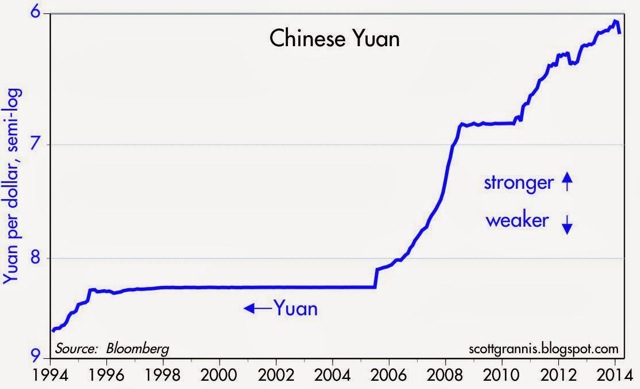
Up until Thursday, February 27, I had no idea that China and the Yuan were in such trouble.  I soon found out I was either misinformed or uninformed.  I was speaking to a business group and drew a question from a member of the audience  on the weakening Chinese currency. He asked, did I “think there was going to be a currency war?”  This took me aback, as I did not believe the Yuan had been that weak.

Checking the media later in the day it turns out the Yuan had been dropping fractionally from its recent highs. Fractions to currency traders are a big deal. In the stock market fractions in currency may not be such a big deal.  My inquisitor turned this into a “currency war.” Wonder what media outlet he was listening to?

Chart of the Day

saupload_Yuan_vs_reserves

Here is a 20 year history of the Dollar/Yuan relationship.  Note the Yuan has spent most of that time strengthening against the Dollar. Scott Granniss (my source), former chief economist at Western Asset Management, gives perspective in “China does not have a problem.”

What do you think?

The information presented in kortsessions.com represents my own opinions and does not contain recommendations for any particular investment or securities.  I may,  from time to time, mention certain securities for illustrative purpose, names where I personally hold positions.  These are not meant to be construed as recommendations to BUY or SELL.  All investments and strategies should be undertaken only after careful consideration of suitability based on the risks, tolerance for risk and personal financial situation.  

Categories
Financial, Stock Investment

Session 55–“You Call This a Crisis?”

BillNASDAQ’s short ‘downtime’ last week (thanks to a technical glitch) sparked a storm of lamentations and consternation in the cable financial media.  They called it a crisis. You would have thought it was the end of the world or, at least, another nail in the coffin of investor confidence.  I bet poor Warren Buffett was really sweating it out when he couldn’t buy or sell any of his O-T-C holdings (NOT!).

It was topic ‘A’ Thursday afternoon and Friday morning.  It even drowned out talk of the “Dreaded Taper.”  So, I could not resist including Randall Forsyth’s recent “Up and Down Wall Street” column (Barron’s 8/24/13–you need a Wall Street Journal subscription to view) in this post.

In his column, Forsyth poked great fun at the financial media.  But then he brings us back down to Earth, pointing out the potential negative ramifications of Fed tapering (again).  Not only could it do grievous harm to the U.S. economy and housing market, but it could gum up the entire world economy (starting with the emerging markets).

The theme of greater negative consequences is now surfacing.  Again, I don’t buy it (see session 53).  As it pertains to the financial press and pundits, they might be wise to consider the words of Mark Twain, “I am an old man and I have known many great troubles, but most of them have never happened.”  If tapering is met with a sharp market decline, then they should ponder this Twain quote, “I was seldom able to see an opportunity until it had ceased to be one.”

What do you think?

Up and Down Wall Street

| SATURDAY, AUGUST 24, 2013

You Call This a Crisis?

By RANDALL W. FORSYTH | MORE ARTICLES BY AUTHOR

The impact of not being able to trade stocks on Nasdaq pales against lots of other things.

Oh, the moaning and gnashing of teeth!

One would assume it was over an event on the scale of the deaths of more than 100,000 in Syria, some from attacks with chemical weapons, or the bloody clashes in Egypt. “What is happening now in the Middle East is the most important event so far of the 21st century, even compared to the financial crisis we have been through and its impact on world affairs,” William Hague, the U.K. foreign secretary, said last week (although one might rank 9/11 even higher).

No, the great human tragedy being played out on the financial cable channels was the outage at the Nasdaq Thursday afternoon.

Imagine not being able to trade shares of the likes of Apple (ticker: AAPL), Amazon.com (AMZN) or Google (GOOG) for more than three whole hours! It created an existential crisis. Do these companies actually exist if investors cannot trade claims on their future values? And if you own one of those claims, are they worth anything if you cannot obtain an instantaneous quote? This was a huge failing for the country, threatening our very national security.

I confess to having been blissfully unaware of the Nasdaq outage at the time, as I was stuck in a doctor’s office that afternoon, dangerously cut off from the markets and the rest of the world while my smartphone was wrested from my hands as I underwent some tests. My impression was that the rest of the office also was ignorant of what was happening in electronic equity markets as the staff and doctors went about their business of treating patients. Only later would I learn of the tragedy that had befallen us.

Can this great nation long endure a lack of stock trading? Perhaps on a somnolent late-summer day, and then for a few hours. But for weeks or months? Well, it has happened, and during a period of great crisis. And the nation not only survived, but arguably benefited.

With the outbreak of World War I at the end of July 1914, Treasury Secretary William G. McAdoo ordered the New York Stock Exchange closed in order to prevent massive liquidation of U.S. stocks by British investors seeking to raise cash. (At the time, the Treasury Secretary was the de facto central banker; although legislation to create the Federal Reserve had been passed the previous year, it was not yet up and running.)

The U.S. then was operating under the gold standard, so the proceeds of sales of American assets could be readily converted to gold, which could flee the country. (This account comes from When Washington Shut Down Wall Street, a 2006 book by William L. Silber, an economics professor at New York University and—full disclosure—a professor of mine in grad school.)

A crisis was averted and, later that year, the NYSE was allowed to reopen. By avoiding a suspension of the gold standard, Silber writes, the U.S. became the international financial center, eventually supplanting Great Britain in that role.

Investors in Microsoft (MSFT) who might have otherwise sold Thursday should thank the Nasdaq for thwarting that possibility. In the great tradition of Charlie Bluhdorn, Microsoft shares jumped nearly 8% Friday after Chief Executive Steve Ballmer announced his intention to retire within 12 months.

Bluhdorn was the consummate conglomateur of the 1970s, combining prosaic companies with the glamorous likes of Paramount Pictures into Gulf+Western Industries, memorably satirized in Mel Brooks’s Silent Movie as “Engulf and Devour.” In one of the great tales of business history, when news of Bluhdorn’s succumbing to a heart attack aboard his private jet in 1983 got out, Gulf+Western shares soared.

So, there are worse things than not being able to trade stocks. Still, it is widely agreed that incidents such as the shuttering of the Nasdaq require a vigorous government response. No doubt SEC Chairwoman Mary Jo White will summon the heads of the exchanges to knock those same heads together to prevent future such glitches.

Here is a case where government might do a better job than the private sector. Who is better at monitoring information networks—which is what exchanges essentially are—than the government? My modest proposal is to put the Nasdaq, the NYSE, et al., under the watchful eye of the NSA. After all, everything else already is.

What’s your take?

The information presented in kortsessions.com represents my own opinions and does not contain recommendations for any particular investment or securities.  I may,  from time to time, mention certain securities for illustrative purpose, names where I personally hold positions.  These are not meant to be construed as recommendations to BUY or SELL.  All investments and strategies should be undertaken only after careful consideration of suitability based on the risks, tolerance for risk and personal financial situation.