Categories
Financial, Stock Investment

UST 10-year rockets — a misguided attempt at beating the Fed to the punch

— A flight to safety … the yield on the 10-year treasury drops 15% in two weeks in a raging bull market.

— For some investors (computerized or not) fears of higher interest rates and inflation trump a rip-roaring economy with a tankful of fiscal stimulus and easy monetary policy as far as the eye can see.

— This attempt of some to beat the Fed to a distant punch is a welcome sign that the ‘wall of worry’ is very much intact.

— Corrections and bear markets lie ahead. They always do and they are hard to predict. I’m just not sure the time is right to load up on 10-year T-notes yielding 1.455%.


The Flight to Safety (may not be so safe)

two orange-and-white Breitling airborne
Photo by Samuel Penn

The flight to safety  (that may not be that safe)represented in the rush to buy the US Treasury 10-year was a very contrary indicator versus the daily new highs being set in the stock market. The folks at CNBC have taken note because it presages something bad happening and that appears to be their life’s blood. You know. Bad news sells.

“10-year Treasury yield falls as investors digest Fed decision” (11/4/21)

“10-year Treasury yield falls even after strong jobs report” (11/5/21)

Wait a minute! This is not supposed to happen. The Fed meeting just finalized the end of Quantitative Easing, the Fed’s bond and collateralized mortgage backed securities buying spree. Rates are supposed to go up … right?

As we have discussed ad infinitum in kortsessions.com, QE was an emergency measure taken on after the financial crisis in 2009 and it was reintroduced during the pandemic (The Big Lie about the end of QE). I will repeat QE … was an emergency measure.  THERE IS NO EMERGENCY. The tapering of QE will not represent a tightening of Fed credit policy. 

The current Federal Funds rate is 0 to .25%. It has been that way since the beginning of the pandemic. It was set at that level because of emergency. There is no emergency! Yet according to recent pronouncements from the Fed, there is no proposal to begin raising the Fed Funds rate for at least the next 12 months. Admittedly this may change and certainly could change in light of higher trending inflation, growing inflation that could be more secular than the Fed’s short-term pronouncements might lead you to believe. This would not be surprising nor the end of the world as these low rates would not be consistent with with a strong, vibrant (non-emergency) US economy.

With this bull market registering new all-time highs for every major index last week it is very hard for me to square last Friday’s plunge in the 10-year yield, 7 basis points (-15% since 10-21-21) with the facts stated above. My overarching opinion is that the ‘wall of worry’ is still very much intact and that augurs well for the market.

Rate fears trump a rip-roaring economy

Photo by Vadim Bogulov

This is in part due to a continuous stream of misinformation and negative bias provided by the media. A stellar example of this came on September 21, when Mike Wilson, Morgan Stanley’s chief US equity strategist, made the pronouncement that a 20 percent correction had become a real possibility. His prophecy went viral. It was all over the media. Of course the market proved him wrong (as it has often done), moving to a series of new all-time highs in the following month. At the time Wilson said fair value on the S&P 500 was about 4000. It closed last Friday at 4697. Wilson was not alone in this call. There was a choir of strategists all calling for significant pullbacks in mid September.

Here’s the solo from the tenor:“Cramer advises investors to sell stocks, says it’s too soon to consider buying the September slide.”

Sept 20, 2021

I will never understand this propensity on the part of many Wall Street types and pundits to try to predict the unpredictable, essentially falling on their own swords to make one great call. Predicting is hard with timing and magnitude, impossible. 

Meanwhile, the economy is rips and roars. 3Q earnings continue to come in great, the employment picture brightens, stimulus continues to flow and recirculate and the Fed is really not doing anything to get in the way.

The attempt to beat the Fed to the punch

woman in white sports bra and black boxing gloves
Photo by Thao Le Hoang

I see last week’s Treasury interest rate rally as attempt, based on headline risk and negative pundit pronouncements, to beat the Fed to the punch, a punch that may not come for several years. In my way of thinking the tapering of QE is an absolute non-event … not a punch. And if the Fed is the reason for this move, not some black swan event that is about to drive us into the abyss, it represents thought process done with a complete lack of understanding of the impact of Fed policy.  This goes for investors placing these trades as well as those who program computer algorithms to enter these trades. As an aside, many of these so-called investors are probably being led to this faulty thought process by uninformed media.

Corrections and bear markets lie ahead!

They always do. This bull market will be no exception. These pitfalls are hard to predict. I just don’t believe, based on the weight of the evidence, that we should be reciting the prayers for the dead on this one. I also believe that if inflation, Fed tightening and higher interest rates are on the way that the best place to hide may not be in the 10-year US treasury note. To me it is a flight to safety that is not so safe. It might just be that common stocks (once known to be inflation hedges) are the safest place to hide.

What do you think?

The information presented in kortsessions.com represents my own opinions and does not contain recommendations for any particular investment or securities.  I may,  from time to time, mention certain securities for illustrative purpose, names where I personally hold positions.  These are not meant to be construed as recommendations to BUY or SELL.  All investments and strategies should be undertaken only after careful consideration of suitability based on the risks, tolerance for risk and personal financial situation.


Categories
Financial, Stock Investment

September … the worst month for stocks … imminent corrections and other things that scare us

–Is September as bad for stocks as the media would have you believe?

–Is a significant correction imminent, and does the “September effect” make it more likely?

–The bifurcated market … the shoe may be moving to the other foot.

September, bad for stocks? The truth will set you free.

The freedom I’m referring to here is the freedom from worry. Here is the truth about September in the stock market for the past nine decades:

“September is usually one of the worst months of the year for the stock market, but shares do better at times when they have already done well. Over the years dating back to 1928, the average September return for the S&P 500 has been a loss of 0.99%. That makes the month far worse than May, which ranks second in providing gloom for investors with an average loss of 0.11%.” (Barron’s (9/1/2021)

Hmm. If the worst performing month was down less than one percent on average and the second worst, May, was only down 11/10s of one percent what am I worried about? If you are worried it is because your media sources did not bother to give you this information, choosing to scare you into giving them your undivided attention rather that educate you. Bad news sells.

Kudos to Barron’s for following up with this little piece of information:

“History indicates that September 2021 could be a good month for stocks. In the years since 1928 when the S&P 500 rose by more than 13% for the first six months, the index’s median September gain was 1.4%, according to Fundstrat. Through June this year, the broad market benchmark rallied 14%.”

Many continue to warn a significant correction is ahead

Since market corrections and worse always lie ahead, I cannot challenge this assertion. I just cannot predict the next one. Also, since the beginning of the republic, the markets have been in a gradual uptrend, punctuated by bad setbacks from time to time so it is hard for me to trade real or imagined potential setbacks.

I might point out that a significant correction may have already taken place in the market (under the surface) even in the face of a succession of new all-time highs for the S&P 500.

“(Mike) Wilson explained that while the broader S&P 500 has failed to correct more than 4% since March, 56% of the companies within the index have seen a drawdown greater than 10% since May 1. Sectors including energy, materials, discretionary, and financials have seen the greatest percentage of stocks with corrections over 10%, he noted.” (Mike Wilson-Morgan Stanley chief equity strategist quoted in Business Insider)

I might point out that while a large group of stocks in the S&P 500 have had greater than 10% corrections the index itself is only off its all-time high by less than 2.5%. I call this discrepancy a return to the “Covid Playbook” [when in doubt, and there are plenty of things to be in doubt about (as is always the case), sell cyclical, sell old economy and buy growth, tech and innovation]. My personal belief is this playbook is getting a bit long-in-the-tooth and we are beginning to see it crack. This was the case this past Friday when the Dow (-.48%), S&P (-.91%) and Nasdaq (-91%) all closing lower with the Russell 2000 (+.18%) ending the day in the black. In other words I see big tech losing its luster in a market full of liquidity looking for shinier objects to play in value, mid-cap and small cap.

Meanwhile, it is not just Mike Wilson out there waving red flags. The choir has many voices.

‘Take those profits’: Strategist says extreme market moves are on the horizon  (CNBC 9/17/21)

  • Paul Gambles, co-founder of investment advisory firm MBMG Group, says investors should consider significantly building up their cash positions.

  • Jim Cramer (9//21) “We’re in a treacherous moment here.”

No Wonder the AAII numbers for the week ending September 15, showed bullish sentiment plummeting to the lowest level since July 29, 2020. This week’s number for bullish sentiment came in down 16.4% from the previous week at 22.4%, well below the historical LOW average of 28%. This level of fear is pretty constructive it my book.

The bifurcated market may be at an end

A bifurcated market, divided into two branches, haves and have nots, large cap growth and technology, may be ending. “Big Tech” versus a vast majority of stocks not in that arena or capitalization level may no longer be the way to outperformance. If this is happening it will negatively effect those indices heavily weighed in “big tech” or tech in general. Those stocks may not perform as well but under the surface of that underperformance a lot of good things will be happening in value, mid cap/small cap value and growth. The arts of stock picking and active management may reemerge.

To wrap up, the numbers presented above regarding stocks that have already gone through corrections would indicate that additional corrective action, that many have been calling for, may not be needed for the vast majority of stocks. Yes,” big tech” may be vulnerable but that is not the end of the world. It would certainly be normal and expected if this were to happen. The huge number of talking heads screaming for correction is also healthy as they, as usual, will be wrong (or they may get lucky vis a vis the stopped clock effect … they are right at least twice a day). Finally, negative  sentiment would appear to line up well  as a key ingredient for a significant rally in most stocks.

“It isn’t China”

I post these statements in full knowledge of the situation at Chinese developer Evergrande and the overnight buzz of the potential contagious nature of this company’s problems. CNBC has already begun the chant–Evergrande, the first domino to fall. My sense is the Chinese come up with a  solution this problem that will not bankrupt the world.

What’s your take?

.

First we have to steel ourselves for October, the cruelest month …and the media feeding frenzy it will spawn.  


The information presented in kortsessions.com represents my own opinions and does not contain recommendations for any particular investment or securities.  I may,  from time to time, mention certain securities for illustrative purpose, names where I personally hold positions.  These are not meant to be construed as recommendations to BUY or SELL.  All investments and strategies should be undertaken only after careful consideration of suitability based on the risks, tolerance for risk and personal financial situation.


Categories
Financial, Stock Investment

“THE WRONG KIND OF STOCKS ARE LEADING THE STOCK MARKET TO RECORDS”

Balwearie demonstrates leadership

You cannot make this stuff up! Thus spake Mike Wilson, Morgan Stanley’s U.S. chief equity strategists. The “wrong kind of stocks” in Wilson’s mind are defensive … names like Pfizer, Merck and HCA. This is all happening while the faster growth leadership names like Amazon and Alphabet (GOOG) have been lagging. To Wilson this means that even though the market has broken out to new all-time highs in the S&P, that does not equate to an all-clear signal for stocks. Maybe you should be cautious!

Yikes!

My Reaction …

Thank you, Mr. Wilson, for laying another brick in that “wall of worry” that just will not seem to come down. For over a decade the Wall Street / CNBC media crowd has been providing cautionary advice to investors, big and small. For over a decade money has been coming out of equities and going into the bond market as investors continue to anticipate imminent market collapse.

Meanwhile, the earnings on the S&P 500 almost tripled between 2009 and 2018 ($56.86 to $143.34) and the dividend grew by 144% ($21.97 to $53.61).The actual index price has quadrupled and these guys have been warning you all the way up to be cautious, to be careful …  that bad times were just around the corner. As you can see it continues.

Since the panic low of 666 in March of 2009 the S&P 500 index (excluding dividends) has compounded at over a 16% annual rate. This has been quite a run. Of course this return was generated off of a panic low. The market had hit an all-time high of 1550 in March of 2000. It may have briefly eclipsed that number in 2007. On a longer-term basis, looking back to 2000, the return has been much more paltry … only about 4% compounded (including dividends).  

The S&P 500’s Long-Term Return Is Mediocre, Really

The above header is a link to a Forbes article from November of last year that talks about historical S&P 20 year rolling returns dating back to the 1970s. 4.5% (1998-2018) is not so hot as the range of these returns averaged, longer-term, between 4% and 8%. As such a possible reversion to the mean down the road would lead me to believe that we could be in for upside returns that might be very surprising to those advising CAUTION. This view is reinforced by the shunning of stocks and favoritism that bonds have been shown over the past ten years.

“According to data from the Investment Company Institute (ICI), domestic equity funds experienced outflows of $105.5 billion in 2018, $30 billion of which flowed out in the fourth quarter.”This continued in the first quarter of 2019.

” … Investors pulled $5.6 billion from stock funds in the first quarter (2019) while pouring $94.2 billion into fixed-income funds, according to Bank of America.”

Investors are so fearful that today they are willing to accept a 1.82% return on a 10-year U.S. treasury note rather than a near 2% return on the S&P 500. I remind you that the S&P dividend was up 144% in the last 10 years. That T-note you bought 10 years ago yielded 3.43% (vs 1.97% on The S&P) but the t-note yield did not grow, nor did its principal value.

Why should we love defensive leadership in the market?

We should love it because it signals fear and caution as the market moves into new all-time high territory. Fear and caution are never present at secular bull market tops.

What’s your take?

P.S. I am attaching a copy of an article from earlier this month that talks about the fact that for the first six months of 2019 investors poured money into money market funds at as strong a pace as they did during the financial crisis in 2008 (link). You know what the market did during the next decade!

The information presented in kortsessions.com represents my own opinions and does not contain recommendations for any particular investment or securities.  I may, from time to time, mention certain securities for illustrative purpose, names where I personally hold positions.  These are not meant to be construed as recommendations to BUY or SELL.  All investments and strategies should be undertaken only after careful consideration of suitability based on the risks, tolerance for risk and personal financial situation. 


Categories
Financial, Stock Investment

“OMG!!!”

images-37


It is obvious from Friday’s market action that the end is nigh, or we are on the “eve of destruction”: or better yet, stock market Armageddon has arrived. What tripped this all off? A well-respected value manager, Marty Whitman and his firm Third Avenue Management got themselves a little bit too far out over their skis with the high-yield (junk) bond assets they run, including Focus Credit Fund (FCF). The firm, which at one time boasted assets under management (AUM) of $3.5 billion, had not performed well and was suffering redemptions … so-much-so, AUM had declined to $800 million. Because of liquidity issues in the high yield market, Third Avenue took the unprecedented action of halting redemptions in FCF… a real shocker.

Martin Fridson, chief executive officer of Fridson Investment Advisors, speaks at the Reuters Restructuring Summit in New York September 23, 2008. REUTERS/Erin Siegal

According to Martin Fridson, CIO Lehman, Livian, Frisson Advisors, LLC., the portfolio was at the very top of the risk spectrum; ergo, very illiquid. Third Avenue has decided that it is in the best interest of all its investors to put a moratorium on redemptions for the time being to allow for the extra time it will take to dispose of these one-of-a-kind, high-risk  assets. Remember, this is not like buying a stock, where every share of General Motors is exactly the same as the next. Each one of these bonds has a set of unique covenants and characteristics that may have appeal to only specific buyers. There may not be a buyer there when an institution wishes to sell. This is obviously very problematic for mutual funds, even more-so for the sponsors of exchange traded funds (ETFs) that specialize in high yield securities…because the sponsors would be responsible for warehousing the bonds in the absence of active bidders in the street.

Fear of Contagion–Systemic Risk

Fear of Contagion
Fear of Contagion

To the point, Blackrock, for example, has over $4.5 trillion in assets under management. As part of this, they sponsor mutual funds and ETFs that invest in high-yield securities. What would be the impact of Blackrock and others having to eat (or even value for sale) a portfolio of illiquid, highly-levered securities? What would be the potential collateral damage? It is hard to speculate on this, but the media is working hard to spin this into the mortgage-backed securities crisis of 2008. This appears to be a real stretch.

According to HighYieldBond.com, the high-yield/junk bond segment of the $8.1 trillion corporate bond market is about 15% or $1.2 trillion in size. According to Morgan Stanley, approximately 13.5% ($162 billion) of the $1.2 trillion is energy related. Admittedly energy is a disaster. At $35.36/barrel on West Texas intermediate (WTI) there is tremendous stress on that part of the market. The most stressed part of energy would be the debt of independent producers and oil field service providers (about 2/3 of energy or $110 billion). If all this goes under (which is unlikely) it represents less than 1.5% of total corporate debt. If Blackrock owned all of these assets, it would hurt: but, again, if it were a total write off it would amount to less than 2.4% of their AUM … taxing, but hardly systemic in my view.

What about the rest of High-Yield?

Interestingly, after all the fear and angst generated about the high-yield market in the last 24 hours, one needs to ask what is really happening in terms of defaults — is this a major credit event in the making? Interestingly, defaults are running well below normal at 2.9% (normal = 4.6%). According to high-yield maven, Fridson, the high-yield market appears to be discounting a 6% default rate, while Moody’s is forecasting only 2.7% defaults in the next 12 months. Fridson explains this disconnect as an increase in risk premium required because of the lack of liquidity in the market. He believes you need a recession, which he does not see, to get defaults up to 6%. One inane conclusion of the media is that next week’s potential 25 basis point increase in the Fed Funds rate might drive high-yield and the economy off the cliff…ridiculous. For a really good explanation of what is going on in the the high-yield sector of the debt market, I’m providing links to two excellent clips from a CNBC interview with Martin Fridson. They are worth your time. (Fridson I) (Fridson II)

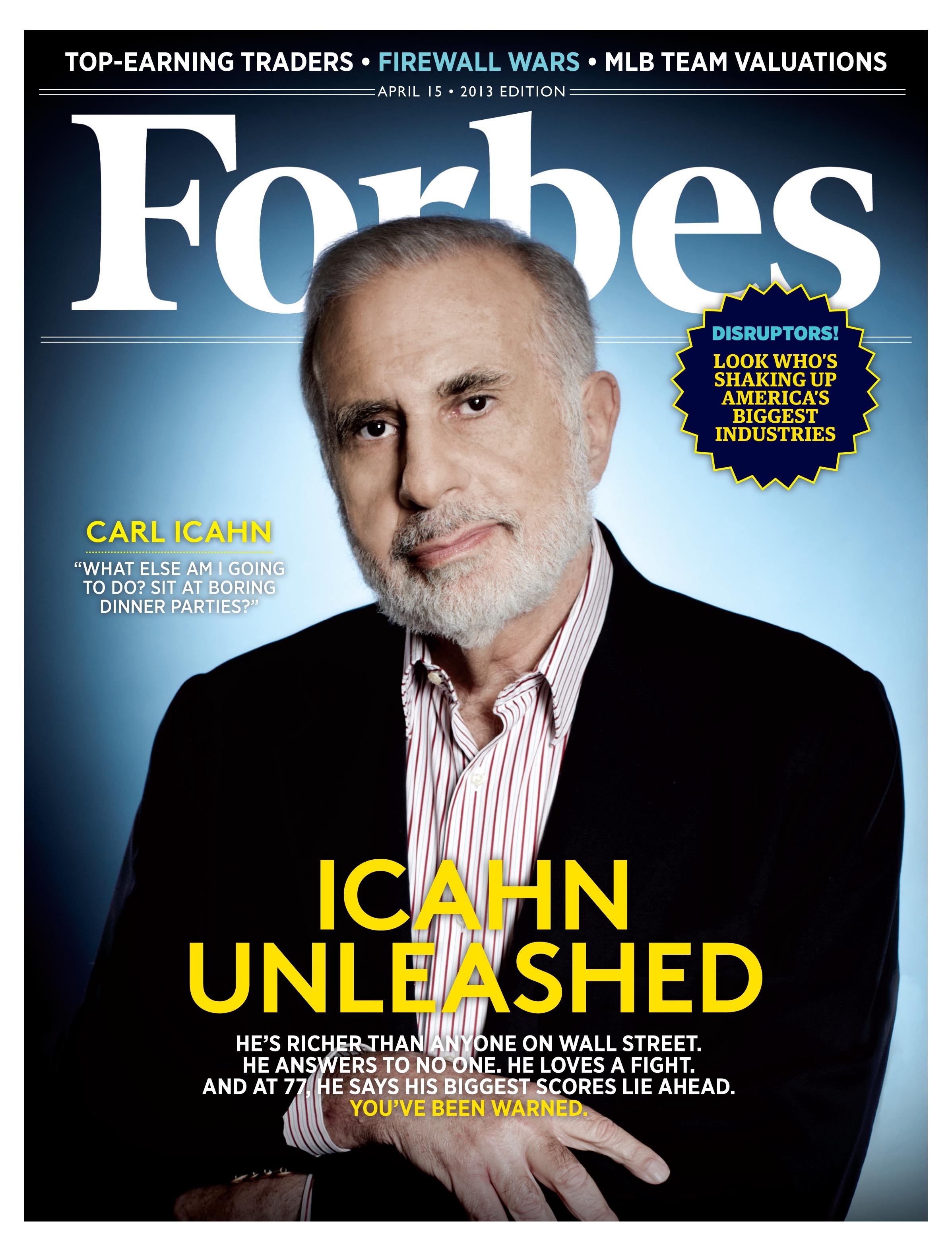
Carl Icahn must be big-time net short

Icahn.Cover_2

He always appears to show up on days when the market is in extreme stress and the viability of high yield is in question with something like this little gem: “The high-yield market is just a keg of dynamite that sooner or later will blow up.”  He did the same thing back on October 1, when he issued his “Danger Ahead” video (I commented in “Help! Plus more piling on”)

A few thoughts as we approach Fed-Day

  • The 10-year UST yield peaked in December of 2013 at 3% (the announced beginning of the “tapering” of Quantitative Easing). Recently with the threat of a potential rate increase it has been no higher than 2.5%. It closed at 2.13%, Friday December 11, as the “fear” trade was clearly in place. A quarter point bump in the FF rate at this point will only reinforce the fear trade. It is, therefore, very unlikely that this increase will have any major negative effect on long-term interest rates. WHEN THE MARKET FIGURES THIS OUT, AND IF THE STATEMENT IS “ONE AND DONE” / “SLOW AND LOW”, I BELIEVE THE ENVIRONMENT FOR STOCKS BECOMES VERY POSITIVE.
  • The dollar was supposed to strengthen when the Fed raised rates… making U.S. goods more expensive in international markets. Now, with this increase being viewed by many as a fait accompli, the dollar has declined over 4.5% from its recent high, even in the wake of Janet Yellin’s hawkish commentary two weeks ago.
  • The absolute positive that $35/$40 a barrel oil brings to everyone, but the producers, has been totally missed in the rhetoric. It is there and working for all individuals and the energy consuming economies they live in. Remember, the prices of oil and many other commodities are down because of oversupply, not because the global economy has ceased to grow.
  • Tax selling, some of which has been panic selling, has created significant opportunities in levered sectors of the market–MLPs, BDCs, REITs, Utilities and even Distressed Debt (don’t confuse illiquidity with viability).
  •  Since I began this post, another fund, a hedge fund Stone Lion ($1.3 billion in AUM, $400 million distressed debt), has suspended redemptions. This is not likely to play well Monday morning. It is important to remember the message in Fridson I and II. Default rates on high yield bonds are extremely low at present (2.9%). It would take a recession (which does not appear to be in the cards right now) to get to 6%, which means at a historical worst-case, 94% of the credits do not default. Ergo, this collapse may be setting the table with some real opportunities.

What Could Go Wrong?

Please Janet Don't disappoint us Janet
Please Janet
Don’t disappoint us Janet

If the Fed delays the rate increase because of the craziness going on in the high yield and commodity markets, we have a real problem. It will signal that the Fed thinks our economy and the world is too weak to withstand even a minor financial dust-up. Even worse, it will mean that the financial media and pundits with their fear mongering will have gained control of U.S. monetary policy. Please, Janet, say it ain’t so.

What are your thoughts?

The information presented in kortsessions.com represents my own opinions and does not contain recommendations for any particular investment or securities.  I may, from time to time, mention certain securities for illustrative purpose, names where I personally hold positions.  These are not meant to be construed as recommendations to BUY or SELL.  All investments and strategies should be undertaken only after careful consideration of suitability based on the risks, tolerance for risk and personal financial situation.