Categories
Financial, Stock Investment

Perspective: The Key to The Market Vault!

— Perspective is the number one biggest shortcoming in the coverage of financial and market news.

— I examine perspectives on inflation, rates and recessions.

— Lack of perspective stems from two causes: The lack of (or willingness to dig for) historical comparisons or the omission of known facts that might soften the fearful impact of a headline.

— Investors with perspective have the key to the vault.

Perspective: The Biggest Shortcoming

Inflation

As stated in my biography I’ve been around the market in a meaningful way since 1970. One of my pet peeves then, as it is now, was the lack of depth demonstrated by the media in reporting on financial matters. Back then television consisted of 3 networks … ABC, NBC and CBS. The news at the time was actually reported by competent journalists with no political or idealogical axe to grind, i.e, no editorializing. There was no internet. Essentially the news (the facts as they were best able to be determined) was the same coming from each outlet. The only difference was the presenter … David Brinkley vs. Walter Cronkite … and the importance accorded to each story. Even then the economy and market were given short shrift (i.e. more bad news on inflation today … CPI inflation up .5% last month and that was above expectation by 1/10 of 1 percent bringing the latest 12 month total to 9.5%). There was no effort made, as is the same case today, to contextualize that .5%. For example that .5% reading if annualized would equal a 6% inflation rate, well down from 9.5%. So we missed by 1/10 % on the estimate, the number was certainly trending in the right direct.

This last week’s wholesale price (PPI) inflation number was treated in exactly the same manner. PPI inflation came in at +.3% (Expectation was plus .2%). The annualized rate versus a year ago was still very high at 7.4%. There is no mention of the the fact that the average increase in producer prices from June through November was a bit under 3%  (June 1.1%, July -.5%, August -.1%, September .3%, October .3% and November .3%). Annualizing a 3% number would get you back to a 12-month rate of 3.6%. With all the gloom and doom around (confirmed by the AAII most recent sentiment survey) it is likely that most people’s favorite news sources were not keeping them up on this very positive trend.

The point being here that you never hear the succinct phrase: The Fed’s policy is beginning to work and the inflation data is trending, as it should be, in the right direction. As to media fare, seldom is heard an encouraging word and the sky is all cloudy all day. 

 Interest rates

This is an easy one. See if you can remember why the rate on the ten-year Treasury note spent so much time under 3%/ under 2%. If you answered the financial crisis and market implosion of 2007/2009, move to the head of the class. A good follow-on answer would be a weak economy and fear of falling back into recession (or worse) … fear of a 1937 style return to recession. At the whisper of any potential geopolitical or economic problem the fear trade would kick in as investors would pile into the 10-year, putting upward pressure on their prices and downward pressure on their yields.

Political pressure on Jerome Powell was intense to keep rates low in the first part of his chairmanship. Enter Covid 19. With all the Federal stimulus dollars Covid brought to the economy, which was not that weak going into the pandemic, the reopening was explosive. The inflation was inevitable and for the first time in over a decade it was clear the economy was strong enough to support a higher, more normalized interest rate structure.

With this as a backdrop no one ever mentions the fact that for most of the last 50 years the 10-year yield has averaged much above 6%. I started my career in October 1970. According to the interactive version of this chart (available on the St. Louis Fed’s website) the 10-year was yielding 7.33%. You might say that’s all fine but from 1981 rates begin trending in the right direction. My counter would be that businesses still had to deal with higher inflation and rates at the time and they and the economy in general did just fine. 

The point I make here is that regardless of the constant media moaning and groaning on the topic of rates they are still historically low and that much higher rates have not kept the economy from solid growth in the past.

(page1image49163440

 Recession

One does not have to work to hard in the consumption of any media … financial, mainstream or political … to hear or see the “R” word. There is a constant drone about the subject and constant speculation about when, where and how this calamity might befall us.

What is a recession:

“a period of temporary economic decline during which trade and industrial activity are reduced, generally identified by a fall in GDP in two successive quarters.”

“The National Bureau of Economic Research (NBER) Business Cycle Dating Committee—the official recession scorekeeper—defines a recession as “a significant decline in economic activity that is spread across the economy and that lasts more than a few months.” 

According to the above definitions a recession is an economic slowdown and not Armageddon. But listening to the rhetoric and emotion that abounds in media comments on the topic you might think otherwise.

Recessions are normal economic events, oft predicted, seldom seen. My guess is we may see the next one as part of the Fed’s effort to combat inflation, but it is just a guess. The economy is very strong and inflation is trending lower. Who knows? Predicting is a very difficult sport.

One last item (scary last item) that might be playing here under the surface is the out-of-left-field nature of our two most recent financial crisis, the 2008 collapse and Covid debacle (most of us saw neither coming). These were obviously traumatic, and there maybe fear that another may be just around the corner on the back of something like Bankman-Fried’s escapades or banks playing fast and loose with credit standards. There is a narrative out there that this ‘something’ may be a systemic issue and that the banks could take a hit. The bank stocks should be rising as a beneficiary of higher interest rates but they are not. They have been moving in the opposite direction.

You might recall that the banking industry was required to become hugely over-capitalized after the financial crisis. If there is exposure to cyber or general bankruptcy due to a recession, it is likely to be well contained. If not, there is always the lender of last resort (i.e. the Fed) and of course the usual bail out. This is really far-fetched but not out of the realm of possibility based on past recent investor experience. It is not my forecast but it makes great fodder for the internet and general media as well. 

My aim here is to point out that this negative media obsession with what is a normal economic event is way overblown. A recession or worse, even one of those nasty black swan events, will not be the end of the world. I repeat, recessions have been much predicted but very rarely have they actually happened.

Media Lack of Perspective: The Causes

I am driven to two conclusions; Either there is a lack of rigorous effort in pursuit of the facts or, the more cynical view, that there is a purposeful omission of positive perspective because bad news without it sells better. The political bent of your favorite news source may also play a role. None of this leads to good critical thinking. That is up to you. In light of what I’ve laid out in this post view, listen or read carefully the output of media you use. Ask if they are giving you the background information that you need to form a rational opinion about the market and the economy based only on today’s headlines? My guess is that most  economic news is reported with little or no mention of the backstory or historic detail that might temper investor concern or alarm. In the case of my PPI comments above it takes very little to check recent PPI readings. Just ask the “Google.” That’s what I did.

“Knowledge is Power”

In the market knowledge (perspective) is power. Without perspective you are just taking information from sources whose primary goals are engagement (bad news sells) rather than imparting useful information. To wit we have had months of negative investor and consumer sentiment statistics in one of the strongest employment (3.5% to 3.7% unemployment) and wage growth (at the lower end of the wage spectrum where most people live) economies that this country has ever seen. Many have seen huge wage gains, well outstripping inflation. This has been juxtaposed against a background of a media voice telling us that inflation and rates should make us unhappy and that the boom is about to fall. Based on the low level of enthusiasm for the market I would say this has become consensus.

Bottom line: Operating with perspective and betting against the consensus have generally always been keys to the market vault!

What’s your take.

The information presented in kortsessions.com represents my own opinions and does not contain recommendations for any particular investment or securities.  I may, from time to time, mention certain securities for illustrative purpose, names where I personally hold positions.  These are not meant to be construed as recommendations to BUY or SELL.  All investments and strategies should be undertaken only after careful consideration of suitability based on the risks, tolerance for risk and personal financial situation. 


Categories
Financial, Stock Investment

The “Christmas Eve Massacre” and where we stand now

First and Foremost …

By early October, 2018, the S&P 500 had more than quadrupled off its 666, 2009 secular bear market low (up over 300%). This was capped off by a spectacular 24 month run that saw the S&P 500 increase more than 50% to a new all-time-high of 2951.81 (10/3/18). I would say a correction of some magnitude (-10% or better) or even a cyclical bear market (-20% or better) would have been in order and to have been expected. This is entirely normal. 

The Dow Jones Industrial Average and S&P 500 both came very close to the arbitrary official bear market level but did not breech it during the December rout. The tech-laden Nasdaq composite made it, down 24% from its August 30, peak … the Russell 2000, ditto, down 24%.  Could it continue? Sure. Some are suggesting a retest of the December 24, lows is needed. However, during the collapse we worked off a tremendous amount of market enthusiasm for stocks and turned it into palpable fear and historically, 20% of the time those retests don’t happen.

From here, a look backward I feel would be useful … getting our bearings, shall we say.

The Origin Of The Collapse Was The September 26  Fed Fund Rate Increase

Federal Reserve bank
of the United States

That move, IMHO, was the trigger event. According to the punditry, including the likes of Jim Cramer, this was too aggressive a move and would likely cause the beginning of an economic contraction that could lead to a recession (defined, two consecutive quarterly declines in GDP). Stop and think about this definition for a moment–a recession, two consecutive quarters of GDP declines! It is stunning that the prospect of a RECESSION, a normal and very survivable economic event, could cause investors (not sure why we use this descriptor) to literally throw away their stocks. But they did just that in the few days leading up to Christmas Eve. I lay this squarely at the feet of a media that consistently makes the “R” word look like the worst thing that could happen without giving any perspective on what the effects of a normal recession might be.

Adding fuel to the fire the Fed, in its statement raising rates, said that it would likely go again in December giving us a four month total increase of 1/2 of 1 percent by year-end to 2.5%. This sent the market into a precipitous decline with the so-called experts screaming this would lead to much higher interest rates which would strangle the economy. Now, there were other issue (trade, a China slowdown, Brexit, etc.) but the Fed and rates was the trigger, exacerbated by the 1/4 point hike in December.


So, Rates Must have really spiked … WRONG!

Before I get into the rate spike that did not happen, a little perspective might be in order. To clear the record on ‘rate spikes,’ the last one we had started in 2013 when the rate on the 10-year US Treasury note moved from 1.75% (4/22/13) to 3.01% (12/23/13). In the 8 months from May thru December, 2013, the 10-year rate almost doubled on the back of a change in Fed policy, the end of quantitative easing — the Fed stopped buying bonds. This was the “Taper Tantrum,” not an actual increase in the Fed funds rate. The S&P 500 had opened 2014 at 1874.

Another interesting fact with regard to the first increase (off the low of 0-.25%) in the Fed funds rate in December of 2015  investors were so fearful that the economy would tank they bought treasuries (Flight to Safety), driving the rate down to a low 1.87% by January, 2016. The highest the rate the 10-year had attained in 2015 was 2.50%. By July of 2016 the rate had fallen to a low of 1.37%, even though the Fed had only moved to raise the funds rate to a range of .50%-.75% … a total of only 50 basis points off the low. Again the pundits told us this, too, would be the end. It was not. The S&P 500 had opened 2016 at 2028. 

After all this sturm und drang the S&P 500 went on to record an all time record closing high of 2930 (up over 50% since the 2013 taper tantrum), September 21, 2018.

What’s been the result since September?

The September increase in the Fed funds rate caused the yield on the 10-year to rally (spike) to a level of 3.24% in early October. It then collapsed to 2.56% (the January 3, 2019 close). This was despite the fact that the Fed, enduring massive media and pundit protests that this would be the end of us, raised the fed funds range again in December to 2.25%-2.5%.

But wait! There’s more!

Wait! There’s more!

There is shrinking the Fed balance Sheet … another econ. killer.  

That balance sheet, as a result of the bond-buying program known as quantitative easing (QE), had swelled by 2015 to $4.5 trillion. The right-sizing of that balance sheet began in the 4th quarter of 2017. To date $500 billion worth of that balance sheet has been sold off, taking liquidity out of the economy. The Fed will continue liquidations (at a rate of $50 billion per month) until they feel right-sizing has been accomplished. The Fed has not said exactly what that size is estimated to be. This sucking of liquidity out of the economy is also deemed by the so-called experts to be the end of us. 

I have to ask, “Where’s the beef?”

With this barrage of negative expert opinion and a 50 basis point increase in the Fed funds rate, the rate on the 10-year Treasury is up only 33 basis points from where the started 2018 (down 45 bps from the 3.24% peak –1/18/19 close 2.79%). Apparently, there is no “beef,” no spike and no disaster, AGAIN.

But wait, wait! There’s even more! (this time positive… I think)

Remember, what triggered the slide in the beginning was a move by the Fed to raise rates and some hawkish language to reinforce that posture. On January 4, as part of the American Economic Association conference in Atlanta, there was a panel discussion featuring the three horsemen (actually two horsemen and a horsewomen) of this apocalypse, Jerome Powell, Janet Yellen and Ben Bernanke. They went out of their way to reinforce the message that everything the Fed did or would do would be ‘data dependent’ and that they were going to be very careful not to exacerbate a weakening economy. This would include careful monitoring of the withdrawal of QE, shrinking the balance sheet. Sakes alive! They wouldn’t want to do anything to derail the gravy train. The so-called ‘Bernanke put‘ is back.

The second concern the the pundits were obsessing about, pre the December 24 panic, was trade. The Chinese have presented a new proposal. Whether or not this is the real deal I cannot say. But, with a White House continually under siege on other fronts, the president would, I’m sure, like to declare victory about something. Diffusing trade issues would be good for stocks … another thing that he benchmarks his success with.

How did we get to the fear level manifested in the ‘Christmas Eve Massacre’?

Ebeneezer Cramer

It is very simple: The media, fishing for eyeballs, knows that in times of crisis the audience is more likely to be engaged and that the worse the picture looks, the better for their ratings. Entertainer Jim Cramer provided a perfect example of this in the run-up to the panic; “Cramer feels ‘powerless after Fed hike, tells investors to buy gold.” Now he didn’t say SELL but his headline tells you all you need to know. His timing could not have been better in terms of maximum impact on an already-spooked investor population on the Thursday night before a 4-day weekend for many (December 20). Friday would not be a well-attended trading session and Monday, the 24th, there was to be an early close (2PM EST). Ergo, liquidity would be limited. This was a perfect set up for a panic and we got it … some really stupid selling, people throwing stocks away. Cramer was not the only one singing this tune. There was a whole choir. And, nowhere did you get the perspective that I presented above — essentially that five years of Fed policy was supposed to be disastrous when, in fact, the rate on the 10-yr. US Treasury Note was virtually unchanged and the S&P was up over 50%. 

In conclusion: I can’t predict when the next recession will occur. Importantly, you need to remember recessions are normal and, according to the definition commonly attributed to them (two consecutive down quarters of GDP reports), not the end of the world. Stocks are not expensive because earnings have been good (organic growth + the impact of the tax cut). At current writing the S&P 500 is trading a little over 15 x estimated earnings with at 2% yield. This is not excessive in an environment where the current yield on the 10yr Treasury is only 2.8% with the Fed on a more cautionary dovish stance. It is certainly not euphoric. The S&P 500 traded at a euphoric 30 multiple and 1% yield in March of 2000 … the 10-year was yielding over 6% (S&P 500 — 1550). That represented the peak of the last secular bull market … something to think about.

What’s your take?

The information presented in kortsessions.com represents my own opinions and does not contain recommendations for any particular investment or securities.  I may, from time to time, mention certain securities for illustrative purpose, names where I personally hold positions.  These are not meant to be construed as recommendations to BUY or SELL.  All investments and strategies should be undertaken only after careful consideration of suitability based on the risks, tolerance for risk and personal financial situation. 


Categories
Financial, Stock Investment

Jeffrey Gundlach — S&P 500 headed to new lows

CNBC felt Gundlach’s commentary to be so valuable, so prescient that they ran this banner headline, “Jeffrey Gundlach says the S&P 500 is headed to new lows: ‘I’m pretty sure this is a bear market'”,  two days in a row. BTW we are already very close to the S&P’s low of the year. A break to new lows is not a very big reach or outlier prediction to make.

Why should we care what Gundlach thinks?

Well, CNBC thinks we should care because Jeffrey, in their mind, has made a couple of good calls recently. For example:

“Gundlach predicted in March that the closely watched 10-year Treasury yield would hit 3 percent and send stocks tumbling. His call came true a few months ago, as October was one of the worst months for U.S. stocks since the financial crisis.” It came to pass September 18, nine days before the Fed bumped the target rate on Fed funds 25 basis points to a range of 2.00% to 2.25% (9/27/18). It did roil the market. Just about every pundit CNBC trotted out was predicting that if the Fed moved rates higher the market would go down. For most of the month of March, when Gundlach made this staggering (?) prediction, the 10-year was trading between 2.80% to 2.85% …not very far from his predicted target. The Fed was talking raising rates. You’d have to be pretty dim not to think the 10-year could trade above a 3% yield when that happened … pretty lame for CNBC to credit Gundlach any predictive chops on this call. Interestingly that 10-year closed back at a 2.81% yield today (12/18/18). Interestingly, based on the above reasoning the market should be rallying. Nobody seems to be making that case.

Jeffrey Gundlach
The Bond King

“Gundlach revealed in February that he was betting against Facebook shares. He said his short was due to falling public perceptions of the company. Facebook’s stock is down more than 13 percent since Gundlach’s call.” This was a good call, but not unique to Gundlach based on information available at the time.

“He also in 2017 envisioned bitcoin cratering, saying that “if you short bitcoin today, you’ll make money.” At the time, bitcoin traded at about $16,000. The cryptocurrency now trades at about $3,400, losing about 75 percent of its value this year.” Again, this is a call that was not rocket science as most credible investors (including Warren Buffett) thought the cybercurrency was a house of cards.

So, again, I ask, why the banner headlines on his prediction about new lows coming in the market ?

My answer is, this attention to Gundlach predictions is unwarranted  

From my perspective in recent years Gundlach’s predictive talents have been pretty unimpressive and unprofitable. I give you a few examples from the Kort Sessions’ archives, circa 2015 and 2016, the last time the market experience a real sinking spell:

Excerpt from “Two major questions facing mankind” (March 15, 2015/S&P 500 2085)

“But, given the growing signs of weakness at home and abroad, hiking rates in the near term would make the folks at the Fed a “bunch of blockheads,” contends Jeffrey Gundlach, the head of the DoubleLine Asset Management complex. (If you are a Wall Street Journal subscriber, you may find link to Barron’s article here —“Global Markets vs. Reality: The Great Divide” )”

Excerpt from “Help! Plus more piling on”(October 5, 2015/S&P 500–2019)

Excerpt from ‘Pity the Fool” (September 5, 2016/S&P 500 2168)

  • Jeff Gundlach (July 29 interview with Reuters): “Sell everything. Nothing here looks good.” (except gold, which has declined since then)  Twenty-six months later (September 29, 2018)the S&P 500 peaked a 2940 … plus almost 50%. Even in the current correction we are still up over 400 points from the level most of these excerpts were taken from.

The information presented in kortsessions.com represents my own opinions and does not contain recommendations for any particular investment or securities.  I may, from time to time, mention certain securities for illustrative purpose, names where I personally hold positions.  These are not meant to be construed as recommendations to BUY or SELL.  All investments and strategies should be undertaken only after careful consideration of suitability based on the risks, tolerance for risk and personal financial situation. 

Categories
Financial, Stock Investment

“American optimism about the economy hits an all-time high … “

d

And that’s a bad thing, at least if you are Patrick Artus, chief economist at French investment bank Natixis. According to Artus, this spike in optimism is but one sign in many that the US economy is about to take a header (“Get ready for a substantial slowdown in the US economy, investment bank predicts). Other factors include “a (supposed) limit to the rise in the  participation (labor?) rate and the decrease in the unemployment rate: real wages … slowing down … Investors should prepare for the consequences.” Who knows? This guy may be the ONE in the legion of pundits who over the past 8 years since the bottom of the financial crisis, have tried (and failed) to predict the next big downturn to actually get it right.

What about the participation rate and unemployment rate is so worrisome?

The September unemployment rate was 4.2% and the labor force participation rate was 63.1% (vs. a recent high of 66% in January 2007), very little improvement off historically low numbers (61% and change). Addressing the labor force participation rate (LFPR): that number has continued to be impacted by the number of baby boomers reaching retirement age (some 10,000 per day), all of whom are considered available for work, even though many have retired. Even if we move back down on the LFPR it should not be a source of concern based on people taking retirement.

As it pertains to the unemployment rate, it was once thought to be the economic Holy Grail that 5% unemployment was FULL employment and to take the rate lower than that would put upward pressure on wages, ergo inflation (higher interest rates). Maybe the wage pressure supplied by globalization turns that thought process upside down? Real wage growth has slowed and gone negative over the past 12 months. Again, this presents an interesting challenge to those worried about the inflationary impact of a lower or stagnant LFPR coupled with lower unemployment stats. Wages and inflation are not spiking despite a tightening labor market. To me lower unemployment without a spike in wage cost is a good thing.

What about all this optimism on the economy!

Normally a big jump in bullish opinion about anything (including record high optimism about the economy) is a real danger sign. Why isn’t it this time? To answer that question you have to ask what are the specifics of the survey quoted? Regarding the survey quoted in the above pronouncements from Netixis, it was originated by none other than CNBC at the economic peak before the collapse of the financial crisis (“American optimism about the economy hits an all-time high … “). It is very understandable to me why this survey might be showing people gaining confidence in the economy and that the so-called record may not be a real spike, considering where the survey was begun. The “high” is an all-time high for the last 8 years … not a convincing sample period to get a good fix on how high economic confidence could actually go.

Oh yes, and you know when the economy improves rates are headed North!

Rates Maybe?

Game, set, match … it’s all over. Higher rates will sink the economy and the market. This has been a common theme (and forecast to be just around the corner) since I began posting, almost five years ago. Here’s an exemplary posting from CNBC on last week’s strong numbers (“Interest rates whipped higher in a perfect storm of stronger US data an Fed speculation). The “Fed speculation” part has to do with the kind of Fed chair the president will name to replace the comfortable choice, Janet Yellen. As of Friday (10/26/17) the smart money was betting on monetary policy dove, Jerome Powell (vs. previous trial balloon candidate, hawk John Taylor). The Treasury 10-year closed up on Friday at a 2.42% yield, .038% less than the previous close and down in yield 3 basis points from the 2.45% close January 3, 2017.

Nonetheless the bond market did manage to scare a few people last week (and for the past month and a half), with the yield on the 10-year moving up from 2.37% (up from a low of 2.05% 9/7/17) early in the week to 2.47% before settling back to 2.42% Friday. The Dow Jones Equity REIT index fell 4.3% during the period while the Alerian MLP index hit a new low for the year, down 15%. My take is the they are down for two reasons: 1) in a market that is in love with growth (higher growth) slower growth REITs and MLPs do not attract much love and 2) the obsession with higher interest rates continues to scare investors out of their shares. A third reason on the MLP front could be feared tinkering with the tax code might alter their favorable tax treatment. Even if the distributions of many MLPs were fully taxed the yields (potentially growing yields) would be very competitive with a fully taxed 2.42% 10-year US Treasury note.

Barron’s this week has a very favorable article on Enterprise Product Partners (EPD –NYSE) — “An MLP That Promises Both Growth and Income.” (you need a subscription)

Compared with other MLPs, Enterprise has better corporate governance and a stronger balance sheet. “Enterprise has been an excellent allocator of capital,” says Matthew Sallee, a portfolio manager at Tortoise Capital Advisors*, an Enterprise holder. “It has built a network that can’t be duplicated.” He says MLPs look appealing, with lower taxes and friendlier regulation than electric utilities.

My point here is that the lust for growth and fear of interest rates moving higher with the back-drop of an improving sentiment on the economy may be setting up some attractive opportunities for income investors.

With regard to my title, all-time high optimism on the economy is in the eye of the beholder (and the time frame).

What’s your take?

* I own shares of Tortoise MLP Fund (NTG–NYSE) as a long term investment in the sector. NTG owns shares of Enterprise Products Partners (EPD). I neither plan to buy or sell NTG or EPD in the next 72 hours following publication of this article. Please see the paragraph below for further information. 

The information presented in kortsessions.com represents my own opinions and does not contain recommendations for any particular investment strategies or securities.  I may, from time to time, mention certain securities for illustrative purpose, names where I personally hold positions.  These are not meant to be construed as recommendations to BUY or SELL.  All investments and strategies should be undertaken only after careful consideration of suitability based on the risks, tolerance for risk and personal financial situation. 


Categories
Financial, Stock Investment

“Yellen’s surprise comments jolt bond market”

You could have knocked me over with a feather! (read “surprise comments” article here)

Who knew?

The Committee intends to gradually reduce the Federal Reserve’s securities holdings by decreasing its reinvestment of the principal payments it receives from the securities held in the System Open Market Account. Specifically, such payments will be reinvested only to the extent that they exceed gradually rising caps. Initially, these caps will be set at relatively low levels to limit the volume of securities that private investors will have to absorb. — Janet Yellen

TRANSLATION & comment: The unwinding of Quantitative Easing (QE) is to be very gradual, so as to not roil the markets (bond or stock). This is a continuation of the cautious, data-dependent Fed policy that has been in place for years.

Once we start to reduce our reinvestments, our securities holdings will gradually decline, as will the supply of reserve balances in the banking system. The longer-run normal level of reserve balances will depend on a number of as-yet-unknown factors, including the banking system’s future demand for reserves and the Committee’s future decisions about how to implement monetary policy most efficiently and effectively. The Committee currently anticipates reducing the quantity of reserve balances to a level that is appreciably below recent levels but larger than before the financial crisis. — Janet Yellen 

TRANSLATION & comment: Again, the operative word is “gradually” and there is a new, but not surprising element, “reducing … the quantity of reserve balances to a level that is appreciably below recent levels but larger than before the financial crisis.”  The economy has grown appreciably over the past 8 years, simply making it necessary for the Fed to keep a larger balance sheet.

Janet Yellen

Complete Text of Janet Yellen’s Remarks

How bad was it in bond land yesterday?

The United States Treasury 10-year note closed the day before (7/11/17) at 2.3945%. Today the 10-year closed at 2.3124%, down .009% in yield as traders rushed to buy (or cover shorts) in light of the not-so-new revelations by Janet Yellen. Those notes traded as low in yield as 2.14%, June 26, 2017. Who got hurt today? The bears, those who were short the 10-year… people anticipating that chairman Yellen would strike a more hawkish tone (i.e. saying policy was to remove excess reserves at a more rapid rate and that the Fed was to be more aggressive on raising the fed Funds rate). 

More negative spin from CNBC …

Fed Chair Yellen: Central bank likely to unwind stimulus despite low inflation

Bottom Line: None of the above represented a “surprise” or new policy thrust except for the bond bears and financial journalists at CNBC who wrote this headline and the title for my post. My opinion is that fear of future Fed action in the removal of QE and tweaking the Fed funds rate higher will continue to be no-news news that the media will present as news and use to scare you to keep your attention. Betting on the media’s/pundit’s infinite wisdom on this topic has not been a high return strategy.

What’s your take?

The information presented in kortsessions.com represents my own opinions and does not contain recommendations for any particular investment or securities.  I may, from time to time, mention certain securities for illustrative purpose, names where I personally hold positions.  These are not meant to be construed as recommendations to BUY or SELL.  All investments and strategies should be undertaken only after careful consideration of suitability based on the risks, tolerance for risk and personal financial situation.
 

Categories
Financial, Stock Investment

” … Famous Last Words: No More Crises”

Janet Yellen

“Would I say there will never, ever be another financial crisis?” Federal Reserve Chair Janet Yellen said at a London conference last week. “You know probably that would be going too far, but I do think we’re much safer, and I hope it will not be in our lifetimes, and I don’t believe it will be.”  — Barron’s 7/1/2017 

I am not certain about the context of this quote (it was probably an answer to a question from her audience), but I will speculate that Chairman Yellen was speaking of a financial crisis a la 2008/2009.  Why?  Because existential meltdowns like that (i.e., 1929) are generational in nature as opposed to garden variety collapses that anyone who has been around the market for awhile has become accustomed to.  Some version of ’08-’09 will happen again, guaranteed, but they generally take a long time – decades maybe – to bubble up. Over the years people will  always forget the hard lessons learned from the last debacle, greed will trump common sense and the finance crowd will create a new way to blow up the economy … usually based on the over-extension of credit. It is the way of the world.

Randall Forsyth in this week’s Barron’s gives us a brief run-down of some of the more run-of-the-mill crises we’ve experienced in the past five decades:

“To review some these greatest hits, there was the Penn Central failure in 1970; the failure of Franklin National Bank and Germany’s Bankhaus Herstatt in 1974; the collapse of the Hunt Brothers’ silver bubble in 1980; the Mexico financial crisis in 1982; the collapse of Continental Illinois in 1984; the Black Monday crash of Oct. 19, 1987; the savings-and-loan crisis that crested in 1990; and in 1994, the mortgage-backed-securities plunge, the bankruptcy of Orange County, Calif., and the Mexican peso Tequila Crisis.” Randal Forsyth, Barron’s 7/1/2017 (“Yellen’s Famous Last Words:No More Crises” –to view you need to subscribe) Just think, if a person had been so unlucky as to own the Dow Jones Industrials at its peak in the late 1960s (around 1000) and suffered all the above calamities, they’d only be worth 21 x more, not including a boatload of dividends they would have received in the interim. HOW AWFUL!

Randall Forsyth

With Forsyth there is little perspective. For him to conflate the existential with the run-of-the-mill is ridiculous, but it does get eyeballs to his column. And, it reinforces the pervasive fear that the next (existential) market debacle is just around the corner … fear that has kept many investors underinvested or on the sidelines for years.

Speaking of pervasive fear … 

Face of Fear

There’s a crowd out there saying the market’s low-volatility, slow grind upward is a sign of growing complacency. I may not have the constant contact with the public to provide an accurate read, but one of my favored weekly reads, Fear and Greed Trader, does. F&G is an independent financial advisor/professional investor. Here is what he had to say on the subject in this week’s post (Secular Bull Market Continues Despite indecision On Short-Term Outlook):

  • “Complacent? As far as I am concerned, that is a buzzword used by many that don’t seem to have their eye on the ball. Can someone step up and show us the so-called hoards of market participants that are not worried if not downright scared of the ongoing political situation. Every client conversation about the stock market starts with that issue. Then, there are the concerns about the flattening yield curve and the Fed’s recent interest rate increase. Oil prices have spiraled lower with concerns now that they may be related to global growth.

    Then, we hear the commentary that there has been no corrective activity for so long, and this economic recovery is way overdue for recession. The list of client worries goes on and on with the summary ending that the VIX is too low, concluding that something has to be terribly wrong with this entire picture. Again I say, complacent? I guess I am looking at a different stock market than most pundits.

    It then comes down to what is really happening; the wall of worry has been, and still is, firmly in place.”

Also worth noting in F&G’s piece are his comments on our secular bull market, when it began and where we might anticipate it is over time.

This market is really skittish!

I saw some really crazy action in the market last Tuesday and could only attribute it to really stupid algorithmic-based computerized trading or spooked money managers trying to beat their peers out the door at the first sign of withdrawal of the significant quantitative easing by the European Central Bank (ECB). Oh yes, the icing on the cake, Alphabet (GOOGL, GOOG) was to be fined $2.7 billion for unfair competitive practices in the Eurozone (subject to appeal). This double-negative cost the S&P 500 a .88% decline and the NASDAQ a decline of 1.6%.

The Treasury market got whacked with prices falling and the yield on the 10-year moving up from 2.13% early Tuesday to nearly 2.26% today (6/30–closing at 2.30%). Meanwhile the dollar dropped sharply closing at its lowest level since October. All because of  what European Central Banker, Mario Draghi, had to say.

What did Mr. Draghi have to say?

Mario Draghi
forexfordummies.es

According to Reuters:

Speaking to a conference in Portugal, ECB President Mario Draghi said the ECB could adjust its policy tools of sub-zero interest rates and massive bond purchases as economic prospects improve in Europe. The euro rose about 1.5 percent, its biggest daily percentage gain against the dollar in more than a year.

But any change in the bank’s stance should be gradual, as “considerable” monetary support is still needed and the rebound in inflation will also depend on favourable global financing conditions, he added.

“The move today is really being driven by the hawkish pivot from Draghi,” said Mazen Issa, senior FX strategist, at TD Securities in New York. He said the euro would likely trade in an elevated range of between $1.10-1.15 in the near-term following Draghi’s comments.

“Hawkish Pivot”… Give Me A Break!

How did this …  any change in the bank’s stance should be gradual, as “considerable monetary support is still needed   “… morph into a hawkish pivot? Or, how could anyone whose had seen the United States experience and the extraordinarily measured tapering of Quatitative Easing panic on these words? For both Bernanke and his successor, Janet Yellen, it was always “data dependent” and it was always very cautious. Draghi was delivering exactly a similar message.

May 23, 2013, I posted Kort Session 36–“Futures Slump as Fed Threatens to Yank Stimulus Rug.” The title was taken from A CNBC story. The S&P 500 was about 1000 points below today’s level and the media and punditry corps were obsessed with and wringing their hands over the tapering of quantitative easing … the same way many are fearful over the withdrawal of QE today.

I believe our experience in “the taper” of QE should be a pretty good template for others. It was not disastrous for us and it should not be a disaster for us as the Eurozone begins the process.

Famous Last Words (for this post): “It ain’t over till its over.” –Lawrence Peter Berra

Yogi Berra

The information presented in kortsessions.com represents my own opinions and does not contain recommendations for any particular investment or securities.  I may, from time to time, mention certain securities for illustrative purpose, names where I personally hold positions.  These are not meant to be construed as recommendations to BUY or SELL.  All investments and strategies should be undertaken only after careful consideration of suitability based on the risks, tolerance for risk and personal financial situation.


Categories
Financial, Stock Investment

Fed Balance Sheet Shrink: Big Problem or Non-event?

Dr. Yellen–What’s Next?

I’d like to begin this post with something I wrote June 17, 2013 (“The Dreaded Taper”).

“The Fed is buying $85.0 billion of intermediate to longer-term treasury securities and agency MBS per month, about $4.0 billion per day split evenly between the two classes. Meanwhile the Treasury is issuing $40.0 to $45.0 billion per month in new debt.  Ergo, it can be said that the Fed is buying everything that Treasury is selling at a rate of $2.0 billion per day.  However, there is an active market in U.S. Treasury securities averaging trading volume over $500 billion per day (you may find a current chart on Treasury market trading volume below).  As to the agency MBS part of the equation, that market trades over $250 billion per day on average.  The $2 billion going into this sector, again, is less than 1% of total volume.  Against the backdrop of both markets $4 billion QE per day seems rather paltry.

Said another way, QE at $4 billion per day represents little more than 1/2 of 1 percent of incremental demand for longer-term government and agency MBS securities.  It sounds like a big number, but in the context of a nearly $22 trillion combined market value and $750 billion combined daily combined trading volume, it is not.

If QE is withdrawn at the same pace that it was applied it will represent little more than half of one percent of incremental supply to the daily trade.  This would seem to be the impending disaster that we will be faced with.  To be sure rates will rise, and for all the right reasons, a stronger economy and a lessening of the fear that would lead an individual or institution to accept a 1.6% on a ten year note to get absolute guaranteed safety.”

I was right about everything above except the last part (interest rates rising). It seems that lower rates in many of the developed economies in Europe and Asia have made our treasuries magnetic for foreign investment. This coupled with many investors still fearful of stocks after their ‘horror show’ experience in 2008 has continued to keep our rates depressed. The rate on our 10-year TSY ended June of 2013 at 2.48%. Last Friday April 7, that rate was 2.38%. Whoda Thunk It?

Freaking out already!


Quantitative Easing (Q.E.) is a fertile field for the media

The reason that I bring this up is that four years ago the media created a major freak-out over Q.E., its creation and eventual tapering. I suspect that now that the Fed has raised the issue of its removal the hype will begin again. As an example, Randall Forsyth devoted half of his “Up and Down Wall Street”  column to the issue this week. (You need a Barron’s or Wall Street Journal subscription to access).

Here’s another ditty from CNBC earlier in the week: “Why mortgages, other interest rates could go up faster than you think.”

This does not mean that the market won’t go down on any Fed move to reel in Q.E. … most people don’t read my work. It does mean, based on past experience, that it will probably not be the end of the world and may even create an opportunity.  Consider this post a preemptive strike on the silliness.

What’s your take?

The information presented in kortsessions.com represents my own opinions and does not contain recommendations for any particular investment or securities.  I may, from time to time, mention certain securities for illustrative purpose, names where I personally hold positions.  These are not meant to be construed as recommendations to BUY or SELL.  All investments and strategies should be undertaken only after careful consideration of suitability based on the risks, tolerance for risk and personal financial situation.

Average Daily Trading Volumes (billions)

U.S. Treasury1
Average Daily Trading Volume
USD Billions
Treasury Bills
Treasury Inflation Index Securities
Floating Rate Notes
Coupon Securities Due in 3 Years or Less
Coupon Securities Due in More Than 3 Years but Less Than or Equal to 6 Years
Coupon Securities Due in More Than 6 Years but Less Than or Equal to 11 Years
Coupon Securities Due in More Than 11 Years
Total2
2002 43.5 2.4 131.3 96.8 79.2 19.3 372.6
2003 43.4 3.6 137.7 122.7 98.7 24.2 430.3
2004 51.0 6.0 170.5 134.7 111.0 24.6 497.8
2005 51.0 8.9 191.9 141.6 126.1 29.4 549.0
2006 33.2 7.8 200.8 122.8 116.9 28.0 509.6
2007 45.7 8.2 209.5 145.0 127.1 30.5 566.0
2008 75.4 8.2 182.8 151.1 111.4 28.7 557.5
2009 76.1 5.2 136.1 82.6 87.2 23.9 411.1
2010 76.8 6.4 163.2 111.2 134.5 31.8 523.9
2011 72.8 9.5 177.7 135.1 137.1 35.7 567.8
2012 77.9 10.9 146.7 118.8 131.7 34.4 520.3
2013 81.1 12.4 146.6 129.7 140.1 35.4 545.4
2014 65.3 11.4 152.3 125.8 117.7 31.6 504.2
2015 65.0 12.8 2.0 134.0 120.4 115.9 39.9 490.1
2016 84.9 15.4 3.2 132.6 121.6 118.2 38.3 514.2
2015
Jan 64.5 14.7 1.6 132.3 125.5 128.0 46.9 513.4
Feb 58.7 14.4 1.7 146.7 137.9 143.9 54.3 557.5
Mar 64.2 14.7 2.3 157.2 127.3 118.5 40.4 524.5
Apr 64.6 12.2 1.5 122.6 105.3 96.6 30.7 433.6
May 59.0 13.2 1.2 132.5 116.8 134.9 45.9 503.5
Jun 59.7 12.2 2.7 137.3 127.6 127.5 39.4 506.5
Jul 59.8 12.1 1.4 120.9 116.8 110.8 41.1 463.1
Aug 67.4 13.6 1.9 129.6 122.9 126.2 47.7 509.3
Sep 67.8 12.9 2.2 142.6 121.6 116.0 35.9 498.9
Oct 53.4 12.1 1.9 114.8 117.2 98.0 38.7 436.2
Nov 73.0 11.6 3.2 151.8 142.9 118.8 36.8 538.0
Dec 84.0 11.1 3.0 125.6 94.5 85.2 27.3 430.7
2016
Jan 87.3 14.4 5.2 154.6 123.1 119.8 37.0 541.5
Feb 80.7 16.7 3.8 137.5 139.1 150.6 45.3 573.8
Mar 88.7 16.3 2.4 124.4 121.6 115.2 33.4 501.9
Apr 67.7 15.4 3.6 116.4 114.2 95.1 31.5 443.9
May 70.0 17.0 4.1 118.7 109.6 113.6 37.0 470.0
Jun 84.5 13.5 3.0 132.9 118.8 123.6 38.3 514.7
Jul 80.8 12.7 3.6 127.1 111.3 110.3 40.8 486.6
Aug 80.8 14.7 3.1 129.8 109.7 110.5 38.4 487.1
Sep 88.2 14.2 1.8 132.4 112.4 112.1 38.0 499.0
Oct 95.1 14.7 2.9 147.1 120.7 100.7 33.8 515.0
Nov 100.6 18.5 2.6 143.0 161.8 159.3 50.6 636.4
Dec 90.8 17.0 2.2 127.6 110.6 98.5 33.0 479.6
2017
Jan 91.5 18.8 4.3 135.2 137.9 114.2 35.6 537.4
Feb 90.0 23.9 3.5 141.5 131.2 118.6 39.9 548.7
Mar
Apr
May
Jun
Jul
Aug
Sep
Oct
Nov
Dec
2016 YTD 87.3 15.6 4.5 146.1 131.1 135.2 41.2 557.7
2017 YTD 91.5 21.4 3.9 138.3 134.5 116.4 37.8 543.0
% Change 4.8% 30.2% -17.9% -12.6% 12.0% -4.6% -3.9% -0.8%

Categories
Financial, Stock Investment

‘Apocalypse Now’?

apocalypse then
apocalypse then

Sure, There are apocalyptic events in the stock market, but the media makes them sound almost routine even though they are few and far between. Market attention via the media has been wrapped around another Fed fund rate increase as a catalyst for such an event. It is very doubtful that a quarter point increase in the rate would be a disaster. In fact, worry over a Fed rate increase at this point is ‘much ado about nothing’.

With the financial media everything is apocalyptical

As an example, Europe has been a continuing media worry, something that might lead us into the abyss.  I’ve been in Europe the past two weeks. Much to my amazement, despite Brexit, the refugee crisis and terrorism the joint was jumpin’ … crawling with touristas spending money. Of course, neither the foreign media or the domestic sources I follow reported on this (much too uplifting). Their focus recently has been domestic centric. In the US it Has been all about TRUMP (a tragedy), the Olympics (sadly Ryan Lochte’s posse–a real tragedy) and in the financial media, Fed speak and interest rates.

I mean, man, like ‘its deja vu all over again,’ groundhog’s Day. The minutes of the July FOMC meeting came out last week and concerns over what Chairperson Yellen would say in her remarks at this week’s Kansas City Fed economic symposium in Jackson Hole began to bubble up.  A Wall Street Journal article reporting on the meeting was headlined: “Fed’s July Minutes Show A Split Central Bank Seeking to Keep Options Open.” You would think there was some major controversy here, but the actual vote was 9 to 1 for maintaining the current posture. By the end of the week this is all CNBC was talking about. They were blaming the market’s lackadaisical performance on uncertainty about when and how many quarter point bumps in the Fed funds rate we might have to endure. I blame the summer doldrums (many Wall Streeters at the shore in August). The real question should be, “why should we care care?” The obvious answer is WE SHOULDN’T. It is noise. Yet, here is the headline that greeted subscribers to CNBC’s web edition Monday morning: Yellin’s speech at Jackson Hole set to dominate the mood in Wall Street.”

Forecasters have been continually wrong about the impact of  policy changes

Remember the end of the infamous bond-buying binge, a.k.a. Quantitative Easing (QE)? That was going to be the end of the world as we knew it… it didn’t happen. When the taper of QE was announced in December of 2013, the ten-year US Treasury yield spiked to 3%. It is now 1.57%. The S&P 500 was 1573–1/1/14 (8/19/16 — 2183). I mean when this happened there were people absolutely screaming this would be the end of the bull. In December of last year the same rap was on regarding the first quarter point move in the FF rate. The S&P stood at 2029 (1/1/16) and the ten-year yield had spiked to 2.33% (again 1.57% right now with the S&P sitting at 2183). In both instances the fear, the flight-to-safety trade took over. People were so fearful of stocks that they were willing to accept little or no return in a bond with a guarantee of getting their principal back. This will probably be the case again as investors, fearing the impact of a minuscule rate increase, run to safety. This fear mindset augers well for stocks. It appears that even though we have attained new all-time highs, there is very little froth in equities. Meanwhile, those so-called ‘safe’ bonds will really get hurt when rates eventually turn up.

Let history be your guide on the pace and magnitude of rate increases

If history is any guide it would seem that it might take years to get the Fed funds rate back to even a 2% level, which would still be well below historical norms (Avg. annual FF rate over 5%+ the past 35 years). Meanwhile, earnings  would continue to grow along with dividends. Financing costs would continue to remain relatively stable on a gentle upward path.

To refresh your memory, the first step in normalization came in January 2014 when the Fed began to taper its Quantitative Easing bond-buying program. The taper was completed October 29, 2014. It took another 14 months (December 2015) before they made the first move raising the fed funds rate 1/4 point. Eight months later and we are still awaiting our second increase. Clearly the path upward is ‘low and slow.’ Even with all the evidence favoring this trajectory, every time the Fed speaks, monetary hawk or dove, the punditry goes crazy, much to the disadvantage of those who would pay attention.

Ergo, no apocalypse now. 

What’s your take?

P.S. ‘No apocalypse’ does not mean ‘no corrections’. Corrections are normal and you should expect them.  They can be violent and feel apocalyptic. Generally, most corrections are scary, but not the end of the world.

The information presented in kortsessions.com represents my own opinions and does not contain recommendations for any particular investment or securities.  I may, from time to time, mention certain securities for illustrative purpose, names where I personally hold positions.  These are not meant to be construed as recommendations to BUY or SELL.  All investments and strategies should be undertaken only after careful consideration of suitability based on the risks, tolerance for risk and personal financial situation. 

Categories
Financial, Stock Investment

Janet, you’ve really stepped in it this time!

King Rant Rick Santelli
Bond Maven?
Rick Santelli

That was the word from a trio of experts (?) Friday on CNBC’s Closing Bell. The ‘three wise men’ were: Guy Adami trader, Art Cashin, Manager of Floor Operations for UBS and CNBC bond maven, Rick Santelli. To a man, they were blaming the current market swoon on the Fed’s move to raise the the Fed Funds rate one quarter point. This is absolutely ridiculous in light of the fact that the markets seem to be marching in lock-step to the decline in the price of crude oil, a decline that not based on a recessionary drop in world-wide demand, but rather on a Saudi, supply-induced glut … a glut that benefits everyone but the producers. But, I digress.

Back to Janet and the Fed stepping in it

Janet, oops!
Janet, oops!

What a quarter point increase in the Fed Fund rate (equating to a quarter point increase in the prime rate) has to do with the most recent decline is baffling. It adds only a tiny amount to borrowing cost. Even if thy raised it a full point, it would only add $10 to the annual cost of borrowing $1000. This will not stop people or businesses from borrowing. If a business project wouldn’t fly under this type of increase, chances are it would not be economically viable anyway. If you are barrowing $20,000 to buy a new car, it is an extra $200 per year ($17). Again, they only bumped it a quarter point. The consistent fed mantra has been future increases will be data dependent. If things turn down in the economy, future increases will be put on hold.

Meanwhile, because of the abject terror this tiny rate increase has created, a direct result of irresponsible media hype, actual longer-term rates have declined. You know, these are the rates that determine consumer mortgage rates and the long-term, borrowing cost of corporations and the Federal Government. In December, when the Fed Funds rate was increased, the yield on the 10-year treasury jumped to 2.36%. Although the yield jumped, it was still well below the level it attained when it was the tapering of Quantitative Easing that was announced. That was 3.00% in December of 2013. Friday January, 15, 2015, the 10-year closed at 2.0365% (at one point during the day the yield was under 2%) … defying the continual, conventional wisdom that rates would spike, killing the economy. It just has not happened.

Not only did Janet step in it, but December retail sales were awful!

Not a pretty picture

It is unbelievable how the media refuses to give perspective in their reporting of financial data. For example, December retail sales were reported down 0.1%, pretty much as expected. Now the spin was that this was more bad news, a sign of a weakening economy. Of course, nobody bothered to point out that year-over-year (YOY-Dec ’14 vs. Dec. ’15) were up 2.2%. You also did not hear much about the fact that Christmas 2015 (Oct-Nov-Dec) sales were up 1.8% vs 4Q2014. Oh yeah, I forgot to mention the tremendous supply-glut-induced drop in gasoline prices, plus continual declines in consumer electronic prices. In both cases, units were up: but to the benefit of consumers, prices were down more. Here is the government report for your perusal. 

Oh, I forgot, China also got pummeled on Friday.

China-flag-snd.svg

Shanghai was down 3.5%. We have addressed China in numerous kortsession posts. Our view is that China is in a government-mandated economic slowdown and a strategic shift away from being an export driven economy to greater consumer orientation. A transition of this nature is bound to have its pitfalls. I believe China makes it. But, even in a worse case, the blowback to our economy would be relatively small. See the ‘Back to China’ section of the ‘The Market’s Gonna Do what The Market’s Gonna Do’.

The Takeaways

320px-Khau_kaduk_mu_yam_plathu

All of the reporting on and media reaction to Friday’s market melt-down was made in a vacuum, without context or perspective.

  • They failed to mention oil demand was growing and gave the impression that world economic weakness was to blame, more than the Saudi’s flooding the market to punish their enemies and suppress US shale oil production. I saw nothing about the tremendous positive that inures to the rest of the world that consumes oil on a net basis … China being one of those countries.
  • They exaggerated the effect of a tiny increase in rates without pointing out the positive (and unexpected) effect this rate hike has on longer-term rates.
  • They focused attention on one month of negative  retail sales without going into the causes — lower gasoline prices, lower (tech-driven) electronic price. Most importantly, they really failed to state that the Christmas (4th) quarter sales were positive, even in the face of a sharp, YOY decline in gasoline retail store sales (19%).
  • All of the above, pretty unconscionable I think!

But, Janet, you really stepped in it this time! GIMME A BREAK!

What’s your take?

P.S. If we open up in a real panic Tuesday morning, it might be a real indication that the worst of this correction may be in the rear view mirror. The S&P 500 closed Friday (1/19/2016) –1906.9.

The information presented in kortsessions.com represents my own opinions and does not contain recommendations for any particular investment or securities.  I may, from time to time, mention certain securities for illustrative purpose, names where I personally hold positions.  These are not meant to be construed as recommendations to BUY or SELL.  All investments and strategies should be undertaken only after careful consideration of suitability based on the risks, tolerance for risk and personal financial situation. 


Categories
Financial, Stock Investment

“OMG!!!”

images-37


It is obvious from Friday’s market action that the end is nigh, or we are on the “eve of destruction”: or better yet, stock market Armageddon has arrived. What tripped this all off? A well-respected value manager, Marty Whitman and his firm Third Avenue Management got themselves a little bit too far out over their skis with the high-yield (junk) bond assets they run, including Focus Credit Fund (FCF). The firm, which at one time boasted assets under management (AUM) of $3.5 billion, had not performed well and was suffering redemptions … so-much-so, AUM had declined to $800 million. Because of liquidity issues in the high yield market, Third Avenue took the unprecedented action of halting redemptions in FCF… a real shocker.

Martin Fridson, chief executive officer of Fridson Investment Advisors, speaks at the Reuters Restructuring Summit in New York September 23, 2008. REUTERS/Erin Siegal

According to Martin Fridson, CIO Lehman, Livian, Frisson Advisors, LLC., the portfolio was at the very top of the risk spectrum; ergo, very illiquid. Third Avenue has decided that it is in the best interest of all its investors to put a moratorium on redemptions for the time being to allow for the extra time it will take to dispose of these one-of-a-kind, high-risk  assets. Remember, this is not like buying a stock, where every share of General Motors is exactly the same as the next. Each one of these bonds has a set of unique covenants and characteristics that may have appeal to only specific buyers. There may not be a buyer there when an institution wishes to sell. This is obviously very problematic for mutual funds, even more-so for the sponsors of exchange traded funds (ETFs) that specialize in high yield securities…because the sponsors would be responsible for warehousing the bonds in the absence of active bidders in the street.

Fear of Contagion–Systemic Risk

Fear of Contagion
Fear of Contagion

To the point, Blackrock, for example, has over $4.5 trillion in assets under management. As part of this, they sponsor mutual funds and ETFs that invest in high-yield securities. What would be the impact of Blackrock and others having to eat (or even value for sale) a portfolio of illiquid, highly-levered securities? What would be the potential collateral damage? It is hard to speculate on this, but the media is working hard to spin this into the mortgage-backed securities crisis of 2008. This appears to be a real stretch.

According to HighYieldBond.com, the high-yield/junk bond segment of the $8.1 trillion corporate bond market is about 15% or $1.2 trillion in size. According to Morgan Stanley, approximately 13.5% ($162 billion) of the $1.2 trillion is energy related. Admittedly energy is a disaster. At $35.36/barrel on West Texas intermediate (WTI) there is tremendous stress on that part of the market. The most stressed part of energy would be the debt of independent producers and oil field service providers (about 2/3 of energy or $110 billion). If all this goes under (which is unlikely) it represents less than 1.5% of total corporate debt. If Blackrock owned all of these assets, it would hurt: but, again, if it were a total write off it would amount to less than 2.4% of their AUM … taxing, but hardly systemic in my view.

What about the rest of High-Yield?

Interestingly, after all the fear and angst generated about the high-yield market in the last 24 hours, one needs to ask what is really happening in terms of defaults — is this a major credit event in the making? Interestingly, defaults are running well below normal at 2.9% (normal = 4.6%). According to high-yield maven, Fridson, the high-yield market appears to be discounting a 6% default rate, while Moody’s is forecasting only 2.7% defaults in the next 12 months. Fridson explains this disconnect as an increase in risk premium required because of the lack of liquidity in the market. He believes you need a recession, which he does not see, to get defaults up to 6%. One inane conclusion of the media is that next week’s potential 25 basis point increase in the Fed Funds rate might drive high-yield and the economy off the cliff…ridiculous. For a really good explanation of what is going on in the the high-yield sector of the debt market, I’m providing links to two excellent clips from a CNBC interview with Martin Fridson. They are worth your time. (Fridson I) (Fridson II)

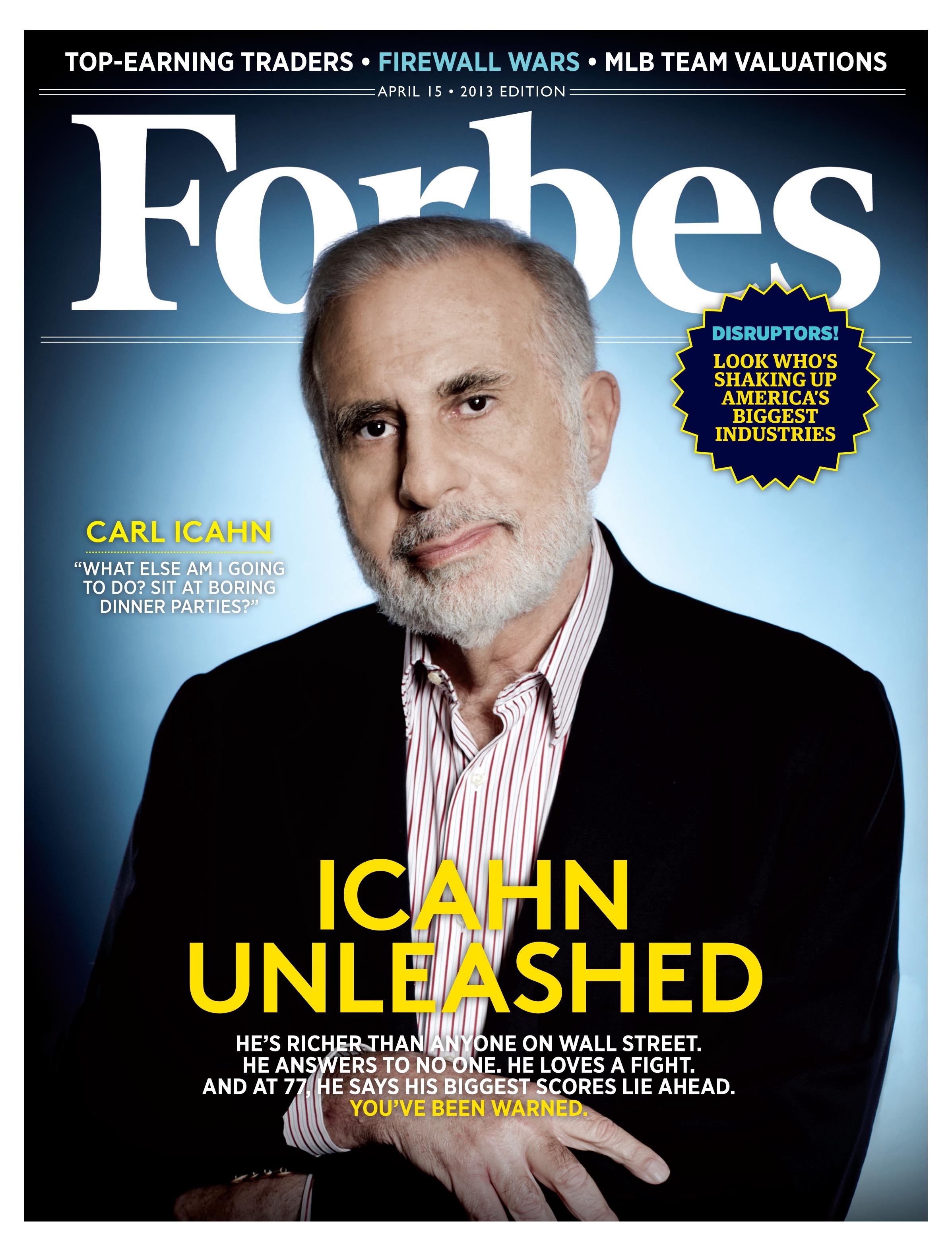
Carl Icahn must be big-time net short

Icahn.Cover_2

He always appears to show up on days when the market is in extreme stress and the viability of high yield is in question with something like this little gem: “The high-yield market is just a keg of dynamite that sooner or later will blow up.”  He did the same thing back on October 1, when he issued his “Danger Ahead” video (I commented in “Help! Plus more piling on”)

A few thoughts as we approach Fed-Day

  • The 10-year UST yield peaked in December of 2013 at 3% (the announced beginning of the “tapering” of Quantitative Easing). Recently with the threat of a potential rate increase it has been no higher than 2.5%. It closed at 2.13%, Friday December 11, as the “fear” trade was clearly in place. A quarter point bump in the FF rate at this point will only reinforce the fear trade. It is, therefore, very unlikely that this increase will have any major negative effect on long-term interest rates. WHEN THE MARKET FIGURES THIS OUT, AND IF THE STATEMENT IS “ONE AND DONE” / “SLOW AND LOW”, I BELIEVE THE ENVIRONMENT FOR STOCKS BECOMES VERY POSITIVE.
  • The dollar was supposed to strengthen when the Fed raised rates… making U.S. goods more expensive in international markets. Now, with this increase being viewed by many as a fait accompli, the dollar has declined over 4.5% from its recent high, even in the wake of Janet Yellin’s hawkish commentary two weeks ago.
  • The absolute positive that $35/$40 a barrel oil brings to everyone, but the producers, has been totally missed in the rhetoric. It is there and working for all individuals and the energy consuming economies they live in. Remember, the prices of oil and many other commodities are down because of oversupply, not because the global economy has ceased to grow.
  • Tax selling, some of which has been panic selling, has created significant opportunities in levered sectors of the market–MLPs, BDCs, REITs, Utilities and even Distressed Debt (don’t confuse illiquidity with viability).
  •  Since I began this post, another fund, a hedge fund Stone Lion ($1.3 billion in AUM, $400 million distressed debt), has suspended redemptions. This is not likely to play well Monday morning. It is important to remember the message in Fridson I and II. Default rates on high yield bonds are extremely low at present (2.9%). It would take a recession (which does not appear to be in the cards right now) to get to 6%, which means at a historical worst-case, 94% of the credits do not default. Ergo, this collapse may be setting the table with some real opportunities.

What Could Go Wrong?

Please Janet Don't disappoint us Janet
Please Janet
Don’t disappoint us Janet

If the Fed delays the rate increase because of the craziness going on in the high yield and commodity markets, we have a real problem. It will signal that the Fed thinks our economy and the world is too weak to withstand even a minor financial dust-up. Even worse, it will mean that the financial media and pundits with their fear mongering will have gained control of U.S. monetary policy. Please, Janet, say it ain’t so.

What are your thoughts?

The information presented in kortsessions.com represents my own opinions and does not contain recommendations for any particular investment or securities.  I may, from time to time, mention certain securities for illustrative purpose, names where I personally hold positions.  These are not meant to be construed as recommendations to BUY or SELL.  All investments and strategies should be undertaken only after careful consideration of suitability based on the risks, tolerance for risk and personal financial situation.