Categories
Financial, Stock Investment

Coronavirus continues its reign of terror

Sars, a distant relative

— COVID-2019 fears continue to dominate the market.

— It is very hard to square the terror that surfaced Friday in bonds and gold with the evidence at hand.

— Will coronavirus just be another obsession that falls by the wayside in the secular bull market?

face of fear

The S&P 500 is just 1.7% from a new record high. Admittedly, this statistic makes it very difficult to connect to the emotion of terror but if you look just under the surface certain investors are flocking to ‘safe haven’ investments … U.S. Treasury securities and gold. Friday, (2/21/20) they ran very hard to these investments on fears of a coronavirus induced economic slowdown. Gold was up $25.00 closing at $1650.00 (a 7-year high) and the 30-year U.S. Treasury bond closed at a record low yield of 1.89%. These numbers, especially in the bond market, denote some sense of panic.

The Proud Peacock

Note these headlines from CNBC:

“Gold surges 1.5% on growing coronavirus concerns”

“30-year Treasury Yield drops to all-time low …amid coronavirus fears”

“Dow drops more 200 points, … coronavirus fears resurface”

“Oil slides … on renewed fears over… coronavirus“

I think you get the picture.

Interestingly, in the face of what looks to some like a global COVID-2019 economic swoon, Dr.Copper was up Friday and significantly higher than it began the month of February. “The term Doctor Copper is market lingo for the base metal that is reputed to have a Ph.D. in economics because of its ability to predict turning points in the global economy.”

It’s very tough to square the fear with stock prices

As I pointed out above we are less than two percent from the S&P 500 all-time high. In fact, the Shanghai market was up every day last week . Yet there is this flight to safety going on in our market.

As of today (Saturday 2/22) the New York Times reported “the virus had spread to 26 countries, and 1,200 cases had been confirmed outside China, including more than 200 new cases in South Korea, multiple infections in Italy and Iran, and one in Egypt, the first to be confirmed in Africa. China has reported over 76,000 cases, including over 2,300 deaths.”

One reason behind the mild resurgence in the Shanghai market might be that the trajectory of new cases in China appears to be flattening. According to Al Jazeera, “Mainland China noted a significant fall in the number of new cases, with 397 reported on Saturday.” Remember this on a base of over 76,000 since the beginning of the epidemic.

The media: a blessing and a curse

On the blessing side of the equation the media rapidly got the word out on the coronavirus outbreak in China and people around the world have acted to prevent its spread (76,000 plus cases in China 1200 outside of China). The curse is exemplified by the headlines above. They are scary, reported without perspective and meant to engage our instinct to focus on bad news.

We are afloat in a sea of Black Swans

We always are. They can become realities out of the blue. The financial crisis of 2008 was one such event. Only the most astute among us saw it coming. The rest of us, including yours truly, didn’t have a clue about what could have ended up being an economic disaster but that is past. Although many expend a great deal of effort trying to forecast the next disaster, there is no way to know where the next blow-up occurs.

What I do know is that many participants or non-participants in the market have been forecasting or looking for “the big one” since the 2009 bottom. Many, much to their chagrin, have met the advance in stock prices with great skepticism and low levels of participation, instead waiting out the uncertainty in the safety of the bond market.

How did that work out?

$10,000.00 invested in a guaranteed safe 10-year Treasury in March 2009 and reinvested in March 2019 would be worth today $10,000.00 plus $4276 in cumulative interest paid during 11 years. This example assumes the best … you got the high tick on yield (low tick on price) in March 2009 as well the high tick on yield on your 2019 buy. At the same time $10,000.00 invested in the S&P would be worth $50,000 today (S&P 666 to 3338). Yet, the extreme fear continues to exist. Investors continually run for cover (at the slightest ripple in their peace of mind), to the presumed safety of bonds, bonds paying historically low rates. I don’t get it. I believe when this caution is reversed the secular bull market will be over. We appear to be nowhere near this inflection point at present.


My advice is quit looking at the trauma in your rear-view mirror. Right now the economy is in good shape and the market is attractive in the context of 1.57% and 1.89% yields on the 10 and 30-year Treasuries respectively … S&P 500 current yield +1.81%. Unlike the US Treasuries, the S&P dividend has grown significantly over time. The treasury you buy today will never raise or decrease its issue coupon rate .

Reigns of Terror

Maximillian de Robespierre Marketable skill Reigns Of Terror

There have been many reigns of terror since the bottom in 2009 and many prior to that time. Since I began to publish kortsessions.com in 2013, I have documented many of these unwarranted and harmful market obsessions. It seems to me, based on the information currently available, COVID-2019 will be another addition to the list.

What’s your opinion?

The information presented in kortsessions.com represents my own opinions and does not contain recommendations for any particular investment or securities.  I may, from time to time, mention certain securities for illustrative purpose, names where I personally hold positions.  These are not meant to be construed as recommendations to BUY or SELL.  All investments and strategies should be undertaken only after careful consideration of suitability based on the risks, tolerance for risk and personal financial situation. 
Categories
Financial, Stock Investment

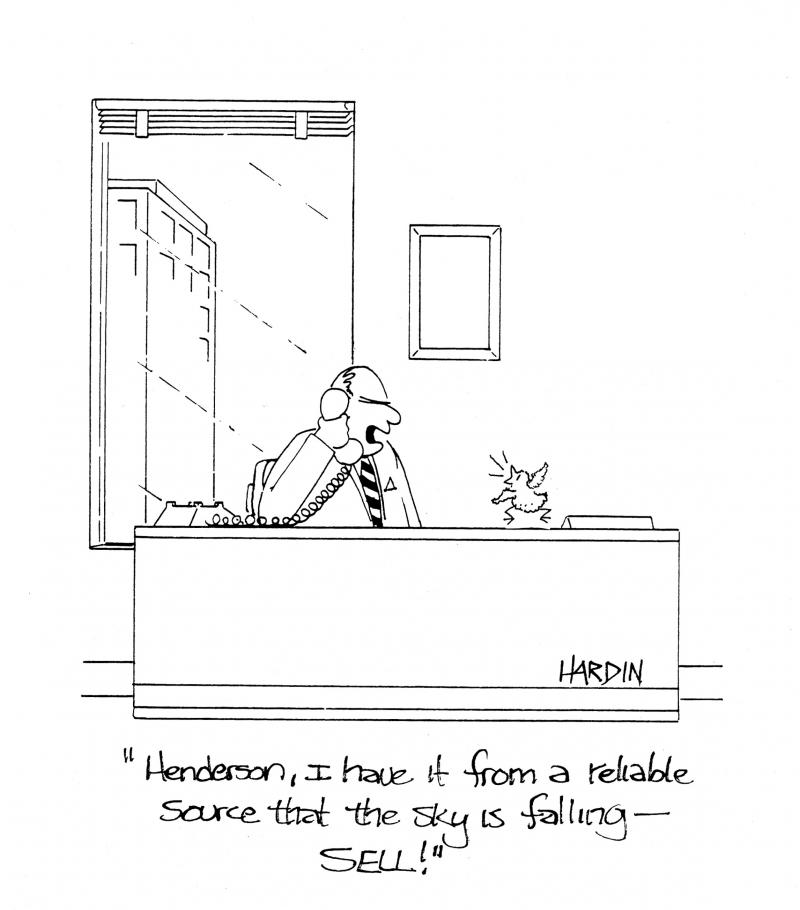
” … , I have it from a reliable source that the sky is falling — SELL!”

A visit with and impeccable source.
A visit with an impeccable source.

Of course, Henderson, the broker at the other end of the line, unaware of the severe consequences of passing inside information, passed this invective from Chicken Little along to ten of his best clients. Before you know it, you have real panic going. Last week’s best frightful and misleading commentary comes to us from the mainstream media … CBS Sunday Morning.

images-58

It was a report, anchored by Martha Teichner, covering the good news and bad news in falling crude oil prices. The beginning 30 seconds had to do with all the happy motorists (all of us) who are saving a bundle at the pump ($150 billion in 2015), the balance (about 5 minutes) had to do with hard times in the oil patch, in particular, Midland, Texas.

Now, I am sympathetic to all of those who have lost their jobs in that industry over the past tw0 years (according to the report, some 275,000). However the oil and gas industry has been a boom/bust industry through all of recorded history. Importantly, the main subject of this report admitted he’d been through four of these cycles in his career. Having said this, when things are good in the oil business, they are very, very good. The gentleman interviewed was an oilfield consultant. During the boom, he was making $1700 to $1800 a week. He is now unemployed. There are obviously many like him.

The flip side of this story is the vast majority of Americans who make nowhere near $1700 per week, people who have suffered for years with high oil prices. The negative story on the oil man reinforces the constant negative media drumbeat of decline and economic stagnation, while the majority of Americans are seeing a real benefit.

Teichner pointed out the causes: US production doubling since 2008 (the shale revolution), Saudi over production to retain market share and, get this, CHINA! Yup, she said Chinese demand had decreased. Not only does she blame China, but she insinuates that demand has declined around the globe (indicating a global economic slowdown) before zeroing in on China. This is incorrect. According to oil industry source, Platts Report, Chinese oil demand (and worldwide demand for oil) continues to grow at a healthy pace…more media malpractice. This  scares Henderson’s clients. It primes them for hitting the exits.

One More Time On The Bullish Virtues Of  Thirty-Dollar Crude

(You are excused if you are on the same page with me. If not read on)

“If oil prices stay between $75 and $95 a barrel, we would see the kind of stimulus package that the Federal Reserve or Congress could never do,” said Douglas R. Oberhelman, the chief executive of Caterpillar, the multinational maker of heavy construction equipment. This quote comes from a NYTimes article dated, November 14, 2014. Obviously, the price on WTI closed Friday 2/5/16 at $31. The stimulus we are now looking at is much larger. This piece from The Hill, dated October 2014, “Lower gas prices will save us all,” posits that every penny off a gallon of gas would equal a $1.4 billion benefit to the economy if maintained over a year. With regular, lead-free gasoline at less than $1.50 per gallon in my market, we are talking about a $2.00 difference vs. two years ago. According to the formula, if held, it would be a $280 billion stimulus. And that’s just in the US. Yet, all is gloom and doom in the media … not one mention of the OIL STIMULUS.

I do hear the critique to this argument: ‘why hasn’t it kicked in?’ That was the same critique the stimulus of 2009 was given. It will, as people begin to accept that this is not a flash in the pan. In the meantime, we will get these runs of panicky selling as the market tries to make a bottom and certain people, Henderson’s clients, hit the exits.

What is your take?

The information presented in kortsessions.com represents my own opinions and does not contain recommendations for any particular investment or securities.  I may, from time to time, mention certain securities for illustrative purpose, names where I personally hold positions.  These are not meant to be construed as recommendations to BUY or SELL.  All investments and strategies should be undertaken only after careful consideration of suitability based on the risks, tolerance for risk and personal financial situation. 
 

Categories
Financial, Stock Investment

I Love the media!

If you can’t spin a story negative, don’t spin it at all.

“Oil’s poised for an ugly start to 2016: analyst”

http://kortsessions.com/wp-content/uploads/2015/12/Lucas_gusher.jpg
Lucas_gusher.jpg

This was the teaser to a story in CNBC on-line: “Oil to fall under $30 before rebounding: Analyst”. Of course, this all depends on whether you are buying or selling. Since the vast majority of the world’s population buys oil and oil by-products and does not sell it, I believe a more apt teaser should be:

Oil’s poised for a great start to 2016: Bill Kort

Thank you for your readership and best wishes for a

Happy, Healthy and Prosperous 

2016!

http://www.kor9px-Felle_Uniformierter_mit_Sektflaschen.jpg

Felle_Uniformierter_mit_Sektflaschen.jpg

The information presented in kortsessions.com represents my own opinions and does not contain recommendations for any particular investment or securities.  I may, from time to time, mention certain securities for illustrative purpose, names where I personally hold positions.  These are not meant to be construed as recommendations to BUY or SELL.  All investments and strategies should be undertaken only after careful consideration of suitability based on the risks, tolerance for risk and personal financial situation. 


Categories
Financial, Stock Investment

“Greece is the word … “

“Syriza for the Win? Anti-bailout party on course to form government”

Alexis Tsipras Syriza Party Leader "The Winner"
Alexis Tsipras
Syriza Party Leader
“The Winner”

CNBC, we pardon the pun (emanating from the title song “Grease is the word,” from the 1971 musical “Grease”). These clever folks are using this headline to help launch the next-big-thing to worry about after Eurozone Quantitative Easing (When? … How much? … too much / too little? …too late?). I mean, will any of this make any difference if Syriza, ‘the anti-bailout party’ gaining control of government, takes Greece out of its Eurozone bail-out deal, or worse, out of the Eurozone completely? I’m not certain; but, I don’t think it will be the end of the world or the end of the Euro for that matter. Trust me, that is not going to be the way they spin it in the wake of the Syriza victory.

Moving On

We have posted 142 kortsessions since we began this blog in February of 2013. In an effort to move on (plus, I’m tired of counting) theses posts will no longer be numbered.

Some really stupid stuff

Rupert Murdoch "the ringmaster"
Rupert Murdoch
“the ringmaster”

Aside from trying to deal with the major media obsessions and misinformed opinions that steer investors in the wrong direction, sometimes I just can’t resist taking a poke at the ‘really stupid’ stuff that is presented.

Along these lines we got a ‘two-fer’ last week from our friends at MarketWatch, both on Friday January 23.

“If oil drops below $30 per barrel, brace for a global recession,” continues to push the idea that oil’s collapse is a result of slack demand, a proposition I don’t buy. None-the-less, this article was one of the top-trenders on MarketWatch, both Friday and Saturday. I guess bad news sells page views. BTW, this sign of global recession was obtained from a survey of 306 ‘financial professionals’. They did not indicate what kind (i.e. stockbrokers, analysts, portfolio managers or financial planners). At any rate we all know how prescient all of the above can be. What a joke (also a scary precept) this is. If every-once-in-awhile MarketWatch did not put up some credible work, this inanity would drive me away from this rhinestone in Rupert Murdoch’s media tiara (which also includes the The Wall Street Journal and Barron’s).

My final piece for your consideration (another top-trender) is this beauty: “Opinion: Stock Market’s fate depends on the next six days.” this article in premised on the ‘January barometer’–‘How goes January, so goes the year.’ This is really useless information when you get right down to it, helpful neither to traders or investors. According to the article the average gain in a year (since the beginning of The Dow Jones Industrial Average, 1896) where January was an ‘up’ month was about twice that of a year where January was down. More importantly, the average January since the beginning of the Dow was UP! It did not make a difference whether January was up or down. You would have made money owning stocks if you owned stocks January 1. The only difference is you would have, on average made more money, if the month of January were positive. Methinks that “Stock market’s fate depends … ”  is a bit strong.

What do you think?

The information presented in kortsessions.com represents my own opinions and does not contain recommendations for any particular investment or securities.  I may, from time to time, mention certain securities for illustrative purpose, names where I personally hold positions.  These are not meant to be construed as recommendations to BUY or SELL.  All investments and strategies should be undertaken only after careful consideration of suitability based on the risks, tolerance for risk and personal financial situation.    

Categories
Financial, Stock Investment

Session 136–Collapsing Crude Prices=Systemic Risk?

Though I am not certain that this will be the case (in fact I believe it won’t be), I’m willing to bet that this is the spin (systemic risk) that the media will begin to attach to rapidly falling oil prices. Why? Because there is potential to come to very negative conclusions about the impact of oil’s collapse, to raise the specter of and to speculate about ‘dire consequences’. And, as we all know, in the financial media, as is the case with most media, ‘if it bleeds, it leads’; and the energy sector is really bleeding.

How bad is it?

"How bad was it!?"
“How bad was it!?”

(only readers of a certain age will get the import of this photo)

To answer this question I provide a quote and a clip (Will OPEC bankrupt U.S. shale producers?) from a CNBC interview with Neil Beveridge, Senior Oil Analyst at Sanford C. Bernstein (The Beveridge interview is the number “3” clip in the article and worth your attention):

“While production growth is very strong [in North America], remember if you look at the debt situation for a lot of these companies, there is a lot of distressed debt,” said Beveridge.

“$68 a barrel is not economical for a lot of these shale oil wells. CDS [credit default swap] spreads and yields on some of the debt are rising very quickly, because at these kinds of oil prices you are going to see producers go bankrupt,” he added.

According to Beveridge, 15% of the high yield (s0-called distressed debt) market is energy related. In preparation for this post I searched for current data on the high-yield market. Unfortunately the most recent was in an article quoting S&P as of March 31, 2013 at $2.2 trillion. If you assume 15% of the earlier total, the junk debt (high-yield) portion would approximate $330 billion.

I think it is important to be armed with these numbers as the potential media rhetoric heats up, even if the number of junk energy credits outstanding is double the $330 billion above. First of all, some junk-issuing producer will go broke (most won’t). Second, regulators are keenly aware of industry loan concentrations, which should impact positively the exposure of the to-big-to fail (TBTF) money center banks. This would also apply to sovereign debt issued by oil producers a la Venezuela.

Speaking of the impact on oil producers …

The drop in prices could create instability among those countries who require higher oil prices to keep the lights on … places like Iran, Russia (“OPEC decision spells trouble for Russia”) and the aforementioned Venezuela. But this could be a good thing. In the case of Russia, Mr. Putin may not be as inclined to retaliate against sanctions by the U.S. and others by curtailing natural gas sales to Europe or the Ukraine. He may also think twice about escalating his Ukrainian adventure. Regarding Iran, they won’t have as much dough to send to their friends in Hamas, maybe giving some brief stability to the Israeli / Palestinian conflict. And, as to Venezuela, I’m not sure what the country is up to in the wake of Hugo Chavez passing, but lower oil prices may lead to a regime that is more friendly with the United States.

What about Texas and North Dakota

Unfortunately for them, they will have to struggle. On the bright side, they have just endured five or six years of unprecedented BOOM TIMES while the rest of the world struggled. I hope they put some money away for a rainy day.

One last Caveat

Although the pundits are calling for this current drop in oil prices to last for some time, it may not. And the more people that join the camp of prolonged low oil prices, the less likely it becomes. So, pay attention to what the choir is singing, you may be able to make money going the opposites direction.

Bottom Line

My opinion is there are six or seven billion of us that will reap great benefits from these price declines, however long they should last. Regardless of the media spin, this does not look like a systemically dangerous event.

What do you think?

The information presented in kortsessions.com represents my own opinions and does not contain recommendations for any particular investment or securities.  I may, from time to time, mention certain securities for illustrative purpose, names where I personally hold positions.  These are not meant to be construed as recommendations to BUY or SELL.  All investments and strategies should be undertaken only after careful consideration of suitability based on the risks, tolerance for risk and personal financial situation.    

Categories
Financial, Stock Investment

Session 112–What a difference a ‘Frack’ made


Sectarian Violence Between  Sunni and Shia at the Battle of Siffin
Sectarian Violence Between Sunni and Shia at the Battle of Siffin, 657 AD

Who would have thought Iraq erupting into sectarian / civil war would have , at most, been the cause of a two-day, 200-point decline in the Dow Jones Industrials (so far)?  Not that it should be a surprise Iraq would fall into chaos upon the departure of U.S. forces, it shouldn’t.  Saddam Hussein, the bad guy (and he was really bad), kept his Shiite brethren, Sunni and Kurdish countrymen apart.  They feared him more than they hated each other.

The Late Saddam Hussien

This dynamic is something that might well have been considered before we went in, as Sunni and Shia have been at one another since 632 AD, when a dispute developed as to who should be the rightful heir to Muhhamad as Caliph (Muslim head of state).  Ergo, in order to extract our military, we would have had to leave Iraq with a leadership just as tough as Saddam, or simply not leave.  Neither of these were ever real options, and now the Sunni and Shia factions in Iraq are working their problems out in a traditional manner…fighting.

What about all that oil?

Rest in Peace
Rest in Peace

There are about 3.6 million barrels of oil daily coming out of Iraq.  What’s interesting is that the price of WTI (West Texas Intermediate) is only up about $7/barrel since the first of May when it was trading around $100.  I will ascribe this muted performance to: 1) Most of the production in Iraq is coming from Basra in the South (the war is North) and 2) the U.S. is much closer to energy independence than it used to be.

We still import oil.  What has made the difference is new production and reserves gained through the application of new technology and techniques…”What a difference a ‘Frack‘ Makes.”  Great strides have been made in horizontal drilling technology and the extraction of heavy Canadian crudes.  We are moving toward energy independence, muting the effects of geopolitical events on pricing and supply disruption that they might create.

You could have knocked me over with a feather!

Mr. Cantor
Mr. Cantor

Another event that might have weighed on the market earlier this week was the defeat of House Majority Leader, Eric Cantor, by a political novice, Professor David Brat.  This was a stunner.  As Cantor, over the years has been a major cheerleader for the Taxed-Enough-Already wing of the Republican Party, he was devoured by his own young.

In a very low turnout election, Cantor was cast as the moderate in the race; a tool of Wall Street (he voted for the TARP) and too close to big business and the U.S. Chamber of Commerce.  This is scary stuff on The Street, if you are a target of their disdain and realize how quickly senior Republican Leadership can be unseated by a virtual unknown.  I mean, this guy Brat and Senator Elizabeth Warren seem to be soul-mates.

Professor David Brat

The media went negative in a big way last week

I will include a clip from Jim Cramer, exhorting his followers to take money off the table, “Something unexpected may be imminent.”  They put a ton of bricks in the ‘wall of worry.’  I really cannot argue with the fact a fairly strong correction is due.  I can’t predict when or identify the trigger.  I can say that it should not be unexpected and it will be normal when it comes. And, if you think the media got negative last week, a real correction will ratchet up the rhetoric big time.  Remember, it will not be the end of the world.

What do you think?

The information presented in kortsessions.com represents my own opinions and does not contain recommendations for any particular investment or securities.  I may, from time to time, mention certain securities for illustrative purpose, names where I personally hold positions.  These are not meant to be construed as recommendations to BUY or SELL.  All investments and strategies should be undertaken only after careful consideration of suitability based on the risks, tolerance for risk and personal financial situation.