— Comments on a possible Israeli retaliation against Iranian energy assets give the market the shakes.
— I believe, should it occur, it might lead to an unexpected outcome.
— Oil market fundamentals since 2020 would tend to argue against this being a huge or long-term negative (or positive for oil prices).
— The myth of “Drill Baby, Drill”
Possible Israeli retaliation vs. Iranian energy assets give the market a case of indigestion.
Although the market ended the week on high note, the previous few days of squeamish market action appear to be a direct reaction to the massive Israeli incursion into southern Lebanon against Iranian proxy, Hezbollah, and the follow-up retaliation by Iran via a heavy missile attack on Israel. This is just but one chapter in the on-again, off-again conflict that Israel has faced since its creation as a state in 1948. My post is not a defense of Israel or the Palestinian sides in this conflict. I will leave that for others. What I am focused on here is the potential ramifications of Israel taking out a portion or all of Iran’s energy infrastructure.
Why? The Islamic Republic of Iran probably does not have many friends in the region or around the world. As a fanatical theocracy, with burgeoning nuclear capabilities, the Iranians scare a lot of people. Anything that can be done to slow them down in funding terrorism, Hezbollah in Lebanon and their nuclear ambitions would be welcomed. This probably would be especially true for their neighbor/enemy across the Strait of Hormuz, Saudi Arabia.
A second potential benefit of reducing or eliminating a large part of Iran’s energy income might be the destabilizing effect it would have on the Iranian economy and the country itself. The current regime is very unpopular. Domestic concerns might keep them off their game of making the world miserable in pursuit of their goal, a world bathed in the light of radical Islam.
On the Upside: recent oil market fundamentals would argue against a huge, long-term jump in prices
Lest we forget, and it seems like investors and the market have an extraordinarily short memory span, a mildly negative US economic statistic or weakness in China can tank the price of oil $2 or $3 a barrel — spiking worry about a potential recession. This obviously is a market in an oversupply condition.
Another important point comes from the fact that Iran is currently supplying 3.2 million barrels a day to the market while Saudi Arabia is producing about 9 million barrels a day (production that has been reined to support current prices). What people forget is that in April of 2020 (you know, when the price of WTI dropped to negative $40 per barrel) Saudi Arabian production averaged approximately 12 million barrels per day. They may not have the capability to produce that much today but even if the number approximated 11 million per day it would cover the loss of 2 million Iranian barrels per day. In other words Saudi production plus that of other producers that has been reined in to support current crude prices could easily recover the loss of every barrel of Iranian crude.
The myth of “Drill Baby Drill”
The United States is the leading oil producer in the world with current daily production standing at about 13 million barrels per day. If massive amounts of federal on-shore and off-shore tracts were open for drilling it would not likely stimulate additional production any time soon. Why? The various producers realize that any abrupt increase in supply would likely put extreme pressure on prices. This is exactly what happened in 2020 when the US increased production dramatically during the shale oil revolution. It was costing Saudi Arabia market share, so the Saudis ramped up production dramatically, thus destroying the crude market. There was so much crude floating around and storage was so full that at one point contract holders who could not take delivery were in a position that they would have to pay people to take it off their hands (ergo the minus $40 a barrel price).
Another factor at work in 2020 was the growing concern that renewables would be displacing hydrocarbon fuels at sometime down the road.
This was an extraordinarily traumatic time for the fossil fuel industry. It caused a massive shift in behavior. The “Drill Baby, Drill” philosophy that made it a priority to grow reserves at a faster pace than growing production morphed into to slowing exploration and development drilling and returning those savings to shareholders via increased dividends, stock buybacks and debt reduction. We made this case in detail in a post published July 11, 2022, “Has Warren Buffett Gone Mad?”.
Bottom Lines: We should be able to withstand an Israeli attack on Iranian energy assets. Oil companies are acting in their own economic self interest. The concept of “Drill Baby Drill” goes against that self interest.
What ‘s your take?
The information presented in kortsessions.com represents my own opinions and does not contain recommendations for any particular investment or securities. I may, from time to time, mention certain securities for illustrative purpose, names where I personally hold positions. These are not meant to be construed as recommendations to BUY or SELL. All investments and strategies should be undertaken only after careful consideration of suitability based on the risks, tolerance for risk and personal financial situation.
–The world goes green. Is that bad for conventional energy producers?
–Game plan for a gravy train collapse
–Supply response vs. higher prices may be different this time
–As convoluted as this might seem green may be good for fossil fuel producers for some time to come.
No Question: the world is going green
Climate change is real. Some may debate the cause but, excepting a few Luddites, this has become consensus. Hydro-carbon emissions are, front and center, the main source of blame for our current environmental issues and the major target for reduction or elimination. This fact is not lost upon oil producing countries or the companies that find, produce and market the ‘black gold.’
What to do when your gravy train begins to collapse
My advice-begin to look for a new gravy train! If you are Saudi Arabia, stop investing in new production or worrying about maintaining market share and start doing everything possible to maximize cash flow and investment in alternative industries that will take you into and finance the future. This may very well be an explanation for the current discipline we are seeing in OPEC+.
If you are Chevron (CVX) or Exxon (XOM) you may want to adopt the same strategy. Exxon in particular may want to think about this as three of their twelve directors are now green beans.
If you are Apache Corporation (APA) (be careful … I own this one), you may want to to hold your maintenance capital expenditures flat and use any excess cash flow to pay down debt. This is exactly what they are doing. Prior to the the Covid 19 collapse in oil prices the company had been paying a quarterly dividend of $.25 (annually $378 million). It was cut to $.0625 during the crash. In the first quarter 2021, the company generated $502 million in free cash flow (an amount well over that needed to fund the entire old annual dividend at $1 per share). During the quarter-end conference call they were asked about increasing their dividend. Their response was that that was not even in the cards until they returned their debt rating to investment grade. They have about $8 billion in debt. If that level of free cash flow continues (no big bumps in spending to increase production, which they stated would be the case), my arm chair analysis says that they could pay off 25% of that debt this year.
What about financing new oil exploration?
So, you’re a banker or investment banker and it is not lost upon you that the future is beginning to look dim, at least in the longer-term, for certain fossil fuels what is the likelihood that you might want to loan or give equity to such a venture? I believe financing really does become an issue even if oil prices remain high.
Up the Down Escalator
This is an apt descriptor for the oil and gas industry. The minute you begin to produce an oil or gas reservoir the production rate starts to decline. In some cases that overall decline rate can take decades before the supply is exhausted and in some cases, like shale oil, it can happen more quickly. On a worldwide basis to maintain current production you have to continue to explore and develop new sources. What I have described above is definitely not conducive to this.
My conclusion: Supply Response vs Higher Prices May Be Different This Time
First and foremost, oil demand continues to grow and was forecasted to grow in 2020. Covid obviously changed the equation. As we reopen it will be coming back with a vengeance.
Why should they or any other oil producer be in a hurry to increase production when a 10% production cut equates to $30 or $40 per barrel more cash flow at a time when your most important source of revenue is under threat by the ‘green revolution?’ Maximizing cash flow and investing away from hydrocarbons would seem a rational course to take. This same question I am certain is being asked in oil company board rooms all over the world and it may very well be why this time the normal policy response, PRODUCE MORE-FIND MORE, is off the table.
THE NEW MANTRA MIGHT BECOME, PRODUCE LESS, MAXIMIZE CASH FLOW, DIRECT NEW INVESTMENT TO ALTERNATIVE ENERGY ENTERPRISES.
THE WILD CARD
The longer it takes for the ‘green revolution’ to transpire the bigger the supply gap/demand and the greater the economic pain of higher oil prices. This could play out over many years because of reticence on the part of managements and countries to invest heavily in new hydrocarbon sources.
As convoluted as it sounds, going green truly becomes a lifeline to fossil fuels. I think you want to own this sector. Caveat, I already do!
What do you think?
The information presented in kortsessions.com represents my own opinions and does not contain recommendations for any particular investment or securities. I may, from time to time, mention certain securities for illustrative purpose, names where I personally hold positions. These are not meant to be construed as recommendations to BUY or SELL. All investments and strategies should be undertaken only after careful consideration of suitability based on the risks, tolerance for risk and personal financial situation.
Barron’s Ben Levisohn proclaims —“no one knows who is winning.” (Barron’s or WSJ subscription needed to read more) May I suggest, based on this headline, I would say fear is winning and if you have read this far my use of the Barron’s headline effectively drew you into this post. If you stick around I will present a slightly less fearful point of view.
But to get back to Mr. Levisohn’s fearful assessment, he asserts, “we all know, though, everything isn’t all right.” He goes on to say that the fiscal and monetary stimulus is but a stop gap. We need to impede the virus and get back to work. If we don’t, pressure on the financial markets will continue to bring us more events like the the workings of the oil market last week.
He wrote , “We can talk all we want about how it was just one futures contract, that it was caused by technical factors due to that contract’s expiration and the lack of storage for the oil that owners of those contracts would have to take delivery of. But just think about how strange that is: If you owned oil, you had to pay someone to take it from you.”
What is amazing to me is Levisohn’s follow-up commentary below. I find it totally incredible coming from the pen of any experienced market observer. Yet, this was front page commentary and opinion from Barron’s this weekend.
“The stock market’s reaction was even stranger. Stocks fell hard for two days (S&P -5% peak to trough)*—first, ones with the most exposure to oil, then everything else—then started to bounce back. By the end of the week, the energy sector had turned positive for the week, and oil was an almost afterthought. It should be considered a warning. “When assets like oil swing wildly, we pay attention,” writes Lindsey Bell, chief investment strategist at Ally Invest.”
(*my addition)
What’s wrong with this picture?
Hmmmmm…
For one thing the set up for the crude disaster in the commodity market has been happening in plain sight for months with China in lock-down earlier in the year (the second largest oil consuming country in the world with smog-free air in Beijing), the Russo-Saudi price war and U.S. producers running at full tilt. The surplus production found its way into quickly evaporating storage capacity. OPEC, with most of the production cuts to fall on the back of the Saudis and the Russians, agreed to a 9.5 million barrel per day cut to begin May 1. This was to be no help easing the pressure on storage. I’m sure there were speculators in the oil market (with no intention of ever taking physical delivery) assuming this massive cut would push prices up. It did not. With limited storage available the April West Texas Intermediate (WTI) contact became a ‘towhomer’ (to whom do you sell it?). So if you were long one Nymex WTI April contract and not particularly interested in having 1000 barrels delivered to your front lawn, you had to find a buyer with storage. Those buyers drove a hard bargain, in some cases requiring the seller to pay as much as $40.00 per barrel to take the physical oil off their hands. The explanation of the ‘why’ for the crash and burn of WTI April seems pretty self evident
Back to my critique of Mr. Levishon and his article. I would say last week was no shock or surprise to the market nor should it have been a surprise to Ben. Oil stock prices reflected this disaster a month ago.
low
Friday (4/24)
Exxon Mobil (XON)
$ 30.11 (3/24)
$ 43.77
Chevron (CHV)
$ 51.60 (3/19)
$ 87.02
Apache* (APA)
$ 3.68 (4/01)
$ 10.69
*bill kort holding
Last week’s oil stock and market ho-hum response to negative crude prices looks to me as though the glut is in the process of reversing itself. Remember, an OPEC 9.5 million barrel per day cut is about to begin Friday May 1. Continental Resources, Inc. (a major Bakken shale player) announced Friday that it was halting all shale production and canceling sales contracts, stating it would not sell its oil at these prices. On top of this many companies have slashed capital spending plans. This all seems to have been lost on the author of the the Barron’s article.
Will we go from surplus to shortage overnight? Of course not but the seeds are being sown. Production is being pared. Investment is being withdrawn. China is coming back on line with the rest of the world to follow … maybe slowly. but things will open up again.
This post is not about the ethics or secular role of oil and fossil fuels.
Is fossil fuel consumption good for the environment?… probably not. Can we flip a switch and do without oil and natural gas today… no. Can we do more with alternatives? … Yes. How long will the process take to displace our dependence on oil and natural gas? I don’t know. My sense is that it will take some time, maybe decades. In the meantime we are stuck with fossil fuels. Does this appear to be a long-term secular growth industry? No. It is not Amazon, Alphabet or Netflix. … It is a very cyclical, boom-bust industry and this characteristic makes the group interesting from time to time. This may be one of those times.
I also make this statement to head off a lot of commentary about the evils of big oil or the concept that the oil and gas industry is ‘a dead man walking.’ Remember before the advent of COVID-19 as a market factor world oil demand was growing at about a 1% annual clip. There are just too many people out there, newly minted middle-classes around the world, who want to live like you and me.
The purpose of this post was to give perspective & highlight bad behavior… bad media behavior
This was our Barron’s headline:
“In a Stock Market Like This, Anything Could Cause the Next Panic. Here’s What to Watch”
face of panic
The story is a compendium of all the bad things that could happen in the economy and market. It leads with a scary recount of all the bad things happening to oil. Zero perspective was given to what appears now to be the general self-correcting nature of the oil industry’s problem or the fact that the oil stocks have had a huge bounce unimpeded by the plunge to negative prices in the oil futures market last week. This is very reminiscent of the kind of stories you would see at the bottom in 2009. The article was not designed to inform, which most of the main stream media try to do (unfortunately, there are some mis-steps into editorial license–opinion). It is not ‘fake news’ because it is really not news. It is opinion designed to scare and reel you in. It is a prime example of media misbehavior. Again, I make the point that the media is not your friend when it comes to charting an investment course.
What’s your take?
The information presented in kortsessions.com represents my own opinions and does not contain recommendations for any particular investment or securities. I may, from time to time, mention certain securities for illustrative purpose, names where I personally hold positions. These are not meant to be construed as recommendations to BUY or SELL. All investments and strategies should be undertaken only after careful consideration of suitability based on the risks, tolerance for risk and personal financial situation.
“West Texas Intermediate futures fell 0.8 percent to $60.19 a barrel, after briefly breaking below $60 for the first time since March. They also fell further into bear-market territory, trading more than 20 percent below their 52-week high.”
Oil prices have increasingly become the focus of the pundits, as the price weakness might signal a weakening of global economies. Oil prices for many have become a ‘canary in the coal mine’. Any weakness in oil and they are willing to throw in the towel and predict a global economic retrenchment The problem is that they are never willing to look at oversupply as the culprit (U.S. Oil Production Is Set To Soar Past 12 Million Bpd). The focus always moves to “global slowdown.” Yet forecasts remain, although tempered by trade concerns, for oil demand growth.
“The IEA cut its estimate for global oil-demand growth for both 2018 and 2019 by about 110,000 barrels a day to 1.3 million and 1.4 million barrels a day respectively. The revision also reflected changes in the way the agency assesses Chinese consumption. Both global demand and supply are close to hitting 100 million barrels a day for the first time.” (source, Bloomberg, International Energy Agency)
We saw the market go into a tailspin in late 2015 and early 2016 for exactly the same reason. I wrote in March of 2016:
Oil prices — On its way to $20 (or lower) a month ago, West Texas Intermediate (WTI) closed this week just a smidgen under $40 per barrel. It was going to $20 because of two misconceptions: 1) world demand was down (especially China) and 2) supplies were growing. Ex. the new oil coming onto the market from Iran. Both appear wrong. World demand was up last year and it is estimated to be up in 2016. In fact, lower prices may have stimulated demand. According to the American Petroleum Institute (API), “Total petroleum deliveries, a measure of consumer demand, rose 2% in February from a year ago levels, to 19.8 million barrels per day. These were the highest deliveries in eight years. Total motor gasoline deliveries rose 5.2% from February 2015 to 9.1 million barrels per day and were the highest deliveries for that month on record.” In this clip Chevron CEO, John Watson, discusses the reasoning behind his expectation that production will be dropping in the face of this increasing demand. Many have laid market weakness at the feet of falling oil and commodity prices, which they equate to weak demand and recessionary pressures. It continues to look to me like oversupply, which in the oil patch, may be in the process of righting itself. Of course, the bear case: this a flash in the pan. (“After you get what you want, you don’t want it”)
Then There’s China
“The weak Chinese economic data come as the U.S. and China engage in a trade spat that has been going on for most of the year. The two countries have slapped tariffs on billions of dollars worth of each other’s goods as the U.S. seeks a better trade deal with China.”
Ex, the trade issues this is another “…Deja vu all over again” moment from two years ago. It is likely this, too, will be settled with really little change in the two country’s trade positions … just enough so the president can proclaim victory.
Yogi Berra, Mr. Deja vu
Then there is Fed policy
“These sharp losses (in the markets) have rekindled worries about a possible slowdown in the global economy, which come as the Federal Reserve looks to further tighten monetary policy. The Fed on Thursday decided to leave its benchmark interest rate unchanged, as was expected, but comments by the U.S. central bank suggested it was on course to continue hiking rates.”
Two years ago the Fed had just begun the process of normalizing interest rates with a quarter point increase in the fed funds rate. (0.0 to .25% to .25 to .5%). For many this was to be the end of the world … didn’t happen.
December 31, 2016 the S&P 500 closed at 1940. Friday, November 8, 2018 the S&P 500 closed at 2781, up 43% in less than two years. The 2015/2016 correction was the last real correction that the market has experienced since the end of its recent run-up. The current market would appear to be correcting this run … not beginning a protracted bear phase.
Ergo, these should not be the times that try your soul, unless, of course, you are paying attention to the media.
What’s your opinion?
The information presented in kortsessions.com represents my own opinions and does not contain recommendations for any particular investment or securities. I may, from time to time, mention certain securities for illustrative purpose, names where I personally hold positions. These are not meant to be construed as recommendations to BUY or SELL. All investments and strategies should be undertaken only after careful consideration of suitability based on the risks, tolerance for risk and personal financial situation.
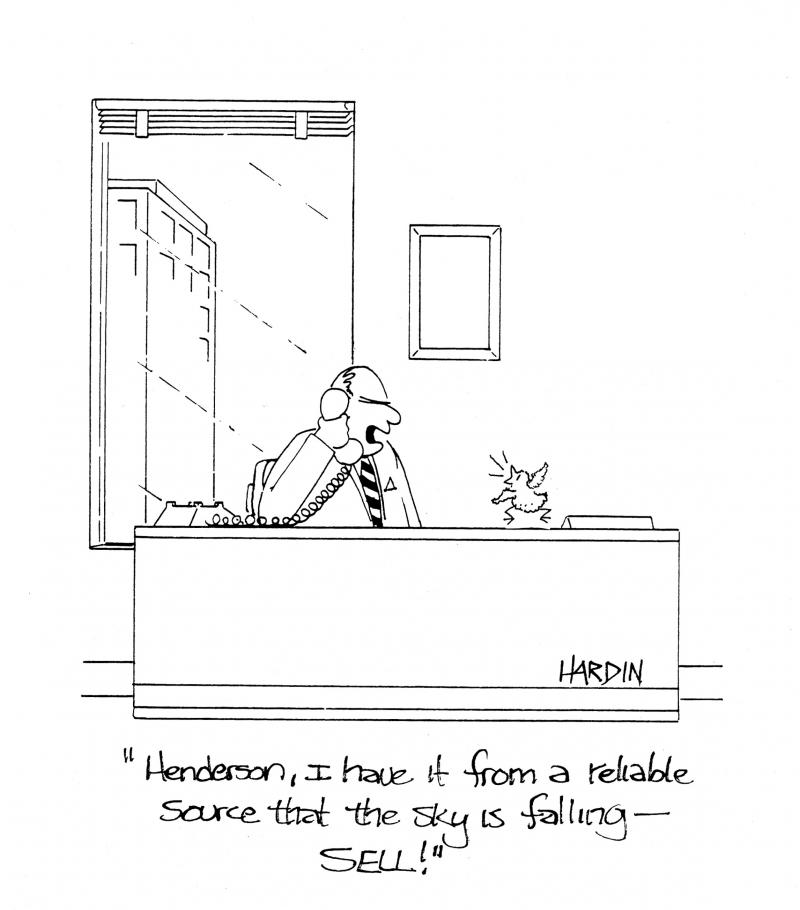
Of course, Henderson, the broker at the other end of the line, unaware of the severe consequences of passing inside information, passed this invective from Chicken Little along to ten of his best clients. Before you know it, you have real panic going. Last week’s best frightful and misleading commentary comes to us from the mainstream media … CBS Sunday Morning.
It was a report, anchored by Martha Teichner, covering the good news and bad news in falling crude oil prices. The beginning 30 seconds had to do with all the happy motorists (all of us) who are saving a bundle at the pump ($150 billion in 2015), the balance (about 5 minutes) had to do with hard times in the oil patch, in particular, Midland, Texas.
Now, I am sympathetic to all of those who have lost their jobs in that industry over the past tw0 years (according to the report, some 275,000). However the oil and gas industry has been a boom/bust industry through all of recorded history. Importantly, the main subject of this report admitted he’d been through four of these cycles in his career. Having said this, when things are good in the oil business, they are very, very good. The gentleman interviewed was an oilfield consultant. During the boom, he was making $1700 to $1800 a week. He is now unemployed. There are obviously many like him.
The flip side of this story is the vast majority of Americans who make nowhere near $1700 per week, people who have suffered for years with high oil prices. The negative story on the oil man reinforces the constant negative media drumbeat of decline and economic stagnation, while the majority of Americans are seeing a real benefit.
Teichner pointed out the causes: US production doubling since 2008 (the shale revolution), Saudi over production to retain market share and, get this, CHINA! Yup, she said Chinese demand had decreased. Not only does she blame China, but she insinuates that demand has declined around the globe (indicating a global economic slowdown) before zeroing in on China. This is incorrect. According to oil industry source, Platts Report, Chinese oil demand (and worldwide demand for oil) continues to grow at a healthy pace…more media malpractice. This scares Henderson’s clients. It primes them for hitting the exits.
One More Time On The Bullish Virtues Of Thirty-Dollar Crude
(You are excused if you are on the same page with me. If not read on)
“If oil prices stay between $75 and $95 a barrel, we would see the kind of stimulus package that the Federal Reserve or Congress could never do,” said Douglas R. Oberhelman, the chief executive of Caterpillar, the multinational maker of heavy construction equipment. This quote comes from a NYTimes article dated, November 14, 2014. Obviously, the price on WTI closed Friday 2/5/16 at $31. The stimulus we are now looking at is much larger. This piece from The Hill, dated October 2014, “Lower gas prices will save us all,” posits that every penny off a gallon of gas would equal a $1.4 billion benefit to the economy if maintained over a year. With regular, lead-free gasoline at less than $1.50 per gallon in my market, we are talking about a $2.00 difference vs. two years ago. According to the formula, if held, it would be a $280 billion stimulus. And that’s just in the US. Yet, all is gloom and doom in the media … not one mention of the OIL STIMULUS.
I do hear the critique to this argument: ‘why hasn’t it kicked in?’ That was the same critique the stimulus of 2009 was given. It will, as people begin to accept that this is not a flash in the pan. In the meantime, we will get these runs of panicky selling as the market tries to make a bottom and certain people, Henderson’s clients, hit the exits.
What is your take?
The information presented in kortsessions.com represents my own opinions and does not contain recommendations for any particular investment or securities. I may, from time to time, mention certain securities for illustrative purpose, names where I personally hold positions. These are not meant to be construed as recommendations to BUY or SELL. All investments and strategies should be undertaken only after careful consideration of suitability based on the risks, tolerance for risk and personal financial situation.