Categories
Financial, Stock Investment

Session 90-In StockMarket Land, the difference between apples and oranges is often hard to discern

Bill“Markets flooded with cash, should Fed prep to stamp out risk(Reuters via CNBC 2/21/2014)?”  First of all, this is a stupid question as their mandate deals with unemployment and inflation.  They are only the ‘risk police’ when it comes to risk of inflation. They can warn about “irrational exuberance”, but it is not their job to stop it, unless it is the indirect result of steps taken by the Fed to cool inflation (i.e. raising rates).  As inflation is rather muted and unemployment still a concern, Fed tightening does not seem very likely at this point.

Back to apples, oranges and other false equivalents…

488px-Czigány,_Dezső_-_Still-life_with_Apples_and_Oranges_(ca_1910)

The “Market flooded…” article tries to compare fed policies in the run-up to the ’08/’09 market collapse to their policies post-crash, and concludes we may be headed for a similar outcome.  The policies were easy money and low rates.  The outcome, according to the Reuters story, was the subprime mortgage debacle.  They forgot to mention Congressionally-mandated lower lending standards and Wall Street’s creation and proliferation of derivatives (“financial weapons of mass destruction”) used to package, insure and market them.  Oh yes, there were the banking and SEC regulators that were asleep at the switch.  Also, we must not forget the profound effect of the removal of Glass, Steagall restrictions on banks being in the securities business. These restrictions that had been in place since the Great Depression.

I think that this piece, lacking perspective (not untypical of most financial reporting), really failed to present an accurate picture of why the Fed kept rates low for so long in the first half of the decade.  The market and the economy were stunned by the ferocity of the bursting of the ‘Tech Bubble’ in 2000.  Ergo a more relaxed Fed policy was called for.  Then we were confronted by the 9/11 terror attacks. These really spooked the market and the economy.  Finally, we entered into two wars.  During the next few years the economy was limping along while oil and gasoline prices spiked to new all-time highs, acting as a counter to the loose monetary policy.  Many worried that the U.S. was becoming the next Japan (economic stagnation) with China ascendant.  Comparing now to then is comparing apples to oranges.

A follow-up on Session 89–From silly to really ridiculous.
Planetary_Movements

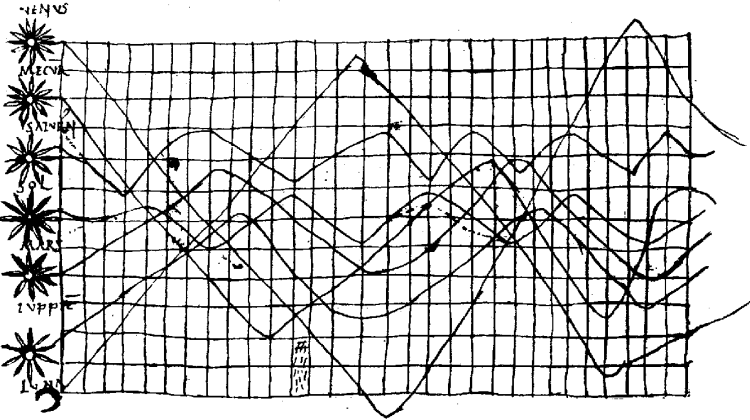
We featured a story in our last post (Session 89–Waiting For The Other Shoe To Drop) about a chart of the current Dow Jones Industrials, which eerily resembled the Dow in September of 1929.  This chart and considerable media commentary about it had raised significant fear and concern in certain circles (you know, “deja vu all over again”).  Well, not to worry, one of the eminent technicians focusing on the chart, Tom McClellan (McClellan Market Report–Chart) sounded the ‘all clear’.  Says McClellan in a column written February 11 (Ironically the same day Mark Hulbert posted a story indicating the chart correlation was drawing eerily more similar), the market had to stop going higher if the comparison were “to keep working.  Continuing higher from here would be a break from that pattern, and would constitute evidence that the analog was breaking correlation.”  Of course, the market did go up… spell broken. No matter, lots of people became overwrought about this as demonstrated in Jeff Saut’s comments in last week’s Barron’s(Dow-pocalypse Now).

Now, I don’t totally dismiss the usefulness of charts.  They are one tool, which coupled with fundamental analysis, can be helpful; but, from my perspective, they should not be used in a vacuum.

What do you think?

The information presented in kortsessions.com represents my own opinions and does not contain recommendations for any particular investment or securities.  I may,  from time to time, mention certain securities for illustrative purpose, names where I personally hold positions.  These are not meant to be construed as recommendations to BUY or SELL.  All investments and strategies should be undertaken only after careful consideration of suitability based on the risks, tolerance for risk and personal financial situation.



Categories
Financial, Stock Investment

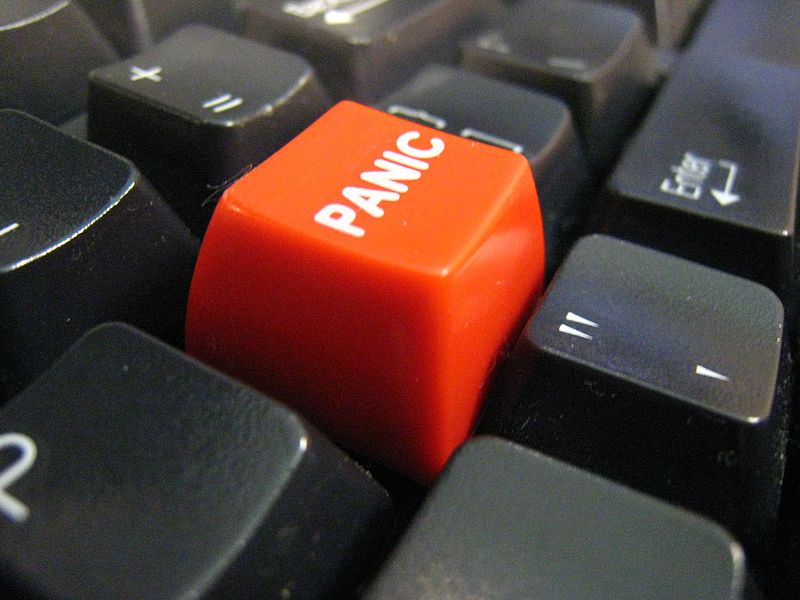
Session 87–One Foot Out the Door, One Finger on the Panic Button

BillI think this describes the mindset of many market participants, suspicious of how far we’ve come since the crash of 2008.  The ghost of that era still haunts investors; so much so, many cut their equity holdings dramatically or totally avoided stocks (sideline money=buying power).  The recent mini-correction has reinforced this skepticism and the media has seized upon this to continue to foment fear and trepidation.  It keeps eyes on the paper, the web sites and, of course, the tube…corrections being a gift that jars investors from the easy complacency of a gradually up-trending market.

Recently, I spotted a couple of particularly egregious reports, specifically designed to draw investors closer to the panic button. Pieces, that if you did not know the background or track record of the presenter, could be very disconcerting.  One of these features the always convivial, always ranting, always negative and never right, CNBC ‘Bond Maven’, Rick Santelli.

The Chartist

SamplePNFillustration1

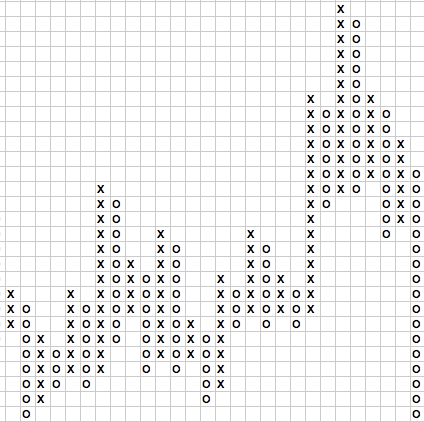
Even though Santelli is supposed to be the ‘Bond Maven’, his commentaries and guests range far afield (including heavy political overtones).  On January 27, Rick’s guest was technician, Tom DeMark.  Chartist DeMark is well-known and a consultant to many high-powered institutional investors and he has had some good calls in his long career.  Having said this, his methods are extremely complex and require many things to fall into place before he makes a call (not always correct).  The reason Santelli had him on was that DeMark recently published a negative piece comparing the chart formation of 1929 to that of 2013.  You see where Santelli is going with this.  The market is down 5% or 6% after a great run and, all of a sudden, we are looking down the barrel at a 40% correction.  This is scary stuff.  Get ready to hit the exits!  Then again, maybe it is just ‘fair and balanced’.  But, wait a minute, Santelli is always negative. (DeMark clip)

800px-Panic_button

The Old Timer

Art Cashin epitomizes the class guys who used to populate the floor of the non-automated New York Stock Exchange.  Although Art has been a cautionary voice for the past few years, he usually is a moderate voice and a voice of market wisdom and experience.

It was very disappointing to me when, at the height of Monday’s (2/3/2014) sell off, Art decided to compare the recent ‘flight to safety’ demonstrated by the strong upward move in the 10-year U.S. Treasury Note to the moves we saw in 2008/2009.  That he made this analogy was bothersome, and that he did while the market was under severe selling pressure was even more disconcerting.  Methinks he’s been hanging with the CNBC crowd too long.

Art’s concern was that rates were supposed to go up after the Fed began its taper of Quantitative Easing.  Instead, they were going down.  Ergo, something really bad was happening under the surface.  What Art seems to have forgotten or may not know, is that QE, even at its height, was just a small part of the daily trading in long-dated treasuries; and, oh by the way, they are still buying $65 billion per month (1/2 treasuries, 1/2 AMBS).  We detail this in session–52.  Anyway, Art was overwrought.  He cautioned if we broke 2.6% on the 10-year it might signal real problems ahead. We did break to 2.58% later that day and closed today (2/5/2014) 2.67%.  It is the safety trade Art, not Armageddon!

I still believe that most investors are not, nor have they been euphoric, that they have one foot out the door and one finger on the panic button. This is a constructive psychological backdrop for the market.

What do you think?

The information presented in kortsessions.com represents my own opinions and does not contain recommendations for any particular investment or securities.  I may,  from time to time, mention certain securities for illustrative purpose, names where I personally hold positions.  These are not meant to be construed as recommendations to BUY or SELL.  All investments and strategies should be undertaken only after careful consideration of suitability based on the risks, tolerance for risk and personal financial situation.