Categories
Financial, Stock Investment

Interest rates and stocks: Heads you lose … Tails you lose!

The Great Conundrum 

In January of 2020 the 10-year US Treasury opened the new year trading with a yield of 1.8%. The S&P 500 was on its way to a 4.6% gain and a new record high by February. Then Covid-19 hit and in the flight to safety that followed  the 10-year yield went below one half of one percent (less than 50 basis points). The confusion comes in when you consider the broadly accepted concept that low interest rates are supposed to be good for business and good for stock prices. My question is why didn’t stocks take off, go through roof, on this dramatic drop in rates? Why wasn’t there a hue and cry on the part of the media and pundits to BUY stocks when rates were in the cellar last spring? It was crickets. Everyone was looking for more shoes to drop.

Now that the market has righted itself those same experts are warning us that rising interest rates and the specter of rising inflation are going to be BAD for stocks. 

Heads you lose …tails you lose.  Ridiculous.

Over reaction by the media

The media rush to board the pain train was pretty predictable. I wrote about it last November 14: “Interest rates are going through the ceiling–The next BIG Thing to worry about.”


Art Cashin
Art Cashin

Again, this should not be surprising. Their job is to get our attention and keep it and they know bad news sells. CNBC knows how to bring it home: “(Art) Cashin expects more stock pain as traders worry the Fed may be losing control of the bond market.” What a cheerful prospect this grizzled Wall Street veteran serves up.

What’s interesting here is that if this were to be the case, the ‘flight to safety trade’ could easily kick in because of the fear that dramatically higher rates would throw the economy into a tailspin. Investors would sell stocks and buy treasuries up and down the maturity spectrum and rates would fall dramatically. Of course, this is but a speculation on my part but we did have evidence Friday, as the 10-year rallied on the close with the yield dropping 11 basis points. The 10-year closed trading for last week at a yield of 1.407%, down from high that day of almost 1.56% .

  • Going into last week the market was overbought (that has certainly been the case with yesterday’s darlings–Big Tech). Ergo, a correction would be normal and expected. Rising rates were just a good trigger.

  • The 10-year was trading at a higher yield (1.8%) before Covid-19. Even that number was historically low and not anywhere near high enough to cause a recession.

  • We have gone through an almost a two decade period of low inflation … the blame globalization, good for prices, bad for pricing, an element in the corporate earnings calculation that has been AWOL for many old economy companies. This was also bad for wage growth.

  • In the past two decades disinflation, as a worry, has reared its ugly head more than once. The Fed has been trying to stimulate inflation back to life as a desirable outcome.

  • Finally, rising rates that come about as the result of an improving economy are normal and to be expected. Rising rates as a result of a fed tightening are something to worry about. The Fed is not tightening.

The conundrum is a media creation.  Don’t let the media scare you out of your stocks on the notion that your stock investments cannot be successful in a rising rate environment. It is simply not correct.

Thoughts?

The information presented in kortsessions.com represents my own opinions and does not contain recommendations for any particular investment or securities.  I may, from time to time, mention certain securities for illustrative purpose, names where I personally hold positions.  These are not meant to be construed as recommendations to BUY or SELL.  All investments and strategies should be undertaken only after careful consideration of suitability based on the risks, tolerance for risk and personal financial situation. 


Categories
Financial, Stock Investment

“After You Get What You Want, You Don’t Want It”

Irving Berlin

This 1920 ditty by Irving Berlin is a perfect descriptor of the punditry corps reaction to: Janet Yellin’s post-Fed OMC (Open Market Committee) meeting comments last week; European Central Bank (ECB) policy moves the previous week; subsequent wilting of the dollar; rising oil prices and a more-measured, less-volatile tone in the market. The damsel in distress in my title pines on “If I gave you the moon, you’d be tired of it soon.” I mean everything that the bears have been complaining about, has reversed and been served up on a silver platter with a very broad five-week up market. And they are still worried.

What did the brainless trust have to say?

Questions, questions ...
Questions, questions …

Actually, they probably are not brainless. They are probably reasonably intelligent people, some of whom  carry the misguided impression that it is smart to be skeptical of all things “Stockmarket”. You know, healthy skepticism makes you look more intelligent. Or, they may be conditioned by the tenets of their occupation, ‘bad news sells’… ‘if it bleeds it leads’. Either way, their pronouncements are usually not very enlightening or useful in the investment decision process.

Bill Griffeth, seasoned CNBC veteran anchor, found the dark lining to the silver cloud of Janet Yellin’s post-OMC meeting comments, not that there was anything really negative in those comments. His dark cloud was that the market did not react in a more violent/ positive way to Ms. Yellin’s comments, indicating the potential for maybe only 2 more rate hikes this year as opposed to four (some now speculate only one). To Griffeth, the market’s muted reaction to the Fed was worrisome. Of course, it was similar to the reaction to the ECB’s moves the week before. The reaction was initially muted, but then the market took off.

Interestingly, this drop in volatility may be signaling a new (maybe improved) phase for the market. After months of frenetic trading on negative news blips, hedge funds and others that practice this mayhem may be getting the message that this does not work. Hedge fund return numbers in the fourth quarter of 2015, would tend to back this up. They were not good (Smart Money Pain).

Then there was Art Cashin, Manager of Floor Operations UBS Financial Services, who was worried about the recent weakness in the greenback, positing that this might take us into a currency war. Mind you, all last year the strong dollar was a huge headwind for the S&P earnings of companies doing business abroad. At its strongest, it took 1.05 dollars to buy a Euro. Now it takes a little over $1.12. Unbelievable! It is a headwind reversed and this guy is painting it as a looming negative.

So, what’s wrong with what’s gone right?

  • Fed Policy — Based on the last Fed policy statement, it looks like the Fed is NOT going to raise rates four times this year, Everyone was scared and obsessed with this scenario back in December. Our post, “Janet, you’ve really stepped in this time”, details the consternation over the first tick up in the Fed Funds rate. “I went to cash today”, posted about a week after “Janet,… ,” delves further into the sackcloth and ashes, being spread by the pundits. They were beside themselves over what appeared to be nothing. It appears now to be off the table. Critique:  Our economy is weaker than we thought. Weak Europe and Asia are running our monetary policy. Inflation risk is on the upturn (which maybe desirable). Ergo, gold, which had become a flight-to-safety story, now looks like it could be in the nascent stages of its inflation hedge appeal. In my humble opinion, lower rates/longer works in favor of the market … PERIOD.
  • European Central Bank Policy, routinely criticized for doing ‘too little, too late’, changed dramatically two weeks ago. Some termed the last announcement a “BAZOOKA.” Part of the new pronouncement is that the ECB will pay European Banks to make loans. And, these payments can apply to refinancing up to 30% percent of their current loan book (see, “What did Mr. Draghi say?”). Critique: Too little, too late … Europe will remain a basket case, a continued drag on the world economy. QE doesn’t work. My take: Europe is recovering (albeit slowly), despite what the naysayers lament. These moves will hasten it. More importantly, it will keep downward pressure on US interest rates, as European investors will continue to find our Treasuries very attractive (10-year notes at 1.88% vs. 10-year Bunds .213%).
  • The Dollar — All last year it was too strong, killing exports and the earnings of US multinati0nal corporations. Now, after weakening a mere 6% from its recent highs, it is too weak. As a result, according to Cashin above, bad things could happen. Give me a break!
  • Oil prices — On its way to $20 (or lower) a month ago, West Texas Intermediate (WTI) closed this week just a smidgen under $40 per barrel. It was going to $20 because of two misconceptions: 1) world demand was down (especially China) and 2) supplies were growing. Ex. the new oil coming onto the market from Iran. Both appear wrong. World demand was up last year and it is estimated to be up in 2016. In fact, lower prices may have stimulated demand. According to the American Petroleum Institute (API), “Total petroleum deliveries, a measure of consumer demand, rose 2% in February from a year ago levels, to 19.8 million barrels per day. These were the highest deliveries in eight years. Total motor gasoline deliveries rose 5.2% from February 2015 to 9.1 million barrels per day and were the highest deliveries for that month on record.”  In this clip Chevron CEO, John Watson, discusses the reasoning behind his expectation that production will be dropping in the face of this increasing demand. Many have laid market weakness at the feet of falling oil and commodity prices, which they equate to weak demand and recessionary pressures. It continues to look to me like oversupply, which in the oil patch, may be in the process of righting itself. Of course, the bear case: this a flash in  the pan.

So, let’s see. After we give the bears and punditry all they want, they don’t want it … they keep finding those dark linings behind every silver cloud … it is not good enough … heads you lose, tails you lose … whatever. The ‘wall of worry’ is still very much intact and we should profit by that knowledge.

What is your take?

The information presented in kortsessions.com represents my own opinions and does not contain recommendations for any particular investment or securities.  I may, from time to time, mention certain securities for illustrative purpose, names where I personally hold positions.  These are not meant to be construed as recommendations to BUY or SELL.  All investments and strategies should be undertaken only after careful consideration of suitability based on the risks, tolerance for risk and personal financial situation. 


Categories
Financial, Stock Investment

‘If it bleeds, it leads!’

Mark Cuban
Mark Cuban

And, Thursday morning’s banner headline in MarketWatch.com was a perfect example of the depths to which the financial media has fallen–“Mark Cuban: This tech bubble is ‘far worse’ than back in 2000.” I thought we might have seen the worst of this talk, maybe even put it to bed in our post, “Will miracles never cease?” Actually, turns out the bubble Mr. Cuban is referring to was not a bubble in publicly traded tech stocks; but, rather a bubble in venture funding for technology start-ups. Now, this is not the type of stuff (systemic risk) that would bring the market or economy to their knees; but, it could put a crimp in rapidly rising San Fransico Bay Area real estate values. I must say in fairness to the author, the headline did get me to look at the article.

Good news is bad news again!

Friday, non-farm employment jumped a surprising 295,000 in February, beating the estimate by 55,000. Unemployment dropped to what used to be called ‘full employment’, 5.5%, and stocks collapsed. Seems, at least to those panicky sellers in this session, that these numbers are the death knell for this bull market as the Fed will most certainly begin to move short-term interest rates higher, sooner rather than later. Again this is an issue we addressed in our last post “Plenty of noise, …”, where I surmised that this would roil the market for a while, but would not be the end of our secular bull.

To paraphrase Warren Buffett…

‘The only reason to have the stock market open is to see how stupid people (and institutions can be).’ Today’s trade was no exception. The media and punditry went to DEFCON1.

Art Cashin Fed, please save us from the inevitable!
Art Cashin
Fed, please save us from the inevitable!

Art Cashin, Director of Floor Operations for UBS Securities, became apoplectic, saying, “I hope someone down at the Fed has the TV on.” Cashin was urging the Fed to provide speakers over the weekend to calm the market. You will not believe the rhetoric and panic in the attached clip (“US stocks fall sharply on fears of pending rate hikes. Dow below 18,000”). It’s like saying, Please, G-d, say it ain’t so … they’re not going to raise short-term rates from zero any time soon! Please! … GIVE ME A BREAK! THIS BEHAVIOR AND RHETORIC IS DISGUSTING.

Faithful on The Street seeking divine intervention

When Arthur went to work in Wall Street back in 1959, the Dow Jones Industrial average was about to pierce the 500 level. It never looked back. Subsequently, Cashin and the markets experienced every calamity imaginable in the United States–wars, assassinations, racial violence, hyper-inflation, September 11, 2001 and the financial bust of 2008/2009. The Dow is now 17300 points higher today than when Art hit The Street. Yet, here he is (in the clip-someone should calm the market) pleading with the Fed to say something to calm the markets after they have retreated only modestly from historic highs. Unfortunately, Art Cashin seems to never let the perspective he should have gotten in all those years, cloud his negative short-term commentary.

Yes, we could be in for a whopper of a correction

Whopper of sorts
Whopper of sorts

This has been a constant theme since the market moved off its lows in 2009. It will happen.  Many have occurred since 1959. But, I point out again, as have in the past, it is hard to trade … easy to get out when you are fearful, hard to get back in if the market moves away from you.

Are you mentally agile enough?

P.S. Here are what a few smart guys had to say about Friday’s mini meltdown.

The information presented in kortsessions.com represents my own opinions and does not contain recommendations for any particular investment or securities.  I may, from time to time, mention certain securities for illustrative purpose, names where I personally hold positions.  These are not meant to be construed as recommendations to BUY or SELL.  All investments and strategies should be undertaken only after careful consideration of suitability based on the risks, tolerance for risk and personal financial situation.    

Categories
Financial, Stock Investment

Session 129–The House of Pain

That’s what I call the small and mid-cap segment of my portfolio. BTW, “House of Pain” is a term most Cramer fans are familiar with. He did not invent it, but I think it is appropriate. I mean it has really gotten ugly out there, not to mention the return of volatility that some were bemoaning the loss of just a few short months ago. Truly this may be the “Big One”, that 10%+ correction many have been saying was ‘just around the corner’ for the past two years.

 House of Pain
House of Pain

What a difference a day made

From up 275 p0ints on the Dow Jones Industrials Wednesday, on nuanced Fed Speak stating their decision process would include consideration of global economic conditions (Europe comes to mind). Fast forward to Thursday, and due to some additional disappointing numbers out of Germany, comments by ECB Chief Mario Draghi and Fed Vice Chair, Stanley Fisher, the Dow reverses field and drops 335 points (1.97%). The damage in the small and mid-cap Russell 2000 was more extensive, down 2.66% (down almost 12% from its March peak).

Why the fuss?

Seems to me it’s all about Europe and fear that recent signs of weakness over there will undo our recovery, even if the weight of the evidence is less than compelling. It is a good excuse to sell things.

One thing that puzzles me is why the U.S. has to pay more than Spain (2.31% vs. 2.06%) to borrow money for ten years and why does Italy enjoy the same rate for 10-year money that we pay. You would think if things had gone so awry over there they would have to pay more. Remember, these are two of the PIGS …Ireland and Greece complete the quartet.” These were the sickest of Europa’s sisters two years ago.

Here is how CNBC contributor, Art Cashin, summed-up today’s action.  Not only did he cover Europe, but he threw in Ebola and ISIS for good measure. BTW, Art failed to mention more good news on the employment from earlier in the day, ignoring the fact that the initial Jobless claims rate came in for the 4th straight week under 300,000 (first time this has happened since 2006). The 287,000 number was 21% below the year-ago number.

“The only thing we have to fear is fear itself “

FDR
FDR

These words were spoken by our 32nd President, Franklin Delano Roosevelt, in his first inaugural address (1933) in the depths of the Great Depression. Those were really tough times. Before this, or future corrections end, the media will be working hard to convince you that these, too, are dire times. Roosevelt’s quote on fear is very applicable when investing in today’s media afflicted world. It is fear that makes us sell low and buy high. So, to finish this session, in a period of rising fear and agitation, I thought I would conclude with a bit more of this wonderful quote;

“….let me assert my firm belief the only thing we have to fear is fear itself –nameless, unreasoning, unjustified terror which paralyzes needed efforts to convert retreat into advance.” 

ONE LAST ITEM: The stock market is the only place that I know of where the concept of ‘The Price Elasticity of Demand” seems to fall apart. Normally lower prices increase demand. However, in the stock market lower prices often create supply, while higher prices create demand. For whatever it is worth, no matter how many solid reasons one can present for higher or lower valuations, these anomalies can persist some time without resolution.

So, enjoy the House of Pain the best you can. It may be with us for a spell.

The information presented in kortsessions.com represents my own opinions and does not contain recommendations for any particular investment or securities.  I may, from time to time, mention certain securities for illustrative purpose, names where I personally hold positions.  These are not meant to be construed as recommendations to BUY or SELL.  All investments and strategies should be undertaken only after careful consideration of suitability based on the risks, tolerance for risk and personal financial situation.

Categories
Financial, Stock Investment

Session 101–April is the new May?

page1-293px-April_Showers.pdf

Despite the title, session 101 is not about the weather or climate change.  It is about that old market saw, “Sell in May and go away”…a reference to a quirky market seasonal pattern  showing, on average, a greater propensity for market profits in the winter vs. less profits in the summer months.  Mark Hulbert (The Hulbert Financial Digest) commented on this Tuesday April 9th (“Should you sell in April and go away?  Opinion: Some advisors are getting a head start this year.”).  Hulbert points out that in the entire history of the Dow Jones Industrial Average (since 1896), the November thru April time period has had an average gain of 5.2% while May thru October has averaged 1.7% (with significantly greater volatility). The implication is that if you are an adept trader, you can pull out before the summer doldrums and re-buy on a dip, drastically improving your returns.  Problem is most people are not adept traders and, of course there are those May/ November periods like we had in 2013 (to get back in November 1st you would have had to pay up 11%). Also, if you just held on your combined return would have been nearly 7% (almost a double every 10 years) without the added friction of transaction costs, much higher commissions than exist now (+ no ETFs for most of the period) and much wider bid / ask spreads.  BTW, since 1950, the overall  stats on the Dow Jones Industrial’s return is more like 7.8%. The message is keep it simple…just hang in there. Unfortunately, sell in May or April is just noise, confusing what real investing is all about.

A gift to the Media

Gift

The week of April 7th and the carnage in the high momentum sector of the market (high flying tech, biotech and social media) was a gift to the media.  It got their precious bodily fluids pumping.  By the end of the week you had CNBC contributor sages, Art Cashin (Economy may be beginning to sputter) and Rick Santelli (recessionary pressures building), calling out the flight to safety exemplified by the drop in the 10-year U.S. Treasury yield to 2.62% as a harbinger of economic weakness, disinflation…maybe the dreaded “R” word.  This might have been a bit premature in light of subsequent economic releases (retail sales, new claims for unemployment benefits, the Philly Fed Beige Book and consumer confidence).

I believe the 2.62% reading on the 10-year (it subsequently trade at 2.58% with the 30-year below 3.5%) was purely a manifestation of the fear and distrust that has been pervasive in the market since the collapse of 2008.

It is all about FEAR!

The Face of Fear
The Face of Fear

I have a long-time friend (62 years), who like me over the years, looked for ways to make a killing in the market.  We took outsized positions in speculative names and routinely ended up losing our fannies.  Subsequently, I changed my ways, but still devote a portion of my portfolio to small-cap speculation.  Unlike me, the market was not the center of my friend’s  world, he made other investments in real estate, income-producing real estate in crummy neighborhoods (the only kind he could afford).  He used the cash flows to fund his creative interests.  Fast forward thirty years, that crummy neighborhood has become gentrified and my friend has a problem, where to invest the bundle he will make when he liquidates the properties. It is a problem, because he has become so traumatized by the events of 2008/2009 he is afraid to put the money in the bank, or give it to someone else to manage (thank you Bernard Madoff). I am told and believe to be true that there are lots of “boomers” out there like my friend, scared to death of investing and unable to know who to trust to invest with.  Ergo, there is a big ‘fear’ demand for Treasuries.

The Takeaway

Corrections in bull markets are normal, but secular bull markets normally do not end in periods of high skepticism and fear.  I believe, accept for the speculative fringe that is currently being pummeled, we are still in a period of fear and skepticism…a healthy sign that this bull has further to run.

What do you think?

The information presented in kortsessions.com represents my own opinions and does not contain recommendations for any particular investment or securities.  I may,  from time to time, mention certain securities for illustrative purpose, names where I personally hold positions.  These are not meant to be construed as recommendations to BUY or SELL.  All investments and strategies should be undertaken only after careful consideration of suitability based on the risks, tolerance for risk and personal financial situation. 

Categories
Financial, Stock Investment

Session 87–One Foot Out the Door, One Finger on the Panic Button

BillI think this describes the mindset of many market participants, suspicious of how far we’ve come since the crash of 2008.  The ghost of that era still haunts investors; so much so, many cut their equity holdings dramatically or totally avoided stocks (sideline money=buying power).  The recent mini-correction has reinforced this skepticism and the media has seized upon this to continue to foment fear and trepidation.  It keeps eyes on the paper, the web sites and, of course, the tube…corrections being a gift that jars investors from the easy complacency of a gradually up-trending market.

Recently, I spotted a couple of particularly egregious reports, specifically designed to draw investors closer to the panic button. Pieces, that if you did not know the background or track record of the presenter, could be very disconcerting.  One of these features the always convivial, always ranting, always negative and never right, CNBC ‘Bond Maven’, Rick Santelli.

The Chartist

SamplePNFillustration1

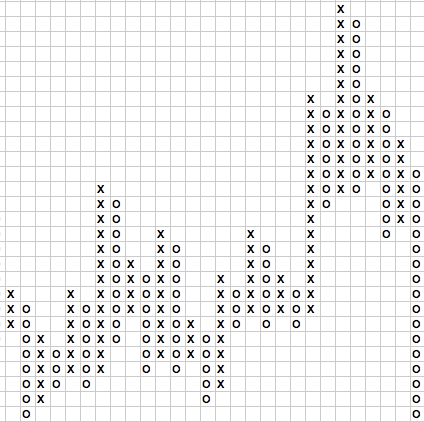
Even though Santelli is supposed to be the ‘Bond Maven’, his commentaries and guests range far afield (including heavy political overtones).  On January 27, Rick’s guest was technician, Tom DeMark.  Chartist DeMark is well-known and a consultant to many high-powered institutional investors and he has had some good calls in his long career.  Having said this, his methods are extremely complex and require many things to fall into place before he makes a call (not always correct).  The reason Santelli had him on was that DeMark recently published a negative piece comparing the chart formation of 1929 to that of 2013.  You see where Santelli is going with this.  The market is down 5% or 6% after a great run and, all of a sudden, we are looking down the barrel at a 40% correction.  This is scary stuff.  Get ready to hit the exits!  Then again, maybe it is just ‘fair and balanced’.  But, wait a minute, Santelli is always negative. (DeMark clip)

800px-Panic_button

The Old Timer

Art Cashin epitomizes the class guys who used to populate the floor of the non-automated New York Stock Exchange.  Although Art has been a cautionary voice for the past few years, he usually is a moderate voice and a voice of market wisdom and experience.

It was very disappointing to me when, at the height of Monday’s (2/3/2014) sell off, Art decided to compare the recent ‘flight to safety’ demonstrated by the strong upward move in the 10-year U.S. Treasury Note to the moves we saw in 2008/2009.  That he made this analogy was bothersome, and that he did while the market was under severe selling pressure was even more disconcerting.  Methinks he’s been hanging with the CNBC crowd too long.

Art’s concern was that rates were supposed to go up after the Fed began its taper of Quantitative Easing.  Instead, they were going down.  Ergo, something really bad was happening under the surface.  What Art seems to have forgotten or may not know, is that QE, even at its height, was just a small part of the daily trading in long-dated treasuries; and, oh by the way, they are still buying $65 billion per month (1/2 treasuries, 1/2 AMBS).  We detail this in session–52.  Anyway, Art was overwrought.  He cautioned if we broke 2.6% on the 10-year it might signal real problems ahead. We did break to 2.58% later that day and closed today (2/5/2014) 2.67%.  It is the safety trade Art, not Armageddon!

I still believe that most investors are not, nor have they been euphoric, that they have one foot out the door and one finger on the panic button. This is a constructive psychological backdrop for the market.

What do you think?

The information presented in kortsessions.com represents my own opinions and does not contain recommendations for any particular investment or securities.  I may,  from time to time, mention certain securities for illustrative purpose, names where I personally hold positions.  These are not meant to be construed as recommendations to BUY or SELL.  All investments and strategies should be undertaken only after careful consideration of suitability based on the risks, tolerance for risk and personal financial situation.