Categories
Financial, Stock Investment

Flight to Safety: “All that glitters is not gold!” — William Shakespeare

A Retraction

Before getting into the meat of this post covering the last ten years of ‘Flights to Safety’ and gold as a flight-to-safety asset, I need to take back all the nice things I said about Barron’s last week because they went back to the dark side this week (“The Dow Celebrates Five Weeks of Futility” and “The Trade War Takes an Ominous New Turn”). It is obvious to me that Randall Forsyth’s title “Trade War Takes an Ominous New Turn” is specifically designed to get your attention in a negative way (OMINOUS … if it bleeds, it leads). It insinuates that the possibility of an economic slowdown, maybe even a recession, is being enhanced without a mention of the fact that recessions are normal and could be expected after the prolonged recovery we’ve seen in the past ten years.

  • “Whatever the factors at work, the U.S. economy is slowing. The Atlanta Federal Reserve Bank’s GDPNow model estimates the economy is growing at a 1.3% annual rate in the current quarter, down from the 3.2% initial estimate for the first quarter, which was flattered by an array of idiosyncratic factors. The Weekly Leading Index of the Economic Cycle Research Institute has also effectively slowed to a stall.”

BTW, this type of article has been a hallmark of Forsyth’s commentary for as long as I have been posting (6+ years) … (“What planet does Randall Forsyth come from?” February 3, 2014 ).

Then there was Ben Levisohn’s contribution on the Dow celebrating 5 weeks of futility where he points to more ominous signs of a weakening economy … “the price of copper–seen as a proxy for manufacturing activity–has slumped 8.9% during the past four weeks, its worst drop since July 2018.” Also cited was the 7.7% drop in the price of crude oil last week. In my opinion this continues to be more a sign of oversupply in the case of both commodities than weakening demand (a harbinger of weaker economic times).

“And then there’s the U.S. Treasury market. Despite the talk of China dumping its holdings of U.S. government debt, investors were scooping up Treasuries as if they couldn’t get enough—another sign of a potential slowdown. Prices jumped, while yields on 10-year notes finished the week at 2.327%, barely off their lowest level since 2017. As if that weren’t bad enough, 10-year yields finished the week below three-month yields, creating yet another yield-curve inversion.” (Ben Levisohn) My take on this is that the run to the ten-year Treasury had much less to do with presaging a recession and more to do, again, with fear and a flight to safety. 

Flights to safety have been a feature of this secular bull market

This is a very good indication that the ‘wall of worry’ remains intact, and that extreme negativity about stocks rules the day.  Negative sentiment is a resounding positive for the long-term health of our market. May I remind you of all the iterations of fear that spiked bond prices emanating from fear of the Eurozone imploding as a result of Brexit or the economic travails of the PIGS (Portugal, Italy, Greece and Spain). When the PIGS squealed our equity markets would routinely take a header while scared investors would run to the safety of the 10-year US Treasury. The same thing happened with the taper of Quantitative Easing, the normalization of the Fed funds rate and the withdrawal of QE. Remember past government shutdowns and the sequester … the same thing happened. It happened recently in November of 2018. The ten-year yield peaked at 3.24% on aggressive Fed speak about raising interest rates. It immediately reversed on fears this would cause recession. The subsequent flight to safety brought the yield down to 2.56%. The most recent trade war rhetoric took that yield all the way down to 2.31%, almost a full point below the November 2018 high. For those worried about the most recent yield inversion as a signal of bad things to come I would suggest it is much more about fear and an emotional flight to safety.

Gold is considered a flight-to-safety asset

It also has been considered and hyped by some as a good safe haven asset that should be a part of every portfolio. As a flight-to-safety asset, investors still buy it. Gold jumped about 1% on the news of renewed trade hostilities between the US and China. As to its value as a good safe haven asset that should be held in long-term portfolios, I strongly disagree. I also would say those media outlets that run advertising soliciting their viewers and listeners to buy gold for its strong investment characteristics are doing a grave disservice.

A little history might be might be helpful in making my case. During my career gold hit its first peak in 1980 at $843 per ounce (it had been pegged at $35 per ounce until 1970) with the next peak coming in 2011 at $1896 per ounce, up 224% in 31 years. During that same period the S&P 500 went from 140 to 1364, up 974%. Today gold is $1284 per ounce and the S&P 500 stands at 2826 … gold up 152% from 1980, the S&P up 2019% (over a 39 year period). Gold has not been a good deal recently nor has it been a good deal over the very long term. At the very best gold has been a trade for very sophisticated investors.

The Wharton School’s Professor Jeremy Siegel did a study on gold prices from the earliest days of our republic (1802 to 2012). A dollar invested in gold from 1802 through 2012 would have been worth $4.52 (adjusted for inflation) in 2012. The same dollar invested in stocks would have been worth $704,999.00. 

So, despite the siren calls of what appear to be totally uninformed or willfully misrepresenting segments of the of media (talking heads or pundits) gold is a trade at best. It definitely does not glitter as a long-term investment vehicle. The Bard of Stratford-upon-Avon had it right.

What’s your take?

P.S. I am not certain why the SEC, CFTC and SIFMA do not clamp regulations on what appears to be very misleading advertising on the part of those in the gold-as-an-intvestment trade. It is definitely needed.

The information presented in kortsessions.com represents my own opinions and does not contain recommendations for any particular investment or securities.  I may, from time to time, mention certain securities for illustrative purpose, names where I personally hold positions.  These are not meant to be construed as recommendations to BUY or SELL.  All investments and strategies should be undertaken only after careful consideration of suitability based on the risks, tolerance for risk and personal financial situation. 


Categories
Financial, Stock Investment

“The Trade War Will Make Stocks Scary. 5 Reasons Not To Panic.” Barron’s

Giving Credit Where Credit Is Due

I spend a lot of time on this blog bashing the media for fear-mongering, pandering to mankind’s propensity to run its mind to the dark side. You know … if it bleeds it leads. The tendency for them is to inundate us with stories, lacking in perspective, that lead us to make rash, unprofitable investment decisions. This week’s cover story in Barron’s Magazine (“The Trade War … 5  reasons Not To Panic.”) is exemplary of the good that the media can do by giving the public a thoughtful examination of the facts and perspective. It deserves your consideration. 

My last post, ‘The only reason to keep the stock market open is to see how foolish people can be,’ was a more cursory attempt to calm people down. Barron’s work on this topic is a significantly deeper dive. Good job Barron’s.

Caveat Emptor

I hate to talk individual stocks in kortsessions.com. We’re a counter to media malpractice. Sometime it is hard not to get into individual names, especially for purpose of illustration (an illustration of irrational pessimism). As such, I point out a Chinese equity that I own and that is mentioned in the article, Ali Baba (BABA–stock information)

After reporting a stellar quarter last week, the stock has been pummeled on trade war news. Other than it being a Chinese company I’m have trouble understanding how their marketplaces and secular growth opportunities are affected by the the current (US Chinese) trade spat. Divya Mathur, quoted below seems to share my belief.

“Divya Mathur, co-manager of global emerging markets strategy at asset manager Martin Currie, is looking to add to those with strong franchises unaffected by trade or that are able to raise prices to offset tariffs. Alibaba Group Holding (BABA) and Tencent Holdings (700.Hong Kong), two stocks widely held by U.S. investors, could face near-term pressure as investors shed China-related stocks. But Mathur would use pullbacks to add to the companies, citing their long-term growth prospects, as they capitalize on the millions who use their platforms and reap benefits of investments they are currently making in emerging technologies.”  Barron’s 5/18/19

Bottom Lines

Barron’s deserves credit as trade is an important market concern these days. This too will pass. Stay the course.

The information presented in kortsessions.com represents my own opinions and does not contain recommendations for any particular investment or securities.  I may, from time to time, mention certain securities for illustrative purpose, names where I personally hold positions.  These are not meant to be construed as recommendations to BUY or SELL.  All investments and strategies should be undertaken only after careful consideration of suitability based on the risks, tolerance for risk and personal financial situation. 


Categories
Financial, Stock Investment

‘The only reason to keep the stock market open is to see how foolish people can be.’ anon.

Actually, I think this is a Warren Buffett quote but I could not document it. Buffett believes that when you buy something you should be willing to hold it even if the market were to be closed for the next ten years. He subscribes to the idea that day-to-day fluctuation in prices are based on noise and not a considered evaluation of long-term fundamentals.

That was the week that was

It was a perfect example of foolish people, or foolish computer antics, as the market gyrated wildly on presidential tweets about trade negotiations. Last Sunday it was the tweet threatening a more-than-doubling of tariffs and new tariffs on Chinese goods, followed during the week by the president’s statements accusing China of reneging on the deal. The president then went on with a tweet stating that there was “no hurry” getting back to the table (a tweet he subsequently pulled down).

The market responded with a week of volatility, 500 point swings  in the Dow Jones Industrial Average. The S&P 500 closed the week down 2.5% from its May 1, all-time-high of 2954. According to Barron’s magazine and its “Up and Down Wall Street” column, “Global stock markets shed an estimated $2 trillion in value from Monday through Thursday, or about 3%, based on the Datastream World index from Refinitiv, The Wall Street Journal reported. Those losses came ahead of the Trump administration’s threatened hike in tariffs to 25% from 10% on $200 billion in goods from China, which took effect a minute after midnight on Friday on the East Coast.”

Friday saw a return to some sanity as the as Chinese, Vice Premier Liu headed back to China with both sides agreeing to continue talking. Both the Dow and the S&P closed higher on he day but still down on the week.

Are our trade issues with China a tempest in a teapot?

What’s the worst case?

A little perspective may be helpful at this point. Our total trade/ exports into China in 2018 was $189 billion [manufactured goods($120 Billion), ag products (10 billion) and services ($59 billion)]. This represents less than 1% of of estimated 2019 US GDP. Total US employment involved in this market is estimated at 911,000 full-time employees.This represents 7/10 of one percent of the 128,000,000 Americans that had full-time employment in 2018.

Our total imports (including services) from China equals $562.8 billion or about 4% of their $14 to $15 trillion GDP.

Worst Case: this trade (balanced or not) all goes away for both countries and trade war morphs into real war … very unlikely. You have to ask before the hot war begins, who’s the biggest loser here? It is not the Chinese. It’s US consumers who will have to pay ever increasing prices (as the tariffs are passed thru) for those Chinese sourced goods they are buying at Walmart, Target and Costco. Effectively the tariffs are a tax increases on US citizens, not China.

Meanwhile, like US farmers, those other sectors of the the economy hurt by the tariffs may be thrown bailout bones (maybe) … another cost borne by US taxpayers.

Worst case — although there were times last week that the market acted like this scenario was imminent (people were throwing away stocks), it is not.

Likely Case

An accord will be reach. Why? It is obvious that it is in China’s best interest; and, In the final analysis our president, a man facing many non-governmental problems, really wants another four years in the White House. He needs to be able to point to a vibrant economy as evidenced in part by a strong stock market. Of course, a real or proclaimed victory on the trade front would be a desirable feather in his cap.

So, don’t be one of those foolish people …

Who panicked at the mere mention of tariffs and don’t be foolish like bond king, Jeffrey Gundlach, who again has called the end of the bull market. Market predicting is a very difficult game. This is something he has done several times in the past few years. Each time he has come a cropper. The link below is from last Tuesday, just as the tariff scare was beginning to bloom.

Jeffrey Gundlach
The Bond King

“Jeffrey Gundlach says stocks are in a bear market …”

What a great time to make this call … throwing a little gasoline on the fire … scaring people … helping to fulfill his own prophecy. He did the same thing just before the 2018 Christmas Eve Massacre … “Jeffrey Gundlach — S&P 500 headed to new lows.” Why does CNBC keep featuring this guy? I think we all know the answer …if it bleeds, it leads. On a more cynical note, Gundlach may have been short equities before he made the call. Of course, he should have been. He runs a large hedge fund.

My continued recommendation — Stay the course.

Your take?

The information presented in kortsessions.com represents my own opinions and does not contain recommendations for any particular investment or securities.  I may, from time to time, mention certain securities for illustrative purpose, names where I personally hold positions.  These are not meant to be construed as recommendations to BUY or SELL.  All investments and strategies should be undertaken only after careful consideration of suitability based on the risks, tolerance for risk and personal financial situation. 


Categories
Financial, Stock Investment

A ‘Bad Trip’ Down Memory Lane

LSD 2D & 3D

The ‘bad trip’ I’m alluding to in my title was the type some substance experimenters used to get from self-administered  hallucinogenic drugs like LSD (Lysergic Acid Diethylamide). This was the preferred trip-inducing substance of Harvard psychology professor Dr. Timothy Leary who thought it might have great potential in psychotherapy.  “He used LSD himself and developed a philosophy of mind expansion and personal truth through LSD”. As such, he became an icon of the hippie counterculture of the 1960’s along with his catchphrase, “turn on, tune in, drop out.” Anyone ingesting LSD was said to be going on a trip. I guess for the most part these trips were pleasurable, mind-expanding voyages. But sometimes they went bad and became terrifying horrible experiences.

Last week was flashback to a bad trip (in the market) I took in the summer of 1974

Richard Nixon circa 1968

Only I was not on drugs. January, 1973, the S&P 500 peaked at 119.87. Twenty-one months later (Oct., ’74) it bottomed at 62.28, down 48%. It was a slow, awful bleed. By the time we got to the summer of 1974 you could not give common stocks away, let alone sell them to people. It was even a struggle to get people to buy electric utility stocks yielding 10%, 11%, 12% because their debt laden balance sheets were so terrible. This was a major problem because, unlike today with the 10-yr US Treasury note yielding 2.9%, back then that note was yielding nearly 8% (on its way to 15% in 1982). Consumer price index inflation was 11.01% in 1974 (on its way to 13.5% in 1980).

Richard Nixon had just resigned in disgrace in the wake of the Watergate break-in and coverup. And after trading between $2.50 and $3.00 barrel for the previous 32 years the price of crude oil spiked as a result of the 1973 Arab Oil Embargo. In 1974 crude averaged $12.52 per barrel. I humbly submit things were a mess. It was THE BOTTOM, born in fear and total distrust of the market. It was the bottom, even though interest rates would almost double over the next seven years and inflation would continue to rip. Keep this in mind the next time you hear a pundit or read an article about the scourge of higher rates and inflation. Also, history would indicate, in the stock market ‘bad trips’ always turn into ‘good trips’ eventually.

What about our current ‘bad trip?’

Yikes!

It reminds me of that time long ago. Like the summer of ’74 we have a president under extreme duress. In the summer of ’74, sitting at our desks in the main office of K.C. based H. O. Peet & Co., Inc., colleagues across aisle and I would comment on how cheap certain stocks had gotten only to come in the next day, or the next week, as the market probed for a bottom to see those names even lower.  Cheap doesn’t make any difference when emotions take over. Don’t confuse me with the facts. Nobody wanted to own stocks.This is eerily similar (to a much smaller extent) to what we are seeing in today’s market. There is no panic. It just goes down every day. The end of last week felt very similar. Even the 2%+ drop in the Dow and S&P seemed calm and orderly. Regardless, it scares people even though there is nothing in the current fundamentals remotely as frightening as those we saw in the summer of 1974.

The pain, however, is real. It has been most prevalent in small cap stocks as evidenced by a 19% drop in the Russell 2000 index since September 1st. Though the S&P 500 is down 10% since September, there are many stocks in the index down over 20%.

 So, what is scaring the market? (perspective in order here)

  • Growth concerns: US growth will slow. It should. A significant part of the growth in corporate earnings this year came as a one-time benefit from the tax cut. There will be NO additional tax cut in 2019
  • Global Growth Concerns: China, OMG! Chinese November retail sales miss estimates by 2/10ths percent coming in at 8.6%. Chinese GDP grew at 6.5% 3Q ’18 over 3Q’17. 6.6% was the so-called consensus. Another metric, November industrial production came in below expectation at 5.4%, 1/2% below consensus. I mean, give me a break! We are dealing with the 2nd largest economy in the world ($13+ Trillion vs. the US near $20 Trillion in 2018). Despite the sackcloth and ashes (see link above) donned by the prognosticators these are not bad numbers considering the size of this economy. Oh yeah, it’s the Trade War.
  • Worry about Fed policy and rates . Fed says we are almost there. According to the Wall Street Journal ... “Still, many investors say that, even with the possibility of a more gradual rate path, they remain cautious heading into 2019. The yield curve, the gap between two- and 10-year Treasury yields, has continued to flatten in the fourth quarter. Historically, that has signaled trouble ahead for the U.S. economy.” (you need a subscription to access). I would advise anyone in this quandary to reread paragraphs two and three of this post.
  • Political uncertainty: Regardless of the outcome of Mueller investigation we will have a divided government, remember gridlock is good. They can’t do anything to hurt us!
  • Government Shutdown. this too will pass if it happens at all.
  • Falling oil prices. It is not about demand. Demand is growing. It is about supplies which look like they are being reeled in by Saudi Arabia and Russia. falling oil prices, while they last, are a good thing.

Turning a ‘bad trip’ into a good one (maybe)

I seldom make recommendations in Kort Sessions (not my mission), but sometimes I see a ‘fat pitch’ I just can’t resist. The trigger for this recommendation came from this week’s edition of Barron’s and an article covering their “Top 10 stock picks for 2019.” One of the top 10 is Energy Transfer Partners (ET).(you need a subscription to view). The Barron’s article talks about the group, which has been very much out of favor for several years: “Master limited partnerships in the U.S. have been getting their act together by setting sustainable distributions (equivalent to dividends) rather than maximizing them, and by ending investor-unfriendly structures that hurt MLP holders and made institutions reluctant to buy.”  I completely concur with the premise of the article. The way I have chosen to participate is through a closed-end, leveraged fund that invests in the MLP sector, the Tortoise MLP fund fund (NTG-$12.77-NYSE). The fund sponsor/manager is Tortoise Capital Advisors. Oh yes ET is NTG’s largest holding.

Caveat Emptor. I own this fund and view it as a long-term income alternative. My most recent purchase was at $13.75. From time to time I may trade around this position, buy more or lighten up as the position moves up or down in the market. I will not be publishing on any of my buys or sells.  Also, as we’ve seen over the past couple of weeks, this stock and may get cheaper. Consider your temperament and suitability for this investment … investigate before you invest.

Thank you for your readership. I hope my ‘bad trip’ will give some perspective and comfort in what has been a pretty difficult market.

bk

The information presented in kortsessions.com represents my own opinions and does not contain recommendations for any particular investment or securities.  I may, from time to time, mention certain securities for illustrative purpose, names where I personally hold positions.  These are not meant to be construed as recommendations to BUY or SELL.  All investments and strategies should be undertaken only after careful consideration of suitability based on the risks, tolerance for risk and personal financial situation. 


Categories
Financial, Stock Investment

The beginning of the end

sir winston Churchill

Or, is it the end of the beginning? Or, is it, as stated in the eloquent and somewhat humorous words of Sir Winston Churchill, ” … not the end. This is not even the beginning the end. But is perhaps the end of the beginning.” This line was delivered to the attendees at the Lord Mayor’s luncheon, November 10, 1942. It actually drew a chuckle from the assembled mass celebrating the installation of the ceremonial Lord Mayor of London. It was a time of of better spirits and hope for Great Britain as she had just been victorious over the Germans in the Second Battle of El Alamein. My title does not evoke hope and is reflective of almost 10 years of negative press given to a secular bull market that has never gotten any respect. Do not despair. This article will have a positive conclusion … I think.

Negative press persists and swells as our recent correction has taken hold

,Enter the commentary of former-perma David Rosenberg who got it right (maybe) in 2008, mainly because he turned negative on the market in 2004 … a stopped clock is at least right twice a day. Now when Rosenberg turned negative the S&P 500 was trading around 1132. In the next 3 years it rallied to a high of 1550 before collapsing to 666 in March 2009. The problem is that he was still negative saying we were in a depression in August of 2010 after the market had regained most of the loss (S&P -1087, down only 45 points from the 2004 warning). He was still negative in 2012 when he posted this commentary about Quantitative Easing (QE) and how it was not going to work (S&P 500 at 1422, 12/1/2012). By October, 2013, Rosenberg had had an epiphany, shifting from a long-held investment strategy of Safety and Income at a Reasonable Price (SIRP–A strategy for a deflationary environment) to HIRP (Hedge Inflation Protect Risk – a strategy for what Rosenberg perceived to be a burgeoning inflationary environment).  With this seismic investment shift Rosenberg jumped on the theme that rates would rise as result of predicted inflation and wholeheartedly recommended bank stocks, many of which had already doubled off their 2009 lows. Also, by then the S&P 500 was making new all-time highs (10/1/13–1720). My question is why does Mr. Rosenberg, with his shoddy track record, consistently get call-backs from the media soliciting what looks to be his very questionable advice. The only thing I can come up with is that bad news sells. It’s more engaging than good news.

Rosenberg’s latest pronouncement on CNBC is “This ‘elephant in the room’could slam stocks … ” Does this get your attention? if you are the least bit concerned about your investments and the market it just might. Rosenberg worries that the unwinding of Quantitative Easing (QE), the Fed selling off the huge bond and mortgage-backed portfolio it acquired to facilitate QE would cause rates to jump. He argues that the Fed may not have to do anything with the Fed funds rate. Shrinking the Fed balance sheet (sucking liquidity out of the system) will have the same effect without having to telegraph rate increases after each FOMC meeting. Remember, he said QE would not work. I’m not sure if it did or not but it seems we are in a much better place today than we were in the dark days of the financial crisis when the program was initiated. Likewise, my bet is that Rosenberg will be just as wrong on the draw down of QE.

The main point of all of the above is to say that it does not look like we have put in a major secular bull market top from the point of view of sentiment or the fundamentals. Investors are skittish, willing to sell on the hint of higher rates or slower economic growth. There has never been anything close to “irrational exuberance” during this entire protracted advance. If this bull dies from skepticism (versus Euphoria) it will be a first. On the fundamentals one of my favorite reads, Fear and Greed Trader, asserts in his most recent post, “History has shown that major bear markets result from 1) recessions, 2) commodity spikes, 3) aggressive Fed tightening, 4) extreme valuations, and 5) excess that eventually needs to be worked off.” Just can’t get to any of F&G’s 5 reasons from here.  As a counterpoint to my assessment and the assessment of the Fear and Greed Trader the vast majority of so-called experts, like Mr. Rosenberg would disagree with much of what I have laid out in this paragraph and they have been wrong for the past 10 years.

Meanwhile, stocks continue to levitate off their recent lows

The Dow Jones Industrials were up another 288 points today (on top of an anticipatory 200+ point move Friday) on the not-so-surprising news from the President that he had struck another amazing trade deal (verbal) at this weekend’s G-20 meeting … very sparse on details, but a trade war with China now appears off the table for at least 90 days ,,, the market breaths a sigh of relief. Why all of this was not-so-surprising … the President had a bad news week going into the G-20 and needed a pick-me-up. Hopefully this does mark the end of trade hostilities between the US and China.

In the final analysis much of the above is just noise. It is important to just be there, invested in equities in a percentage of your portfolio that is suitable and comfortable to your circumstance. So, is this the end or the beginning of the end or the end of the beginning? Forget about these questions. Trading is hard. Just be there!

John Pierpont Morgan founder of the feast

According to a study prepared by JP Morgan if you had been fully invested in the S&P 500 during the 20 year period between January 2, 1996 and December 31 2015, your rate of return would have been 8.18%. If you had missed the 10 best up days in that period, your rate of return would have dropped to 4.49%. Here’s the kicker, 6 of the 10 best days came within two weeks of the 10 worst days (days that you may have been scared out or traded out of the market)!

What do think?

P.S. Tuesday 12/4/2018 … The DJIA was down 799 points (3.1% ) with the S&P 500 and NASDAQ down 3.24% and 3.8% respectively. Yes, economic growth should slow in 2019 after the tax-cut induced surge of 2018. Yes, rates will probably increase somewhat (interestingly the yield on the 10-year Treasury has dropped about 10% since 11/8/18 peak of 3.24%). The operative fact here is that fear of sharply rising rates, the prime mover to begin this correction, has turned out to be misplaced. Yes, the 2 and 5-year Treasury yield curve inverted, something that has been seen before in strong economic environments (not presaging recession). Yes, after boasting of negotiating a great trade deal the President warned if progress was not made the deal would be off. None of this is new news! A year ago at this time the pundits were complaining about a lack of volatility … be careful what you wish for. 

The information presented in kortsessions.com represents my own opinions and does not contain recommendations for any particular investment or securities.  I may, from time to time, mention certain securities for illustrative purpose, names where I personally hold positions.  These are not meant to be construed as recommendations to BUY or SELL.  All investments and strategies should be undertaken only after careful consideration of suitability based on the risks, tolerance for risk and personal financial situation. 


Categories
Financial, Stock Investment

“These are the times that try men’s souls”

Thomas Paine

Thank you Thomas Paine and CNBC contributors Fred Imbert and Ryan Browne for the title and inspiration for this post. Paine’s pamphlet “The American Crisis” penned during the Revolutionary War, did indeed reflect dire times in our history. Meanwhile, CNBC’s post-market post (Dow drops 200 points on worries about global economic growth–11/9/18) reflected on  potential dire times in the midst of economic prosperity.

Key Points of the CNBC Post

  • “West Texas Intermediate futures fell 0.8 percent to $60.19 a barrel, after briefly breaking below $60 for the first time since March. They also fell further into bear-market territory, trading more than 20 percent below their 52-week high.”

Oil prices have increasingly become the focus of the pundits, as the price weakness might signal a weakening of global economies. Oil prices for many have become a ‘canary in the coal mine’. Any weakness in oil and they are willing to throw in the towel and predict a global economic retrenchment  The problem is that they are never willing to look at oversupply as the culprit (U.S. Oil Production Is Set To Soar Past 12 Million Bpd). The focus always moves to “global slowdown.”  Yet forecasts remain, although tempered by trade concerns, for oil demand growth.

“The IEA cut its estimate for global oil-demand growth for both 2018 and 2019 by about 110,000 barrels a day to 1.3 million and 1.4 million barrels a day respectively. The revision also reflected changes in the way the agency assesses Chinese consumption. Both global demand and supply are close to hitting 100 million barrels a day for the first time.” (source, Bloomberg, International Energy Agency)

We saw the market go into a tailspin in late 2015 and early 2016 for exactly the same reason. I wrote in March of 2016:

  • Oil prices — On its way to $20 (or lower) a month ago, West Texas Intermediate (WTI) closed this week just a smidgen under $40 per barrel. It was going to $20 because of two misconceptions: 1) world demand was down (especially China) and 2) supplies were growing. Ex. the new oil coming onto the market from Iran. Both appear wrong. World demand was up last year and it is estimated to be up in 2016. In fact, lower prices may have stimulated demand. According to the American Petroleum Institute (API), “Total petroleum deliveries, a measure of consumer demand, rose 2% in February from a year ago levels, to 19.8 million barrels per day. These were the highest deliveries in eight years. Total motor gasoline deliveries rose 5.2% from February 2015 to 9.1 million barrels per day and were the highest deliveries for that month on record.”  In this clip Chevron CEO, John Watson, discusses the reasoning behind his expectation that production will be dropping in the face of this increasing demand. Many have laid market weakness at the feet of falling oil and commodity prices, which they equate to weak demand and recessionary pressures. It continues to look to me like oversupply, which in the oil patch, may be in the process of righting itself. Of course, the bear case: this a flash in  the pan. (“After you get what you want, you don’t want it”)

Then There’s China

  • “The weak Chinese economic data come as the U.S. and China engage in a trade spat that has been going on for most of the year. The two countries have slapped tariffs on billions of dollars worth of each other’s goods as the U.S. seeks a better trade deal with China.”

Ex, the trade issues this is another “…Deja vu all over again” moment from two years ago. It is likely this, too, will be settled with really little change in the two country’s trade positions … just enough so the president can proclaim victory.

Yogi Berra, Mr. Deja vu

Then there is Fed policy

  • “These sharp losses (in the markets) have rekindled worries about a possible slowdown in the global economy, which come as the Federal Reserve looks to further tighten monetary policy. The Fed on Thursday decided to leave its benchmark interest rate unchanged, as was expected, but comments by the U.S. central bank suggested it was on course to continue hiking rates.”

Two years ago the Fed had just begun the process of normalizing interest rates with a quarter point increase in the fed funds rate. (0.0 to .25% to .25 to .5%). For many this was to be the end of the world … didn’t happen.

December 31, 2016 the S&P 500 closed at 1940. Friday, November 8, 2018 the S&P 500 closed at 2781, up 43% in less than two years. The 2015/2016 correction was the last real correction that the market has experienced since the end of its recent run-up. The current market would appear to be correcting this run … not beginning a protracted bear phase.

Ergo, these should not be the times that try your soul, unless, of course, you are paying attention to the media.

What’s your opinion?

The information presented in kortsessions.com represents my own opinions and does not contain recommendations for any particular investment or securities.  I may, from time to time, mention certain securities for illustrative purpose, names where I personally hold positions.  These are not meant to be construed as recommendations to BUY or SELL.  All investments and strategies should be undertaken only after careful consideration of suitability based on the risks, tolerance for risk and personal financial situation. 


Categories
Financial, Stock Investment

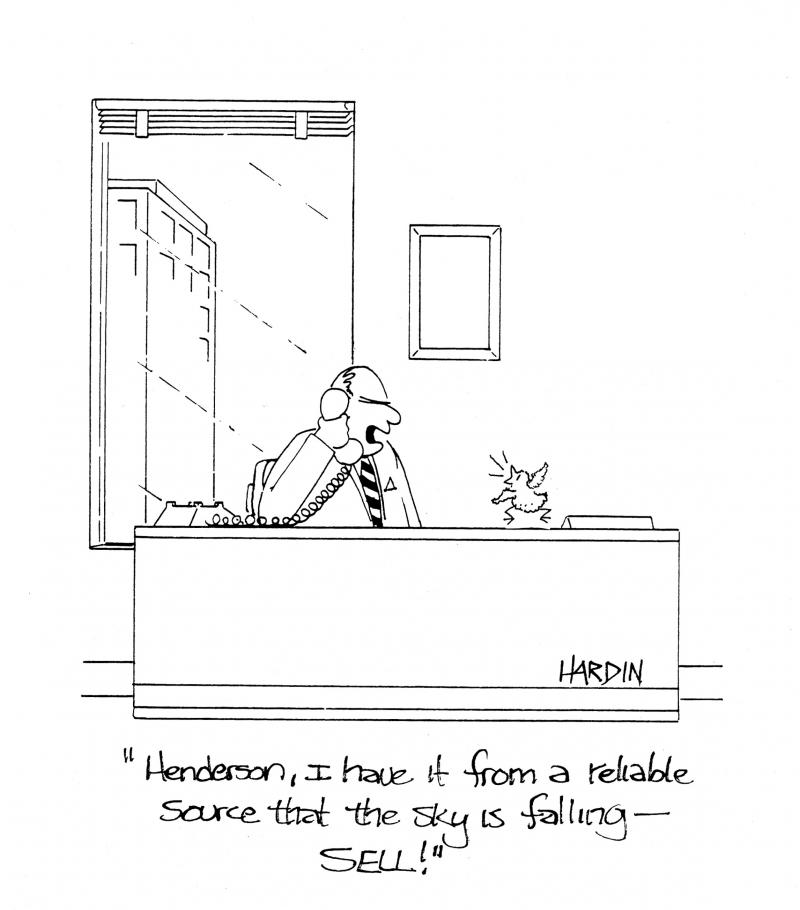
” … , I have it from a reliable source that the sky is falling — SELL!”

A visit with and impeccable source.
A visit with an impeccable source.

Of course, Henderson, the broker at the other end of the line, unaware of the severe consequences of passing inside information, passed this invective from Chicken Little along to ten of his best clients. Before you know it, you have real panic going. Last week’s best frightful and misleading commentary comes to us from the mainstream media … CBS Sunday Morning.

images-58

It was a report, anchored by Martha Teichner, covering the good news and bad news in falling crude oil prices. The beginning 30 seconds had to do with all the happy motorists (all of us) who are saving a bundle at the pump ($150 billion in 2015), the balance (about 5 minutes) had to do with hard times in the oil patch, in particular, Midland, Texas.

Now, I am sympathetic to all of those who have lost their jobs in that industry over the past tw0 years (according to the report, some 275,000). However the oil and gas industry has been a boom/bust industry through all of recorded history. Importantly, the main subject of this report admitted he’d been through four of these cycles in his career. Having said this, when things are good in the oil business, they are very, very good. The gentleman interviewed was an oilfield consultant. During the boom, he was making $1700 to $1800 a week. He is now unemployed. There are obviously many like him.

The flip side of this story is the vast majority of Americans who make nowhere near $1700 per week, people who have suffered for years with high oil prices. The negative story on the oil man reinforces the constant negative media drumbeat of decline and economic stagnation, while the majority of Americans are seeing a real benefit.

Teichner pointed out the causes: US production doubling since 2008 (the shale revolution), Saudi over production to retain market share and, get this, CHINA! Yup, she said Chinese demand had decreased. Not only does she blame China, but she insinuates that demand has declined around the globe (indicating a global economic slowdown) before zeroing in on China. This is incorrect. According to oil industry source, Platts Report, Chinese oil demand (and worldwide demand for oil) continues to grow at a healthy pace…more media malpractice. This  scares Henderson’s clients. It primes them for hitting the exits.

One More Time On The Bullish Virtues Of  Thirty-Dollar Crude

(You are excused if you are on the same page with me. If not read on)

“If oil prices stay between $75 and $95 a barrel, we would see the kind of stimulus package that the Federal Reserve or Congress could never do,” said Douglas R. Oberhelman, the chief executive of Caterpillar, the multinational maker of heavy construction equipment. This quote comes from a NYTimes article dated, November 14, 2014. Obviously, the price on WTI closed Friday 2/5/16 at $31. The stimulus we are now looking at is much larger. This piece from The Hill, dated October 2014, “Lower gas prices will save us all,” posits that every penny off a gallon of gas would equal a $1.4 billion benefit to the economy if maintained over a year. With regular, lead-free gasoline at less than $1.50 per gallon in my market, we are talking about a $2.00 difference vs. two years ago. According to the formula, if held, it would be a $280 billion stimulus. And that’s just in the US. Yet, all is gloom and doom in the media … not one mention of the OIL STIMULUS.

I do hear the critique to this argument: ‘why hasn’t it kicked in?’ That was the same critique the stimulus of 2009 was given. It will, as people begin to accept that this is not a flash in the pan. In the meantime, we will get these runs of panicky selling as the market tries to make a bottom and certain people, Henderson’s clients, hit the exits.

What is your take?

The information presented in kortsessions.com represents my own opinions and does not contain recommendations for any particular investment or securities.  I may, from time to time, mention certain securities for illustrative purpose, names where I personally hold positions.  These are not meant to be construed as recommendations to BUY or SELL.  All investments and strategies should be undertaken only after careful consideration of suitability based on the risks, tolerance for risk and personal financial situation. 


Categories
Financial, Stock Investment

Janet, you’ve really stepped in it this time!

King Rant Rick Santelli
Bond Maven?
Rick Santelli

That was the word from a trio of experts (?) Friday on CNBC’s Closing Bell. The ‘three wise men’ were: Guy Adami trader, Art Cashin, Manager of Floor Operations for UBS and CNBC bond maven, Rick Santelli. To a man, they were blaming the current market swoon on the Fed’s move to raise the the Fed Funds rate one quarter point. This is absolutely ridiculous in light of the fact that the markets seem to be marching in lock-step to the decline in the price of crude oil, a decline that not based on a recessionary drop in world-wide demand, but rather on a Saudi, supply-induced glut … a glut that benefits everyone but the producers. But, I digress.

Back to Janet and the Fed stepping in it

Janet, oops!
Janet, oops!

What a quarter point increase in the Fed Fund rate (equating to a quarter point increase in the prime rate) has to do with the most recent decline is baffling. It adds only a tiny amount to borrowing cost. Even if thy raised it a full point, it would only add $10 to the annual cost of borrowing $1000. This will not stop people or businesses from borrowing. If a business project wouldn’t fly under this type of increase, chances are it would not be economically viable anyway. If you are barrowing $20,000 to buy a new car, it is an extra $200 per year ($17). Again, they only bumped it a quarter point. The consistent fed mantra has been future increases will be data dependent. If things turn down in the economy, future increases will be put on hold.

Meanwhile, because of the abject terror this tiny rate increase has created, a direct result of irresponsible media hype, actual longer-term rates have declined. You know, these are the rates that determine consumer mortgage rates and the long-term, borrowing cost of corporations and the Federal Government. In December, when the Fed Funds rate was increased, the yield on the 10-year treasury jumped to 2.36%. Although the yield jumped, it was still well below the level it attained when it was the tapering of Quantitative Easing that was announced. That was 3.00% in December of 2013. Friday January, 15, 2015, the 10-year closed at 2.0365% (at one point during the day the yield was under 2%) … defying the continual, conventional wisdom that rates would spike, killing the economy. It just has not happened.

Not only did Janet step in it, but December retail sales were awful!

Not a pretty picture

It is unbelievable how the media refuses to give perspective in their reporting of financial data. For example, December retail sales were reported down 0.1%, pretty much as expected. Now the spin was that this was more bad news, a sign of a weakening economy. Of course, nobody bothered to point out that year-over-year (YOY-Dec ’14 vs. Dec. ’15) were up 2.2%. You also did not hear much about the fact that Christmas 2015 (Oct-Nov-Dec) sales were up 1.8% vs 4Q2014. Oh yeah, I forgot to mention the tremendous supply-glut-induced drop in gasoline prices, plus continual declines in consumer electronic prices. In both cases, units were up: but to the benefit of consumers, prices were down more. Here is the government report for your perusal. 

Oh, I forgot, China also got pummeled on Friday.

China-flag-snd.svg

Shanghai was down 3.5%. We have addressed China in numerous kortsession posts. Our view is that China is in a government-mandated economic slowdown and a strategic shift away from being an export driven economy to greater consumer orientation. A transition of this nature is bound to have its pitfalls. I believe China makes it. But, even in a worse case, the blowback to our economy would be relatively small. See the ‘Back to China’ section of the ‘The Market’s Gonna Do what The Market’s Gonna Do’.

The Takeaways

320px-Khau_kaduk_mu_yam_plathu

All of the reporting on and media reaction to Friday’s market melt-down was made in a vacuum, without context or perspective.

  • They failed to mention oil demand was growing and gave the impression that world economic weakness was to blame, more than the Saudi’s flooding the market to punish their enemies and suppress US shale oil production. I saw nothing about the tremendous positive that inures to the rest of the world that consumes oil on a net basis … China being one of those countries.
  • They exaggerated the effect of a tiny increase in rates without pointing out the positive (and unexpected) effect this rate hike has on longer-term rates.
  • They focused attention on one month of negative  retail sales without going into the causes — lower gasoline prices, lower (tech-driven) electronic price. Most importantly, they really failed to state that the Christmas (4th) quarter sales were positive, even in the face of a sharp, YOY decline in gasoline retail store sales (19%).
  • All of the above, pretty unconscionable I think!

But, Janet, you really stepped in it this time! GIMME A BREAK!

What’s your take?

P.S. If we open up in a real panic Tuesday morning, it might be a real indication that the worst of this correction may be in the rear view mirror. The S&P 500 closed Friday (1/19/2016) –1906.9.

The information presented in kortsessions.com represents my own opinions and does not contain recommendations for any particular investment or securities.  I may, from time to time, mention certain securities for illustrative purpose, names where I personally hold positions.  These are not meant to be construed as recommendations to BUY or SELL.  All investments and strategies should be undertaken only after careful consideration of suitability based on the risks, tolerance for risk and personal financial situation. 


Categories
Financial, Stock Investment

Stock Market or Stewpud Markit?

450px-Museum_of_Lincolnshire_Life,_Lincoln,_England_-_DSCF1724

My take: hands down, it is the ‘Stewpud Markit’. I have never, ever seen the expenditure of intellectual energy that has gone into the stupid pursuit of the meaningless questions, ‘when will the Fed begin to raise rates for the first time after an 8 year hiatus and what will be the resultant economic impact?’ It is amazing, especially since the messaging coming out of the Fed has been, ‘whatever we do, whenever we do it, will be low and slow.’ How many times do you have to hear it? There is no question that this will NOT be a tightening or precipitous event. It may even be a complete non-event, very much akin to the much dreaded end of Quantitative Easing (See “The dreadful end of Quantitative Easing” 8/17/2014).

Why is this so difficult for the market to get its arms around?

It seems as hard as the Fed works to beam this message out, loud and clear, the media is working even harder to portray it as a big deal, dangerous occurrence or mistake. The attached clip/argument is typical of the constant carping on the topic. Kudos to Brian Sullivan, CNBC anchor, for being the voice of reason in this mini melee (his message is, ‘Just do it!’). “U.S.Stocks drop sharply as jobs report intensifies Fed rate debate” .. this headline from MarketWatch (9/4/15), exemplifies the angst-building process going on in media land.

My Perspective


After much complaining last year over the lack of volatility in the market and a meaningful correction not having happened in over two years (10% or better), we are finally getting both. Again, it is that old admonition, ‘be careful what you wish for.’ All of a sudden market participants and the media are trying to pin the decline on something more onerous: China imploding or a Fed rate increase throwing us and the world into recession. You can observe this fear in the action of the 10-year US Treasury note. The yield should increase and the price should drop on bullish economic news. That did not happen yesterday.

In the face of another drop in the unemployment rate (to 5.1% from 5.3%), ostensibly good news that might trigger a 1/4 point Fed Fund rate increase in September, the 10-year price/yield remained virtually unchanged (although the yield did jump to 2.16% right after the employment data was released) at 2.1314%. Stocks dropped, yields dropped on a flight to safety. But, again, I ask the question, if you thought rates were heading North with any speed, why would you buy anything with a long-dated maturity? It is just plain stewpud!

The market will figure this out one of these days and come to realize that Pfizer with a 3.57% yield or GE with a 3.83% (for that matter the S&P 500 with a 2% yield) might be pretty good deals versus those treasuries. If rates do increase, those treasuries will drop in market value, only to retrieve their full value at maturity.

Let’s talk China (the other bugaboo)

 Ben Stein The "Bugaboo Buster"
                 Ben Stein The “Bugaboo Buster”

What do actor/economist/social commentator, Ben Stein and the government of the People’s Republic of China have in common? They have both tried to clear the air about China recently. In the case of the Chinese Government, they ordered hundreds of high-polluting factories around Beijing to be closed several weeks ago, so that the massive military parade they staged in Tiananmen Square, Thursday September 3, could be viewed against the backdrop of a crystal-blue sky.

Ben Stein, in a commentary on CBS Sunday Morning (8/30), attempted to clear the air about the potential fallout from a much-feared economic slowdown (collapse to some) in China. Stein made two points: one addressing the economic impact of a slowing China not importing as much from the US as in past years, the other China, under economic duress, being forced to liquidate its $1.23 trillion horde of US Treasury securities.

Point One — In 2014 we exported to China $120 billion in goods and services. This represents .0066% of our nearly $18 trillion GDP. Certainly, we would not want to lose it. The number might be less in future years; but, truly, this is just not a big deal.

Point Two — China owns about 8% of US sovereign debt ($1.23 trillion). At 2.134%, we are one of the most attractive liquid rates available in the world, versus Japan (.364%), Germany (.80%), plus we have a big enough market to handle that type of liquidation, which is probably a very low probability event. We continue to be the best house in a bad neighborhood.

Maybe I’m stewpud, but this seems to be ‘Much Ado About Nothing.’

What’s your take?

The information presented in kortsessions.com represents my own opinions and does not contain recommendations for any particular investment or securities.  I may, from time to time, mention certain securities for illustrative purpose, names where I personally hold positions.  These are not meant to be construed as recommendations to BUY or SELL.  All investments and strategies should be undertaken only after careful consideration of suitability based on the risks, tolerance for risk and personal financial situation. 


Categories
Financial, Stock Investment

Back up the hearse … Cue the mourners … This market’s toast

China-flag-snd.svg-2

When you have the world’s second largest economy ($10.36 trillion GDP) growing at 12% per annum, you are going to have a significant upward tug on commodity prices. It did, and it was China and this was happening in 2006 /2007. In 2009, that all changed as the Chinese government began a concerted effort to ratchet that growth down (as opposed to letting it bubble over) to a still-enviable, but much-less-daunting 7%… no more massive cities constructed on the basis of ‘if you build it, they will come’ coupled with a substantial reduction in spending on new infrastructure. The game changed dramatically, but many in the media and punditry corps, failed to pick up on the implication for commodity prices and demand for those things used to obtain those commodities (a la Caterpillar Tractors). The world was moving into what appears to be a secular bear market for commodities, a bad thing if you own or figure in some way in producing them, a great thing if you use them to manufacture your products or fuel your home or automobile. It is not demand. It’s oversupply!

What puzzles me is that every time you get a swoon in commodity prices, the immediate reaction of the media and market is to take this as a harbinger of bad times. The facts would simply not indicate this. On the contrary, bubbling commodity prices appear to be the leading indicator of ill winds for business and markets. A perfect example lies below.

“Weak Commodity Prices Signal Slowing Global Growth”

The Dark Cloud Man Randall Forsyth
The Dark Cloud Man
Randall Forsyth

It is not surprising (considering the source) Randall Forsyth used falling oil and commodity prices, along with a disappointing earnings report (and guidance) from Caterpillar, as the trigger for a broadside on the world economy and the stock market (Barron’s–Up and Down Wall Street, 7/25/2015). If you take Barron’s or the Wall Street Journal, you may click on the title above to retrieve this chronicle of woes.

To Randall’s credit, he did include one paragraph for balance.

As Evercore ISI points out, commodity-price weakness correlates with slower global economic growth. That is consistent with signals such as the Broad Leading Indicator of the Organization for Economic Cooperation and Development rolling over, and with it, global industrial production. But the redoubtable outfit led by Ed Hyman also notes that recessions typically were preceded by spikes in commodity prices, not declines. That would include the oil shock of 2007-08 that sent crude to a record $140, which preceded the financial crisis.

The flip side of Forsyth’s analysis can be found in one of my earlier posts, “What’s so bad about cheap oil?” and a quote from Ian Shepeherdson, Chief Economist, Pantheon Macroeconomics. 

Ian shepherdson
Ian shepherdson

“The oil business and everything to do with it is a very small share of the economy. Could it be more than 5% of G.D.P. (G.D.P. = $17 trillion plus)?  No, and the other 95% of the economy is saying, ‘Thank you very much.”

Oh yeah, forgot to mention Fed plans to raise rates

That’s bad! It means a stronger dollar, cheaper imports and upward pressure on longer-term U. S. interest rates, maybe. Last week, the 10-year US TSY note closed to yield 2.26%, up only 14 basis points from where it began the year (down from 2.5% in June). This compares with 10-year sovereigns from Spain–1.9%, Italy–1.87% and Portugal–2.5%. Looks like there is a lot of money more afraid of recession and economic weakness than the impact of Fed rate increases.

All of this is very confusing to me! 

Very Confused!
Very Confused!

First of all, why does the US have to pay a higher interest rate for ten-year debt than Spain or Italy? Secondly, why does Portugal only have to pay a 24 basis point premium to the US for 10-year money? Remember, these are the supposed dominos that might fall, if Greece were to leave the Eurozone.

Another anomaly to the continued low rates available on our ten-year debt is the absolute trashing many interest-sensitive sectors have taken (REITs, Utilities, BDCs, MLPs). This would indicate much higher rates are in the offing, and in a short while. Bank stocks are reflecting a similar message.

A former client, a long-short bank stock hedge portfolio manager, told me the other day that he is about ready to call it quits. In his world, based on a reasonable analysis of what the Fed might, or might not do over the next couple of years, bank stocks look incredibly over extended (according to my friend current prices reflect a 2.75% to 3% Fed Fund rate by the end of 2017). But, the market in bank stocks seemed to have detached from fundamentals and have become momentum stocks. He doesn’t want to own them because of their current high valuation, but he doesn’t want to short them because of the irrationality that has crept into the market.

Confusing as this all is, I’m not sure that it is time to “Back up the Hearse … ” Unless you are in the media and get paid to emphasize the dark-side, it is really not that bad out there.

What’s your take?

The information presented in kortsessions.com represents my own opinions and does not contain recommendations for any particular investment or securities.  I may, from time to time, mention certain securities for illustrative purpose, names where I personally hold positions.  These are not meant to be construed as recommendations to BUY or SELL.  All investments and strategies should be undertaken only after careful consideration of suitability based on the risks, tolerance for risk and personal financial situation.