Categories
Financial, Stock Investment

“Why the Fed Should Stand Pat”

 Randall Forsyth
Randall Forsyth

Do I buy this title from Randall Forsyth and Barron’s this weekend? NO. It is just one more example of the media stirring the pot on a trivial issue that it has managed to build into a tower of worry and grief. The tag-line on this header is even worse, “Fed tries to avoid torpedoing global economy and market.” What a great evocative verb torpedo is — fire on the water, oil-soaked survivors clinging to life boats with the stern of the USS Economy sinking into the deep blue. When the Fed meets this Wednesday, Forsyth gives this (a quarter point bump in the fed funds rate) a 50-50 chance of happening.  If they pull the trigger, we get to stop worrying about ‘when it will happen’, and focus will be, ‘how bad will it be?’ And, of course, the media will not provide any context or history upon which to make an educated judgement. I will later in this post.

Harry S.Truman
Harry S. Truman

“The only thing new is the history you don’t know.” – Harry S. Truman

I think the 33rd President of these United States had it right, especially as it pertains to the markets. There will be booms and busts, bear and bull markets, rallies and corrections, scams and scammers, and catastrophic events like 1929. The only reason 2008 was not a repeat of 1929 was that Ben Bernanke had immersed himself, as an academic, studying the causes of the Great Depression. He knew how badly conditions had deteriorated and the type of strong fiscal and monetary measures needed to stop us from repeating the mistakes of the 1930s. Importantly, it took us seven decades to dig the type of hole that we created in the 1920s (it takes time, maybe a generation or two to forget past lessons). They idea of a repeat in the near-term, a fear many have, seems a bit far-fetched. These events are like earthquakes. It takes a long time for the pressure to build on the tectonic plates of the market and economy. Regardless, if history is a guide, there will be other 1929/ 2008 events. It is baked in the cake.

Jeremy Siegel

Jeremy Siegel

On the plus-side, history (according to Jeremy Siegel) would say stocks were a good place to have your money (especially after debacles a la 1929 and 2008). In Siegel’s book, “Stocks for the Long Run,” a 20o year study of equity returns showed stocks giving a compound total real rate of return equaling 6.8%, while bonds delivered 3.5%.  There were lots of booms, busts, scams, corrections, bears and bulls during the two century period covered.

Again, if history is a guide, equities should be an asset class to be friendly to. Don’t let the noise and short-term thinking get the best of you. If you are looking for history and perspective, kortsessions.com is here to help.

More Perspective and History

For peace of mind, if you wish to dig a bit deeper, here are commentary and links to several short articles that might be of help.

Bill Greiner
Bill Greiner

As to the question, ‘What might be the downside/duration of the current correction?’, former client and friend, Bill Greiner, (Chief Investment Strategist, Mariner Wealth Advisors)  provides appropriately enough, “Let History Be Your Guide.” This piece examines what one might expect of this correction, based on a look back at previous corrections from similar market environments. Though no one can know for certain if this decline will not be a worse or more-shallow correction than the norm, you do get some parameters as to potential downside.

The second comes from another friend and former client, Marc Vincent, Managing Director, Redstone Advisors. As Redstone is primarily a fixed income money manager, I thought Marc a very credible source on that market’s history. Redstone’s “Economic and Market Review” from the first quarter of 2015 contains a great rundown on three major Fed rate moves in the last 25 years (pages 7 & 8). The piece  refers to these as ‘tightening cycles’. Importantly, they did not reel in money supply to tighten. They just raised the price. That will be the case this time as the Fed moves the price of short-term money up a measly 25 basis points. An abundance of liquidity will remain in the system.

The 2004 -2006 should be of interest, because, during that move the Fed Funds rate was increased by 425 basis points (from 1% to 5.25%) while the yield on the Treasury 10-year note hardly budged. The curve flattened. We see this same phenomenon happening today, every time there appeared a threat of the removal of QE or a fed fund lift-off, yields spike on the threat, then back off on fear the rate increase will bring economic weakness … a flight to safety. Again, my bet is that when lift-of does occur we will see a similar action. Fear continues to TRUMP greed and that is good psychological base for the market.

Point, Counterpoint

We began this post with a comment on Randall Forsyth’s “up and Down Wall Street” column, “Why The Fed Should Stand Pat.” For a more sanguine view of any upcoming Fed moves, I Include Ben Appelbaum’s piece in this morning’s New York Times (9/13/15), “The Fed’s Policy Mechanics Retool for a Rise in Interest Rates”  (Wall Street Journal / Barron’s subscribers only). This article gives you a sense that they are prepared for many potential outcomes on their actions, and that we are not looking at a runaway train.

What is your take?

The information presented in kortsessions.com represents my own opinions and does not contain recommendations for any particular investment or securities.  I may, from time to time, mention certain securities for illustrative purpose, names where I personally hold positions.  These are not meant to be construed as recommendations to BUY or SELL.  All investments and strategies should be undertaken only after careful consideration of suitability based on the risks, tolerance for risk and personal financial situation. 


Categories
Financial, Stock Investment

Fed Policy Statement: A Change of Heart?

For some time now I have been advocating for a more normal short term interest rate policy from the Federal reserve vs. the ZIRP (Zero Interest Rate Policy) that they have been pursuing. My reasoning was, although the US GDP was not humming along at a more normal 3% real trend-line growth rate, things were not that bad at 2%+ with unemployment at 5.5% (down from 10.5% in 2009) … we could stand a one or two percent Fed Funds rate. Sooner or later rates would have to move back up. Why not move now, to slowly raise rates, rather than wait for an emergency?

But wait! OMG! They dropped the word “patient!”

OMG! They dropped the wortd "patient"
OMG! They dropped the wortd “patient”

Indeed they did, but the Fed inserted some really open-ended guidance when they indicated that the unemployment rate wasn’t to be a key determinant of their policy. Remember 5.5% was always, in the past, considered to be ‘full employment’ (as there would always be a portion of the population in transition). Below that level was considered to be inflationary, as it would put upward pressure on wages, causing employers to pay up for qualified employees.

This gets into the nuances of what unemployment really means. The Bureau of Labor Statistics has several gradations above the ‘unemployment rate (U3)’–U4, U5 and U6. The ne-plus-ultra is U6, which adds to the unemployment rate discouraged workers, marginally attached workers and part-time workers for economic reasons. Louis Efron, in Forbes, 8/24/14, gives a good account (“Tracking the Real Unemployment Rate … “). At that time the U6 unemployment rate was 12.6%, more than double the U3 rate of 6.2%. Why this huge disparity exists is not certain. Maybe it is a residual effect of the great recession and crash of 2008; or, possibly globalization. Whatever the reason, it appears that the Fed has decided to zero in on the quality of jobs and wage growth (which has been very scant) and not the old standard U3 unemployment rate, as benchmarks for setting rates. Who can know with certainty what is on their mind? This is what I surmise. Bottom line: Rates look to be lower longer. These comments from Fed governor Charles Evans may back up my contention– “Fed statement doesn’t rule out lengthy stay at zero (for rates) …”.

My change of heart: Rates lower longer is not such a bad thing

A changed heart
A changed heart

I heard a presentation last week by a very successful fixed income money manager, whose name will remain anonymous, since much of his thought process may not have been disseminated to his own firm and clients. None-the-less the thought process rang true.

Why no need to rush higher rates:

  • The US economy is not setting the world on fire. Europe is still a mess and Asia continues to grow, but at a moderating rate … no signs of overheating globally.
  • Inflation does not appear to be an issue as we are, and have been, in a commodity bear market for the last six years.  “The typical commodity bull market lasts about 13 years followed by a 21 year bear market” — Tony Caldero, “the ELLIOT WAVE lives on”. Another source pointed out that a 13 year bear market in commodities was shortest on record. Assuming the current bear goes 13 years, we still have a long way to go without a lot of commodity price inflation. This is very pro stock market, pro equity, as raw material costs are lower and will remain in check for some time if these metrics hold true.
  • One of the Fed’s concerns is the lack of wage growth, a continued sign of low inflationary bias.
  • Europe, after years of resistance to quantitative easing and a strong adherence to economic austerity, is just beginning to grudgingly loosen up. The past austerity may make it very difficult to reignite growth. This is very much akin to what happened in the United States during the Great Depression. The New Deal (a massive stimulus program) beginning in 1933, pulled us out of the worst of the depression; but in 1937 we slipped back in as the Fed began to tighten. This was in part due to the damage the economy suffered in the early 1930’s via austerity. Importantly, interest rates here in the US (even at today’s pitifully low level) are still very attractive. Raising them now would further harm Europe, syphoning funds from their economies. These numbers are really stunning (just take a look at this table from Bloomberg Business).

I have seen the light!

The Light
The Light

And, it is not that of a freight train coming at me from the other end of the tunnel. Our economy is not in perilous straights. Rates may be lower longer because of qualitative judgements on the part of the Fed regarding employment quality issues, wage growth and distressed Europe. Also, inflation, the other part of the Fed’s dual-mandate seems to be well in check (and may remain well in check).

Yes, rates will eventually head North, but based on the way the Yellen Fed couched its comments last Wednesday, it could be much later than many expect. Ergo, stocks continue to be the place to be. And, unless inflation comes roaring back, they may continue to be attractive well after rates begin to rise in the ‘Great Lift-off’.

What do you think?

The information presented in kortsessions.com represents my own opinions and does not contain recommendations for any particular investment or securities.  I may, from time to time, mention certain securities for illustrative purpose, names where I personally hold positions.  These are not meant to be construed as recommendations to BUY or SELL.  All investments and strategies should be undertaken only after careful consideration of suitability based on the risks, tolerance for risk and personal financial situation.    

Categories
Financial, Stock Investment

Session 142–“What’s so bad about cheap oil?”

hephers

Aside from the potential negative geopolitical effects, detailed in session 141 (“What really worries me” 1/12/15), nothing! As I established kortsessions to counter ridiculous media obsessions and misdirection, I thought it appropriate to flog this theme again; because the media just will not let it go. Also, it is important to acknowledge the good work that the media does when I see it.

Gretchen Morgenson "What's so bad…?
Gretchen Morgenson
“What’s so bad…?

Gretchen Morgenson’s “Fair Game” column in this Sunday’s New York Times Business Section deserves that credit. Morgenson asks and deftly answers the question, “What’s so bad about cheap oil?” That’s why she makes the big bucks at the Big Apple’s iconic newspaper. If the media has you concerned about the impact of $50 oil on the U.S. energy sector and the overall economy, her article should provide a great sedative.

As a teaser, one of Ms. Morgenson’s sources, Ian Shepherdson, Chief Economist at Pantheon Macroeconomics, offered the following:

Ian shepherdson
Ian shepherdson

“The oil business and everything to do with it is a very small share of the economy. Could it be more than 5% of G.D.P. (G.D.P. = $17 trillion plus)?  No, and the other 95% of the economy is saying, ‘Thank you very much.'” This just a tease. If you want more corroboration, there is lots more in the article … definitely worth your time.

BTW, they are beginning to go after copper, another market in the tank after binge buying by China in its growth spurt of several years ago … the collapse of copper, another sign the world economy is heading into the economic dumper (deflation). I just can’t get there yet.

What do you think?

The information presented in kortsessions.com represents my own opinions and does not contain recommendations for any particular investment or securities.  I may, from time to time, mention certain securities for illustrative purpose, names where I personally hold positions.  These are not meant to be construed as recommendations to BUY or SELL.  All investments and strategies should be undertaken only after careful consideration of suitability based on the risks, tolerance for risk and personal financial situation.    

Categories
Financial, Stock Investment

Session 138–Welcome to the panic!

Panic may be a bit hyperbolic; but, as of Friday’s close, things were getting a bit goofy in the market. Of course, when this happens on the downside it is usually a good thing, signifying that we are a lot closer to a bottom than a top. This is really intriguing, since we are only down 3.7% from the very best level that the S&P 500 ever traded at (2079.47), and 3% of that drop occurred last week. As for the narrow, but often quoted, Dow Jones Industrial Average, it had its worst week since 2011. All in all, I will make the case that this is positive with one caveat that I will address at the end of this post

On The Plus Side

85px-OCR-A_char_Plus_Sign.svg

  • Most would agree that a real correction (-10% or better) is in order after the run we’ve had the past 2 years (S&P 500 up over 50%). This would be expected and normal.
  • Any euphoria bubbling under the surface has been dampened in the last month. Investors are back focusing on the downside; and, with every dollar drop in the price of crude, visions of 2008 begin to dance in the psyche of many. This is an overriding positive as it has, and continues to, keep a tons of money on the sidelines … ‘once burned, twice shy’.
  • Finally, an examination of the underlying facts would argue against the extreme fear and pessimism that has built over the last couple of weeks.

“4 reasons collapsing oil prices are rattling stocks”

Not Rattling Stocks
Not Currently Rattling Stocks

This was the MarketWatch headline Friday evening, December 12, 2014. Published at the end of the Dow’s worst week in two years (S&P 500’s worst in 2.5 years). the VIX (Volatility) indicator spiked 68% in the last five trading sessions, ergo a ‘panic’ in my mind. The “4 reasons … “:

  1. Global growth slowing … this is a real puzzlement to me. No matter how often that the statistic, ‘the world is producing a million barrels a day more than we need’ is quoted, many continue to attribute it to economic slowdown rather than energy efficiency. The world does not need all that shale oil right now and the Saudis do not want to give up market share. Here is a little something from Tom Porcelli, Chief US Economist at Royal Bank of Canada to back this up. Unfortunately there was more in the interview where Porcelli delineated the size of the high-yield energy market. Energy high-yield was not a very big part of the market and CNBC cut it … too much good news. It is not global growth. 
  2. High-yield pressure … carnage in the high yield market as investors begin to worry about heir riskier bets in energy. Yes, if prices stay here there will be bankruptcies and losses, but a lot of this debt will be restructured or taken out via acquisition by stronger partners. This is not the housing crisis.
  3. Russia Redux–Problems in Russia in 1998 (long-Term Capital Management) triggered a mini-crisis. We dealt with it then and will deal with Russia, or other sovereign crises as they arrive. My concern here is that Russia (Vlad), in light of the sanctions and collapse of oil, does something stupid a la lashing out like a wounded animal.
  4. Last, but not least, “Bank Exposure” Maybe this will be a problem for some of the more oil-centric regional banks. The table below (extracted from the article) prepared by BMO (Bank of Montreal) Capital Markets might shed some light on this issue. interestingly, the most systemically import bank on the list, Wells Fargo, does not seem to be hung out very far in the energy sector. To put this in perspective, the total loans outstanding in this report (including energy) at BOK and Cullen Frost, (the most energy exposed banks) represent only 2.7% of Well’s total loans outstanding.

                                                         My Caveat

Aside from this MarketWatch article, the media (Barron’s. Wall Street Journal, CNBC, New York Times business section) spent very little, or no time on Friday’s meltdown. I guess they are getting used to this stuff and that is complacency, which is never a good feature when it shows up in the market.

Anyway, tomorrow should be interesting.

What do you think?

The information presented in kortsessions.com represents my own opinions and does not contain recommendations for any particular investment or securities.  I may, from time to time, mention certain securities for illustrative purpose, names where I personally hold positions.  These are not meant to be construed as recommendations to BUY or SELL.  All investments and strategies should be undertaken only after careful consideration of suitability based on the risks, tolerance for risk and personal financial situation.    


Categories
Financial, Stock Investment

Session 122–An interview with special guest, Wade Slome

BillIt would be nice if someone would create an app for PCs, mobile electronic devices and televisions that would flash a large ‘Red BS‘ (mid-screen) every time the media went overboard or off the track on a news item. The downside for those who watch CNBC would be the screen flashing red all the time.

I was immediately reminded of the above quote from session 64 (“The Killer App”) when I read a post from a former client, Wade Slome, Founder and President of Newport Beach, CA, based Sidoxia Capital Management.LLC. Wade is a kindred spirit when it comes to the media and investing. In Sidoxia’s August Monthly investment letter, “Psst…Do you want to join the club?” (The Successful Investors Club), Wade offered to two rules for admittance:

Rule #2

“Don’t waste your time listening to the media.”

Rule #1

I will let you take a look at Wade’s piece for that.

By way of background, I met Wade in the late 1990’s when he was working as an equity analyst with the American Century Funds in Kansas City. Subsequently he rose to the position of senior portfolio manager on the team that managed the $20 billion American Century Ultra Fund, at the time one of the largest ‘large-cap’ growth funds in the country. He left American Century in 2007 to return to his home turf in California and build his own firm.

I reconnected with him through some favorable articles that he wrote about one of my personal holdings for the web site “Seeking Alpha.” Of course, anyone who likes one of my stocks is an outright genius!

I thought it would be interesting to get his take on the sentiment of his clients in the current market environment…what kind of issues are they raising with him, their concerns? Are they ebullient or fearful? Here is my Q & A with Wade Slome:

KS-Today, when you recommend a client take on, or increase equity exposure, what are the most common push-backs that you get? Have these changed in the past few years? If so, could you explain? 

WS – Given the events that have transpired over the last 15 years, I expect to receive a healthy dosage of pushback. Many investors have naturally been scarred from the 2008-2009 Financial Crisis, so convincing certain people that the 100-year flood will not occur every 100 days can be challenging. Regardless of the skepticism I receive, I feel it’s my duty to provide the best possible advice I can to existing clients and prospective clients. I can lead a horse to water, but I believe it’s not my job to force clients into a single investment option. At Sidoxia, we customize investment plans that meet clients’ risk tolerances, time horizons, and overall objectives. With regard to sentiment changes in recent years, it is true that the tripling in equity market values since early 2009 has changed investor moods. Risk appetites have definitely increased. Nevertheless, cynicism is still rampant. Surveys done by Gallup show that stock ownership is near 15-year lows and despite stocks at or near record highs, ICI fund flow data shows money fleeing U.S. stock funds in 2014. With generational low interest rates, I see many long-term investors being too imprudently conservative. However, on the other hand, my responsibility is to also prevent other clients from taking on too much risk, especially if they have shorter investment time horizons or have limited funds in retirement.

KS – When you speak with clients today, what are prominent worries do they have about their investments: The general level of the market, valuation, the economic backdrop, U.S. political issues or geopolitical concerns (all of the above)? Could you rank or tell me which concerns seem to be paramount?

WS – In this 24-hour news cycle society we live in, an avalanche of real-time data gets crammed down our throats daily through our smartphones and Twitter-Facebook pages. As a result, the overwhelming barrage of news gets disseminated instantaneously, which in turn spreads fear like wildfire by word of mouth. In this type of environment it comes as no surprise to me that the general public is on edge. Every molehill is made into a mountain by media outlets for a simple reason…fear sells! Before the internet 20 years ago, virtually no one could find the location of Cyprus, Syria, Ukraine, or Gaza on a map – now we have Google and Wikipedia to show us or the Twitter feed scrolling at the bottom of our television sets reminds us. As far as concerns go, it’s tough to rank which ones are paramount. One day it’s the elections or Iran, and then the other day it’s the stock market crashing or the Ebola virus. Eventually the emotional pendulum will swing from fear and pessimism to optimism and euphoria, it always does. Like a lot of different professions, one of best strengths to have as an investment manager is the experience in knowing what noise to filter out and the ability to identify the relevant factors that drive outperformance.

KS – Could you share the short-form responses that you might give to your clients when addressing the aforementioned issues?

WS – The best advice I can give investors is to ignore the headlines. This principle is just as true today as it was a century or two ago. Mark Twain famously said, “If you don’t read the newspaper, you are uninformed.  If you do read the newspaper, you are misinformed.” This is obviously presented a little tongue-in-cheek, but the main point being is headlines should not drive your investment decisions. It’s perfectly fine to be informed about the economy and politics, but people must realize the stock market often moves independently and in contrarian directions to prevailing media stories. Rather than emotionally react to news flow, it is much more important to create an objective, long-term investment plan that takes advantage of market noise, hype, and volatility.

KS – Finally, this is a little bit of a leading question that I hope you might run with (as it is the second rule of entrance to “the club”). Do you find any useful purpose being served by the financial, general or political media that might aid an individual’s investment process?

In my view of the financial markets, there are a few underlying principles that drive stock prices over the long-term, and they include such basic factors as earnings, valuations, interest rates, and market psychology. What I would objectively try to argue is that the financial, general, or political media have little to no impact on the first three factors and only modest influence on the last one (market psychology). Part of the reason I have been so constructive on the markets on my Investing Caffeine blog over the last five years is because all these factors have generally pointed in the right direction. I will become nervous when earnings decline, valuations get stretched, interest rates spike, and/or psychology turns euphoric. Right now, I don’t think we are seeing any of that occurring. With that said, I do believe there are exceptions to the rule that “media is evil.” If you have the time, interest, and patience to walk through the endless desert of financial media, you can find a few rare flowers. Although I do consume mass amounts of media, 99% of it goes in the trash. I do my best to reserve my media consumption to those successful investors that have lived through multiple market cycles and have a track record to back it up. You can find sage investment bloggers, Warren Buffett interviews on CNBC, or newspaper interviews of winning venture capitalists, if you properly filter your media diet. What should generally be avoided at all costs are rants from economists, journalists, analysts, commentators, and talking heads. No matter how eloquent or articulate they may sound, the vast majority of the people you see on television have not invested a professional dime in their careers, so all you are getting from them are worthless, vacillating opinions. I stick to commentary from the tried and true investment veterans.

Actually, from my point of view, Wade’s Rule #2 should be Rule #1, and Rule #2 should be don’t forget Rule #1. 

Thank you Mr. Slome!

Wade Slome Sidoxia Capital Management, LLC

The most wonderful feature of my 42-year career in the investment business were the good and talented people (both on the BUY side and SELL side) that I had the opportunity to meet and work with. I have been truly blessed.

So, what about a Killer App #2?

killer app
killer app

Like Killer App #1, Killer App #2 has not been created yet. But, rather than using app #1 (The Red Flashing BS), maybe someone could create an APP that operates thus: when an investor moves to access any dubious media source on any electronic conveyance, that device would impart a non-lethal electric shock to the user. After being shocked several times, the investor will not go there anymore. They would be happier, sleep better and be smarter: not to mention the potential for better investment results.

Would you buy this APP and how much would you pay?

The information presented in kortsessions.com represents my own opinions and does not contain recommendations for any particular investment or securities.  I may, from time to time, mention certain securities for illustrative purpose, names where I personally hold positions.  These are not meant to be construed as recommendations to BUY or SELL.  All investments and strategies should be undertaken only after careful consideration of suitability based on the risks, tolerance for risk and personal financial situation.

Categories
Uncategorized

Session 109–Fear and Loathing on Wall Street

It never ceases to amaze me how rapidly market sentiment can shift.  Last week was a perfect example; from ‘Fear and Loathing’ at the beginning of the week to a “Calm sea and Prosperous Voyage” at weekend (May 23, 2014).  Of course, when this happens it is usually the media driving the train, picking news items and guru pronouncements, magnifying them and obsessing on them.

The week before, sharp weakness in the small cap and momentum sectors created fears that this weakness would spread to the large caps of the S & P.  This was amplified by cautionary comments from the likes of hedge fund guru, David Tepper.  Layer on the fear generated by the spike upward in long treasury prices, pushing the yield on the ten-year note below 2.5% (It closed this week at 2.54%).  This flight to safety brought fears that there was something lurking out there that might be ready to tank the economy, or that the economy was much weaker than we thought and was heading back into recession. This was the backdrop as we moved into last week when the market and media were confronted with comments from New York Fed President, Bill Dudley, and Philly Fed President, Charles Plosser.  Neither said anything new or varied from their past positions, but the media and market focused on the negative implications of each comment. Dudley (the dove) said he expected rates to remain low for a long time (presaging a continued weak economy).  Plosser (the hawk) urged a more rapid withdrawal of Quantitative Easing (which would weaken an already perceived soft economy).

Speaking of Recession

Douglas Borthwick
Douglas Borthwick

Here is an interesting clip featuring Doulas Borthwick, Head of Foreign Exchange at Chapdelaine (Tuesday, May 20. 2014), who claims that the U.S. is already in recession. (Borthwick Bio)

Abigail Doolittle Perma-bear
Abigail Doolittle
Perma-bear

If this exchange does not bring a smile to your face, I guarantee that the next clip from CNBC’s “Closing Bell” (Wednesday May 21, 2014) will.  It features anchor, Kelly Evans, actually doing her job, going after perma-bear, Abigail Doolittle (Founder, Peak Theories), on her consistently bearish (consistently wrong) market call.  This is followed by always-bearish, always-wrong and always-obnoxious bond maven, Rick Santelli, going after another guest (who has been right) for being wrong (at least, up to now) on the possibility of a “great rotation” out of bonds into stocks.  Seriously, Santelli is so rude and looks so stupid in this exchange, I am surprised CNBC allowed it to be part of their video highlights.

Well, that was the week that was, and despite all the “sturm und drang,” the S & P 500 closed at a new all-time high of 1900.53.

“Maybe There’s Life in the Old Bull Market Yet”

Laszlo Birinyi Not Noise
Laszlo Birinyi
Not Noise

Jeff Sommer, in his “Strategies” column today (NY Times, 5/25/2014) reports out on an interview with frequently kortsession quoted source, Laszlo Birinyi (Birinyi Associates, Wesport, Conn).

Birinyi believes “we are in the last stage of a great bull market…it’s the exuberant phase.”  Sommer adds, to paraphrase Birinyi, “Yet investors aren’t acting exuberantly, which is good, he says, because the long rally underway since 2009, is likely to end only after the party becomes dangerously wild.  From that perspective a dose of sobriety is salutary, a good sign.  It suggests the bull market has plenty of room to run.”

Here is one last quote from the article, which is worth your time to read in its entirety: “Most of what passes for news about the market is noise.”  I wholeheartedly agree!

What do you think?

The information presented in kortsessions.com represents my own opinions and does not contain recommendations for any particular investment or securities.  I may,  from time to time, mention certain securities for illustrative purpose, names where I personally hold positions.  These are not meant to be construed as recommendations to BUY or SELL.  All investments and strategies should be undertaken only after careful consideration of suitability based on the risks, tolerance for risk and personal financial situation.   


Categories
Financial, Stock Investment

Session 99–Nasdaq Meltdown: Shades of Y2K

BillIt’s Friday April 4, 2014.  I am getting ready to run out the door to a meeting and I hear someone compare the the Nasdaq mini-meltdown of recent days (down 2.6% on Friday) to the beginning of the “tech bubble” bursting in March of 2000.  Unfortunately, I was not recording at the time and there is no video clip that I can produce to prove it or give it context.  Having said this, “Nasdaq Meltdown: Shades of Y2K,” is the perfect gambit for the media to begin to pound on.  In case you didn’t remember, the Nasdaq composite peaked in March of 2000 at 5048.52 and then begin its inexorable descent to 1268.64 at the bottom March 9, 2009…a slick 75% retracement.  From its recovery high, a month ago (4357.97), we are down only 5.3%.  Nonetheless, when you look at the carnage in the momentum leaders (Tesla, Linkedin, Facebook and the biotech sector…some 15 to 20 percent downside moves), it looks pretty gruesome.  I guess what I am saying is that, if this continues, you will likely read and hear more about the “Y2K” comparison and my inclination would be to ignore it.

This is not your father’s Nasdaq Composite

According to Matt Egan at Fox Business News (Meet the Nasdaq Composite 2.0), back at the peak of the ‘dot.com boom’, the average Price/Earnings ratio (PE) on the index hit 150.  At the beginning of 2014 it stood at 31.  Thirty-one times earnings is not chicken feed, but it is not stratospheric like March of 2000.  On top of this the index has morphed from a broad haven for startup oriented names to a list of much larger, financially stable companies.

My point is that a small group of momentum stocks supercharged the index to run to within 15% of its all-time high in March 2014.  Based on current fundamentals (Nasdaq Composite 2.0) there does not seem to be a compelling reason to expect a calamitous decline like the one commencing in Y2K.

Correction Talk

200px-Icon_announcer.svg

Having said all that, this could be the beginning of that whopping-big correction we have been waiting for over the past year and half.  Intelligent talk about the potential for correction is always welcomed.  Ron Insana, former CNBC anchor, turned financial consultant/ CNBC contributor, provides that in the attached clip (Ron Insana: 10 to 20% correction ahead).

Follow-up: Warren Buffett’s advice to heirs

In Session 95 (Keep it Simple Stupid) I talked about Warren Buffett’s advice to his heirs on what to do with the money.  Essentially Buffett said it is hard to beat the market on a consistent basis, especially when you are investing a large amount of money.  So, be the market…buy an S & P 500 index fund and forget about trying to one-up the market.  Jeff Sommer in todays New York Times, posted an article critical of Mr. Buffett’s recent performance,  with which I’m certain the Oracle of Omaha would concur.

Post Mortem: High Frequency Trading

Anatomical theatre of the Archiginnasio, Bologna, Italy

It is hard to believe, even as last week ended, the talking heads were still obsessing about High Frequency Trading (HFT) and charges of the market being rigged (a bit of hyperbole).  Yes, it’s disgraceful these loopholes exist. Front running of any kind should not be permissible.  But, it is really immaterial when it comes to long-term investing and should not deter anyone from participating in the market directly, or indirectly through ETFs or Mutual funds.  As a final point, HFT has greatly reduced spreads and the actual costs to do trades…don’t ban it, just reform it.

Media, get over it!

What do you think?

The information presented in kortsessions.com represents my own opinions and does not contain recommendations for any particular investment or securities.  I may,  from time to time, mention certain securities for illustrative purpose, names where I personally hold positions.  These are not meant to be construed as recommendations to BUY or SELL.  All investments and strategies should be undertaken only after careful consideration of suitability based on the risks, tolerance for risk and personal financial situation.


Categories
Financial, Stock Investment

Sesssion 94–Rootin’, Tootin’ Putin


images

What a guy.  His continued saber rattlin’/pistol packin’ stance over the Ukraine, plus continued worries about a Chinese debt crises and, voila, you have a mini market meltdown.  It always amazes me how quickly the market can turn tail and run on little or no new news.  On the other hand, yesterday may have been more about a long, overbought market in need of a good thumping correction.

As we go into the weekend with the market on pins and needles, I thought you might like a little perspective.

Ukraine: A big country with a small economy

120px-LocationUkraine.svg

The Ukraine’s land mass is about the size of Texas(Ukraine=233,820, sq. miles Texas 268,000 sq. miles).  The population is about 44 million, most of those Ukrainian with about 17% ethnic Russians and most of those live in the Crimean Peninsula at the Southern end of the country. GDP is about $180 billion (less than the GDP of Connecticut). Economically, the troubles in the Ukraine should have little or no impact on the West.

Even though the U.S. has been talking tough with regards to a potential annexation of Crimea by the Russian Federation (which could happen), this talk appears to relate to economic sanctions and not military action.  Think about it, we have had it up to our gills with foreign military action (Iraq and Afghanistan), plus we have the ongoing issues of Iran, Syria and our friends in North Korea).

The capitalist genie is out of the bottle in Russia and it will hard to get it back in.  Putin has to be getting tremendous pressure from business interests in Russia, and he has to be aware of the effect his macho routine is having on the equity markets in his country (“Russia stocks tumble ahead of weekend vote”).  His actions in this crisis could have a very chilling effect on foreign investment in the Federation, as well as trade. This becomes very problematic for Vlad at home.

China: The New Eurozone

Okay, so the Ukraine may not be the start of a new U.S. military conflict.  What about China?

I believe China has become the media’s new Eurozone.  You remember the Eurozone.  Every day there was some new crisis afoot.  We waited with baited breath for the results of the next Italian, Spanish or Greek debt sales.  Would Germany, the de facto central banker for Europe, go for the terms of the next Greek bailout?  What a soap opera.  They muddled through, even though their union was only monetary and not fiscal.

China has become the new Eurozone with a potential big credit bubble on the verge of busting.  China was in the news over the past week, posting less-than-stellar economic results…ergo, the bubble talk begins to boil again.  The important difference between China and the Eurozone is that, like the United States, they are a fiscal/monetary union.  They, like the U.S., can print their way out of a tight spot.  They can inflate.  My bet is that, to insure the ‘domestic tranquility’, they will resort to these methods.

So, as we go into the weekend, we have Russian troops back massing on the Eastern Ukrainian border, Asian stocks under pressure on a weak U.S. market (as traders hit the exits versus potential bad outcomes this weekend–the Crimean referendum) and continued China fears.

Exit Question: If you were the sole owner/ proprietor of any company stock you owned, would you even be thinking about selling, as a result of the geopolitical/ world economic backdrop posted here?

P.S. Four days after our post “10 things the gun industry won’t tell you”, the article continues to rank in the top five searched titles on MarketWatch.com.  Unbelievable!!!

The information presented in kortsessions.com represents my own opinions and does not contain recommendations for any particular investment or securities.  I may,  from time to time, mention certain securities for illustrative purpose, names where I personally hold positions.  These are not meant to be construed as recommendations to BUY or SELL.  All investments and strategies should be undertaken only after careful consideration of suitability based on the risks, tolerance for risk and personal financial situation.


Categories
Financial, Stock Investment

Session 87–One Foot Out the Door, One Finger on the Panic Button

BillI think this describes the mindset of many market participants, suspicious of how far we’ve come since the crash of 2008.  The ghost of that era still haunts investors; so much so, many cut their equity holdings dramatically or totally avoided stocks (sideline money=buying power).  The recent mini-correction has reinforced this skepticism and the media has seized upon this to continue to foment fear and trepidation.  It keeps eyes on the paper, the web sites and, of course, the tube…corrections being a gift that jars investors from the easy complacency of a gradually up-trending market.

Recently, I spotted a couple of particularly egregious reports, specifically designed to draw investors closer to the panic button. Pieces, that if you did not know the background or track record of the presenter, could be very disconcerting.  One of these features the always convivial, always ranting, always negative and never right, CNBC ‘Bond Maven’, Rick Santelli.

The Chartist

SamplePNFillustration1

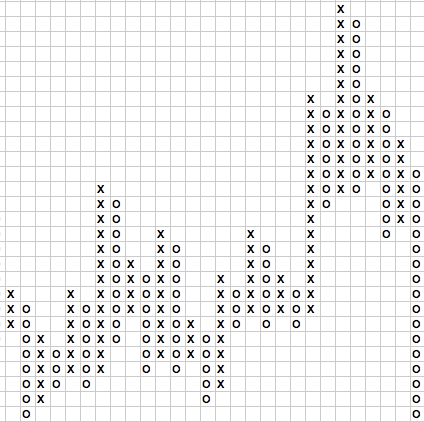
Even though Santelli is supposed to be the ‘Bond Maven’, his commentaries and guests range far afield (including heavy political overtones).  On January 27, Rick’s guest was technician, Tom DeMark.  Chartist DeMark is well-known and a consultant to many high-powered institutional investors and he has had some good calls in his long career.  Having said this, his methods are extremely complex and require many things to fall into place before he makes a call (not always correct).  The reason Santelli had him on was that DeMark recently published a negative piece comparing the chart formation of 1929 to that of 2013.  You see where Santelli is going with this.  The market is down 5% or 6% after a great run and, all of a sudden, we are looking down the barrel at a 40% correction.  This is scary stuff.  Get ready to hit the exits!  Then again, maybe it is just ‘fair and balanced’.  But, wait a minute, Santelli is always negative. (DeMark clip)

800px-Panic_button

The Old Timer

Art Cashin epitomizes the class guys who used to populate the floor of the non-automated New York Stock Exchange.  Although Art has been a cautionary voice for the past few years, he usually is a moderate voice and a voice of market wisdom and experience.

It was very disappointing to me when, at the height of Monday’s (2/3/2014) sell off, Art decided to compare the recent ‘flight to safety’ demonstrated by the strong upward move in the 10-year U.S. Treasury Note to the moves we saw in 2008/2009.  That he made this analogy was bothersome, and that he did while the market was under severe selling pressure was even more disconcerting.  Methinks he’s been hanging with the CNBC crowd too long.

Art’s concern was that rates were supposed to go up after the Fed began its taper of Quantitative Easing.  Instead, they were going down.  Ergo, something really bad was happening under the surface.  What Art seems to have forgotten or may not know, is that QE, even at its height, was just a small part of the daily trading in long-dated treasuries; and, oh by the way, they are still buying $65 billion per month (1/2 treasuries, 1/2 AMBS).  We detail this in session–52.  Anyway, Art was overwrought.  He cautioned if we broke 2.6% on the 10-year it might signal real problems ahead. We did break to 2.58% later that day and closed today (2/5/2014) 2.67%.  It is the safety trade Art, not Armageddon!

I still believe that most investors are not, nor have they been euphoric, that they have one foot out the door and one finger on the panic button. This is a constructive psychological backdrop for the market.

What do you think?

The information presented in kortsessions.com represents my own opinions and does not contain recommendations for any particular investment or securities.  I may,  from time to time, mention certain securities for illustrative purpose, names where I personally hold positions.  These are not meant to be construed as recommendations to BUY or SELL.  All investments and strategies should be undertaken only after careful consideration of suitability based on the risks, tolerance for risk and personal financial situation.


Categories
Financial, Stock Investment

Session 82–“A Correction Is Coming!” Part II

BillLest I appear to be a complete “Pollyanna,” I thought it would be useful to point out that, yes, there are many negatives facing the market: some real, some imagined and some not yet foreseen.  I subscribe to the old saw, “no tree grows to the sky.”  I am acutely aware that the current, unabated move in the market is overdue for some real corrective action.  The question is not if, but when?

“A Correction Is Coming!…”

Back on April 5, 2013 we published session 20 “A Correction Is Coming! When And How Bad?”  The Friday before the S&P 500 had closed at 1614.42 (14% below its close of this last Friday January 10, 2014).  The title was a reflection of the common media wisdom of that time: The market had moved too far, too fast.  Stocks were overvalued.  You should be selling, not buying!

My position back then, as it is now, was that corrections were normal and they should not be feared.  I also asserted that versus the ten-year U.S. Treasury yield of 1.77% stocks were attractive.  This is the case today, even though the ten-year is yielding closer to 3.0%. I believe we should view the market through the prism of moving out of a thirteen-year period of ZERO returns from stocks, rather than focusing on the sharp recovery we have had from the panic lows of 2008/2009.  In other words stock fundamentals have improved dramatically since the ‘bubble’ top of 2000, while the S&P is up, in total, 20% over that 13-year span (about 1.5% per year).  The PE on the index is down from 29  to 16.  Plus, corporate balance sheets have never been stronger. To me stocks still look interesting, even as ten-year rates approach 3%.  Having said this, in light of the uninterrupted move we have had, it is hard for me to push people up to buy stocks right this minute.

Predicting is a very tough game.

For example, I believe as outlined in session 7 (“My Biases…”), we will have to deal with significantly higher inflation somewhere down the road.  When?  That is hard to pinpoint; but, I believe you should be prepared.  Preparing for inflation calls for owning assets (common stock being one alternative); and, if you have good economic purpose, borrowing money long-term at low rates.  You do not want to be a lender.  As to owning stocks (i.e. owning businesses) there is considerable empirical evidence favoring this asset class as a long-term hedge against inflation.

As it pertains to a correction, I can with great certainty tell you we are overdue for a major one.  Forecasting the catalyst, when or how deep it will go is impossible.  Also, we might move even higher before any downdraft sets in.  Seasonality might play a role here as we move into the spring of the year…you know ‘sell in May and go away’.  Whatever the cause, it will be scary, normal and may present investors with opportunities to deploy funds.

The Stopped Clock Syndrome 

2010-07-20_Black_windup_alarm_clock_face

The naysayers of a year ago are still the naysayers.  One in particular, Jeff Sommer with the New York Times continues to pop up on my radar.  “A Streak Has Ended, but the Echoes Haven’t” (NY Times 10/12/2014) captures his current negative slant, which really has not changed much in the last year. For reference on Sommer’s past dire pronouncements see session 8 (“a Masterpiece of Uncertainty…”) and session 22 (Latecomers Flocking…).  His most recent work comments on the coincidence that the market closed the first trading day of 2012 and 2013 (both very good years for the market) on a positive note (a string).  For shame, that string was broken in 2014.  Oh yes, and he quotes a source stating that the market had gone from undervalued last year to overvalued. Of course, Sommer was saying that last year too. Oh well, even a stopped clock is right twice a day.

What do you think?

The information presented in kortsessions.com represents my own opinions and does not contain recommendations for any particular investment or securities.  I may,  from time to time, mention certain securities for illustrative purpose, names where I personally hold positions.  These are not meant to be construed as recommendations to BUY or SELL.  All investments and strategies should be undertaken only after careful consideration of suitability based on the risks, tolerance for risk and personal financial situation.