Categories
Financial, Stock Investment

“I’m mad as Hell, and I’m not going to take it anymore”

Howard Beale
Howard Beale–Obviously mad as hell

This has become a regular theme in the 2016 political cycle. And it was a famous line uttered by fictional network news anchorman, Howard Beale (the late Peter Finch) in the 1976 motion picture, Network. This is not only a theme with the electorate, but it also seems to be working its way into the realm of the general divesting public. However, based on the performance of the market since the lows of 2009, maybe the quote should read, I’m mad as hell, and I don’t know why anymore.


Josh Brown
Josh Brown

According to Josh Brown, CNBC contributor, CEO Ritholtz Wealth Management and blogger “thereformedbroker.com” there is “Anger at 18000” on the Dow Jones Industrial Average (and 2091 on S&P 500).

The anger about the new all-time high the S&P 500 is currently approaching is palpable. Take my word for it, I read everything and everyone.

The 14.5% rally off the February lows, on nothing but worsening earnings and cuts to GDP forecasts has people utterly furious. I’m trying to remember a time in which stocks were on the verge of a breakout and people were so angry about it. The Dow just broke above 18,000 for the first time in nearly a year, and no one wants to even smile. (FYI, this is known as the ‘wall of worry’)

Shawn Langlois
Shawn Langlois–not so mad

Another sign of investor dismay can be seen in this headline from Shawn Lanlgois and MarketWatch, “People are falling out of love with stocks in a big way.” According to Langlois, a recent Gallup poll found that only 52% of Americans currently have money invested in the stock-market, down from 65% at the recent peak in early 2007 and that this represents the lowest equity exposure for individuals since the survey began 19 years ago. This would date back to 1998, a period pre-Tech Bubble. The S&P 500 stood at 970.43 January 1, 1998. It would gain another 60% by the peak in March of 2000. The reading at that peak was 62%. Of course, at the peak, the public and the media had all come back, touting stocks as an investment for the long-haul. Fifteen years later, after a tumultuous decade and half with the S&P showing an average gain of only 2.3% per year, they continue to shun stocks.

I have said this before and will say it again, bull market tops are not made in periods of extreme pessimism and loathing of stocks. They come in periods of euphoria and invincibility. Does this preclude steep market reversals from here? Absolutely not! What it should indicate is that there appears to still be considerable upside from here; and, that maybe we should focus more on what could go right, as opposed to what could go wrong. Also, when the media begins to change from its consistent negative slant on the market to a more positive view, that is when you should become more cautious.

Finally, The Price Action Lab Blog says that once again, the prophets of disaster have been knocked back by those market highs (referred to earlier). It argues there are just two types that make long-term calls about the market: the inexperienced and the psychotic. Read more here. (MarketWatch) As I am not inexperienced, I must be psychotic. Remember, too, I am not forecasting time or price, just that the market will probably go higher over time. Two centuries plus of US market history would tend to back up that opinion. (Jeremy Siegel–Stocks For The Long Run)

What do you think?

P.S. With oil prices having stabilized around $40 per barrel, I knew it would be just a matter of time before this narrative showed up: “With gas prices up over 4% in the last week, how much pain are we going to feel at the pump this summer?” Scott Wapner, CNBC

They are transitioning from the negatives that falling oil prices portend to the negatives that rising gas prices signal for the consumer. Interestingly, they never focused on the benefit that falling crude and gas prices had all the way down. BTW, those plus effects are still at work, as the price of regular lead-free gas is still down over a buck and a half from its peak. With the media it is always the same. Heads you lose, tails you lose.

The information presented in kortsessions.com represents my own opinions and does not contain recommendations for any particular investment or securities.  I may, from time to time, mention certain securities for illustrative purpose, names where I personally hold positions.  These are not meant to be construed as recommendations to BUY or SELL.  All investments and strategies should be undertaken only after careful consideration of suitability based on the risks, tolerance for risk and personal financial situation. 

Categories
Financial, Stock Investment

What did Mr. Draghi say?

120px-CNBC_logo.svg

It never ceases to amaze me how the media (specifically CNBC) seems to consistently get it wrong. And, yesterday it seemed to be almost intentional. Wednesday, March 9, all were eagerly awaiting Thursday morning’s European Central Bank (ECB) policy pronouncement. When it arrived via ECB Chair Mario Draghi, the markets in Europe and the US stood and saluted. They cheered with many terming it a “Bazooka”, strong medicine for what ails Europe. Of course, that was before the market turned lower around 10 AM (EST). At the high yesterday, the Dow Jones Industrial Average was up 116 points. By 2 PM it had swung 295 points lower, down 179 points on the day. What happened? The talking heads and pundits began to parse Mr. Draghi’s policy statement.

Why? It’s what Mr. Draghi said!

Mario Draghi forexfordummies.es
Mario Draghi
forexfordummies.es

“We don’t anticipate it will be necessary to reduce rates any further.” — (Mario Draghi)

This is part of what he said and it is what the media glommed onto to make the leap from what seemed to be a pretty bullish policy statement to a mind-numbing move to the dark side, triggering big moves down in Europe and US stocks. The snap conclusion was that the ECB would do NO more to stimulate (or, some said could do no more to stimulate) … game, set, match … La Fin. Here is another clip from Fast Money contributor, trader, Tim Seymour, taken at midday to reflect this sentiment.

I know that there will be those who read this who will react in the following manner: ‘Told you so’ or ‘just blowing up a huge bubble’ or ‘the world economy is toast’. To all I say, “you may be right.” My bet is that this ends with significantly higher inflation. The only question is ‘When?’ not ‘If’? And, if I am correct, the key to protecting yourself in an inflationary environment is owning assets. Stocks are assets that benefit from inflation. However, I’m agnostic. If not stocks, you need to own some type of assets. Be not a lender! Again, I cannot time inflation rearing its ugly head, but the money printing that is currently under way is a good precursor.

But, what did Mr. Draghi say in addition to the above quote?

Mario Draghi forexfordummies.es
Mario Draghi
forexfordummies.es

“We don’t anticipate it will be necessary to reduce rates any further. Of course, new facts can change the outlook.” — (Mario Draghi)

This sounds very much like Fed-speak, ‘data dependent’. The latter part of this quote was conveniently omitted from the rest of the commentary yesterday. In fact, CNBC reporter, Bob Pisani, did a recap of the day’s trading, citing the first half of the quote as the prime reason. He even played a clip of Draghi’s complete quote, with him referring to the bit about ‘new facts’ changing ‘the outlook’. It seemed pretty clear to me that the ECB could do more if necessary. But Pisani refused to frame it that way.

They failed to mention, potentially the most bullish element new program.

BANKS GET PAID TO LEND!

Community_Noun_project_26111.svg

Here, according to the New York Times, is the program (E.C.B. Takes Bold Steps to Stimulate Eurozone Economy):

  • The new approach, being paid to lend, will apply to a special program that allows banks to borrow money for four years, provided they lend the money on to consumers and businesses.
  • Initially banks will pay zero percent interest, the new main benchmark rate. But if the commercial banks meet certain criteria, they will get a bonus of 0.4 percent annually on the value of the loan after two years, applied retroactively.
  • Theoretically, banks would be able to refinance up to 30 percent of their loan book under this new arrangement.

If there is continuing severe pressure on European banks due to credit issues, the 30% refinance provision should provide some relief. The pay-to-lend provisions should provide strong incentive to make new loans at attractive rates.

Obviously, the message to some will be, ‘Europe is worse off than we thought’. I don’t buy this. It is Europe finally taking measures it should have taken more aggressively after the 2008 financial crisis … making up for lost time (stagnation). Having said all this, I have to give credit where credit is due. CNBC morning anchor, Brit, Simon Hobbs, seems to have really gotten it right! Watch this clip, it is very much worth your time. BTW, Hobbs made this comment early in the trading day. The rest of the organization chose to ignore his point of view. Is it because it didn’t bleed? It did not accentuate the negative?

What do you Think?

P.S. The market seemed to get this later in the day with both the Dow and S&P 500 closing virtually unchanged.

The information presented in kortsessions.com represents my own opinions and does not contain recommendations for any particular investment or securities.  I may, from time to time, mention certain securities for illustrative purpose, names where I personally hold positions.  These are not meant to be construed as recommendations to BUY or SELL.  All investments and strategies should be undertaken only after careful consideration of suitability based on the risks, tolerance for risk and personal financial situation. 


Categories
Uncategorized

Selling Climax, Please!

Just when I thought we were about to see the final washout, the purge of all the excesses of the last five years, a real ‘selling climax’, they yanked the rug out from under me again last Thursday afternoon.Then, again, Wednesday and Thursday of last week may have been a feeble, but effective end to the downdraft for now. Who know’s? The market’s gonna do what the market’s gonna do. Still, with all the bad news that the media and Wall Street pundits threw at it, it held and rallied late Thursday and in a very strong way on Friday.

The Backdrop for the Climax

We had just finished one of the worst Januarys on record. We finished it on a strong note, with the S&P trading up 47 points to 1940 (+2.4%) 1/29. By Monday of last week, we had lost all that, closing at 1851. By Thursday we were again threatening a break below the January low of 1812. On top of this, fear trade 10 yr UST prices spiked with the yield falling to 1.54% and gold broke out, spiking to $1264 per ounce, up nearly 6% from its breakout (back down $64 since). Yikes!…Panic City!

News backdrop —

  • With no movement by OPEC or the Saudis to stabilize oil prices (WTI), which had rallied in January (1/20) from $27.56 to $34.40 (1/29), the price collapsed to a new low Thursday of $26.o5. At this point last , the UAE oil minister suggested “that a consensus was developing within OPEC that it was time to discuss cuts with non-members.” This put a tourniquet on the market, reversed its course, but it still closed negative. Subsequently, oil has rallied strongly without confirmation of any deal.

images-4

  • Bank industry commentary, both here and abroad, continues to swirl with speculation that energy loans, bad loans by European banks and a sluggish economy in the Eurozone are heading these banks for disaster. This was based on weakness in European banks, especially Deutsche Bank (DB). DB reported its biggest loss since 2009 as a result of restructuring their investment bank and adding to litigation reserves. The CEO, John Cryan, did not help matters, trying to reassure the crowd by saying the bank was “rock solid.” He did help Friday by announcing a $5 billion tender for certain DB debt.
  • While the DB fiasco was in progress, Jamie Dimon and his beloved J.P. Morgan were cast into the penalty box. Dimon, who has been saying that not only things are fine at his bank, but the US economy is doing fine as well, placed a personal vote of confidence with his bank, in fact $25 million times. He bought nearly half a million shares of the bank.
  • Battered Bank Stocks Reflect Not Just Jitters, but Mistrust—This little ditty from Gretchen Morgenson and the NY times really says it all with regard to sentiment, replaying the tapes from 2008. Not unsurprisingly, people assume “deja vu all over again.” My retort is it will happen again, but it will take time and forgetfulness.
  • The entire banking industry has been beaten badly for two reasons: 1) The unlikelihood of the Fed moving quickly to raise rates — something that had been hyped as a tonic to improve spreads/profitability, which now seems very unlikely; and 2), worry about contagion from the oil patch and Europe. This clip (DEFINITELY WORTH YOUR TIME) from analyst, Bob Albertson:Overreaction in US banks, may be helpful to you. “Everyone is trying to find another 2008 in this, and there is not another 2008 in this.”
  • Retail sales were reported out on Friday up .02% (.04% if you adjust out falling gas prices). Now, that was from the month of January 2016. Excluding the effects of cheap gas, retail sales were up 4.5% from the 12 months earlier January. THIS IS NOT A BAD NUMBER! Interestingly, here is the headline from the Washington Post article that presented this data: “U.S. retail sales increased slightly in January.”

Oh yes, Fed / Monetary Policy Obsession Continues

images-4

It seems our friends at Deutsche Bank cannot stay out of the limelight. A team of analysts with the bank, headed by team leader Sebastian Raedler, is out with a new report concluding that the market is toast, if Ms. Yellin and company don’t ease up on monetary policy: “Without policy intervention, there is more risk of a downturn in equities”–“Only the Fed can save stocks now: Deutsche Bank” (this is CNBC’s headline on the story). Give me a break!

Finally, There’s Politics

The Donald
The Donald

America is a great country, despite the fact that Donald Trump is even being considered a serious presidential candidate! America is great, despite the fact Trump says he will make it ‘great again.’ However, when people are faced with a diet of constant badmouthing and negativity (badmouthing by both parties) on the economy, the direction of the country, etc., the rhetoric just might begin to stick. Of course, that bothers not those who are saying it. Their main interest is gaining election. Unfortunately, this will not stop for another ten months.

So, this is what the market had to contend with last week, yet, no climax. Maybe, we don’t get one this time. Who knows, the market’s gonna do what the market’s gonna do.

What do you think?

The information presented in kortsessions.com represents my own opinions and does not contain recommendations for any particular investment or securities.  I may, from time to time, mention certain securities for illustrative purpose, names where I personally hold positions.  These are not meant to be construed as recommendations to BUY or SELL.  All investments and strategies should be undertaken only after careful consideration of suitability based on the risks, tolerance for risk and personal financial situation. 

Categories
Financial, Stock Investment

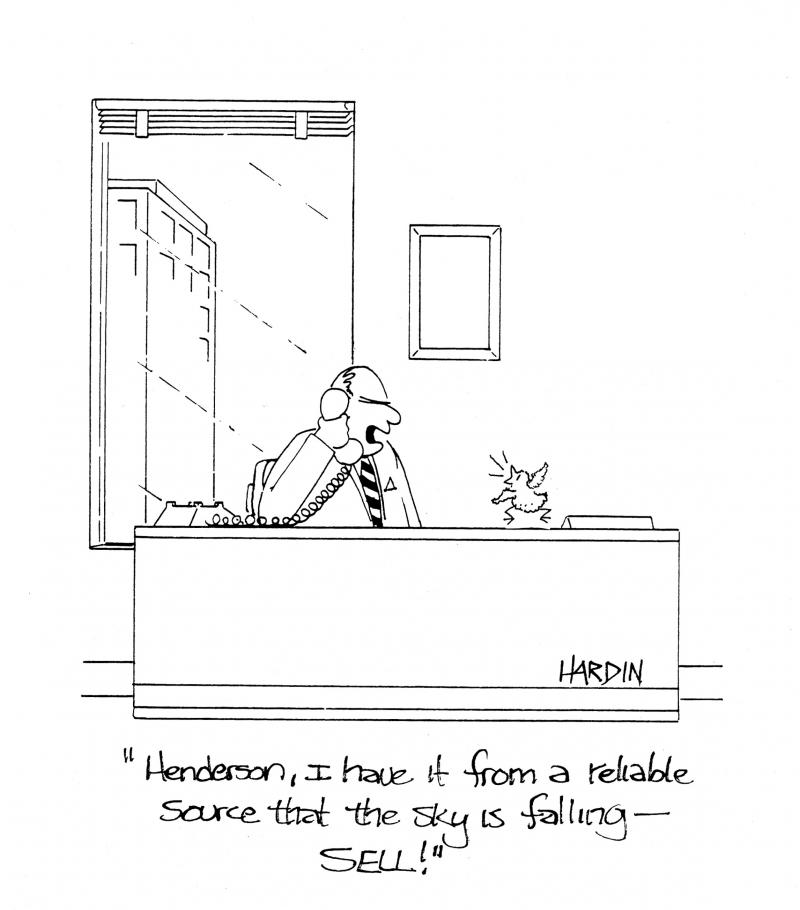
” … , I have it from a reliable source that the sky is falling — SELL!”

A visit with and impeccable source.
A visit with an impeccable source.

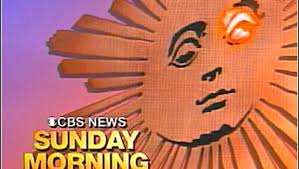
Of course, Henderson, the broker at the other end of the line, unaware of the severe consequences of passing inside information, passed this invective from Chicken Little along to ten of his best clients. Before you know it, you have real panic going. Last week’s best frightful and misleading commentary comes to us from the mainstream media … CBS Sunday Morning.

images-58

It was a report, anchored by Martha Teichner, covering the good news and bad news in falling crude oil prices. The beginning 30 seconds had to do with all the happy motorists (all of us) who are saving a bundle at the pump ($150 billion in 2015), the balance (about 5 minutes) had to do with hard times in the oil patch, in particular, Midland, Texas.

Now, I am sympathetic to all of those who have lost their jobs in that industry over the past tw0 years (according to the report, some 275,000). However the oil and gas industry has been a boom/bust industry through all of recorded history. Importantly, the main subject of this report admitted he’d been through four of these cycles in his career. Having said this, when things are good in the oil business, they are very, very good. The gentleman interviewed was an oilfield consultant. During the boom, he was making $1700 to $1800 a week. He is now unemployed. There are obviously many like him.

The flip side of this story is the vast majority of Americans who make nowhere near $1700 per week, people who have suffered for years with high oil prices. The negative story on the oil man reinforces the constant negative media drumbeat of decline and economic stagnation, while the majority of Americans are seeing a real benefit.

Teichner pointed out the causes: US production doubling since 2008 (the shale revolution), Saudi over production to retain market share and, get this, CHINA! Yup, she said Chinese demand had decreased. Not only does she blame China, but she insinuates that demand has declined around the globe (indicating a global economic slowdown) before zeroing in on China. This is incorrect. According to oil industry source, Platts Report, Chinese oil demand (and worldwide demand for oil) continues to grow at a healthy pace…more media malpractice. This  scares Henderson’s clients. It primes them for hitting the exits.

One More Time On The Bullish Virtues Of  Thirty-Dollar Crude

(You are excused if you are on the same page with me. If not read on)

“If oil prices stay between $75 and $95 a barrel, we would see the kind of stimulus package that the Federal Reserve or Congress could never do,” said Douglas R. Oberhelman, the chief executive of Caterpillar, the multinational maker of heavy construction equipment. This quote comes from a NYTimes article dated, November 14, 2014. Obviously, the price on WTI closed Friday 2/5/16 at $31. The stimulus we are now looking at is much larger. This piece from The Hill, dated October 2014, “Lower gas prices will save us all,” posits that every penny off a gallon of gas would equal a $1.4 billion benefit to the economy if maintained over a year. With regular, lead-free gasoline at less than $1.50 per gallon in my market, we are talking about a $2.00 difference vs. two years ago. According to the formula, if held, it would be a $280 billion stimulus. And that’s just in the US. Yet, all is gloom and doom in the media … not one mention of the OIL STIMULUS.

I do hear the critique to this argument: ‘why hasn’t it kicked in?’ That was the same critique the stimulus of 2009 was given. It will, as people begin to accept that this is not a flash in the pan. In the meantime, we will get these runs of panicky selling as the market tries to make a bottom and certain people, Henderson’s clients, hit the exits.

What is your take?

The information presented in kortsessions.com represents my own opinions and does not contain recommendations for any particular investment or securities.  I may, from time to time, mention certain securities for illustrative purpose, names where I personally hold positions.  These are not meant to be construed as recommendations to BUY or SELL.  All investments and strategies should be undertaken only after careful consideration of suitability based on the risks, tolerance for risk and personal financial situation. 


Categories
Financial, Stock Investment

Finally, I think I get it!

I have been puzzled for many weeks over the apparent, lock-step action in the stock and oil markets. Whenever the price of oil dropped, equities would immediately follow. I questioned this, because I felt lower oil prices were a major benefit to every consumer and industrial user, even if it might create hardships for certain segments of the economy. The basic takeaway was this was good for us and all the energy-dependent economies around the world (India, China, Japan, Europe, etc.).

Jon Najarian
Jon Najarian

Thanks to a comment by Jon Najarian, who called out oil-producing countries’ sovereign wealth funds as the culprit. He indicated these funds, which include all types of investments (stocks, bonds, real estate, private equity, etc.) were liquidating US stocks (very liquid, very broad markets) to offset budget revenue shortfalls brought on by plunging oil prices. All of a sudden, I think I get it.

Of course, when the big stocks in the S&P can’t get a bid, with prices continuing to drop, this brings in selling on small and mid-cap issues, selling just because the market is going down. These are stocks that the wealth funds would never own because of liquidity concerns. Ergo, you get overall market weakness, not related to any real fundamental or economic weakness.

What is the magnitude of the sovereign wealth fund equity overhang?

Hard to say…according to the Sovereign Wealth Fund Institute, there is a little over $7.0 trillion in assets in Sovereign Wealth Funds (SWFs). Of the $7T, approximately $4T sits in the funds of oil producing countries. These funds are highly diversified. I am speculating and don’t know the exact composition of these portfolios, but it would be hard to imagine, as much as $1t being in US equities. But a Trillion is still big money. Although $1T sounds like a big number, if you take it in the context of trading in the US equity market, it is not. Last week (Jan 11.), according to The Daily Market Summary, nasdaqtrader.com, total dollar value of trading on all markets, where any nasdaq securities trade, was nearly one half trillion dollars. Nonetheless, it does represent a headwind, as long as crude prices are declining or remain low.

What’s Next?

Unfortunately, the market’s gonna do what the market’s gonna do.   Although the S&P and Dow closed virtually unchanged yesterday, the small and mid cap sector, as represented by the Russell 2000, took another hit, down 1.28% (at 994.87) on the day and 23% from its June, 2015 all-time high of 1296. This beating continues today, with the panic that was going on under the surface, emerging in full force throughout the market. All of this is happening in the face of fundamentals that do not seem to be falling apart. It is not surprising to see a decline like this end in an overall panicky sell-off… a washout.

Everybody has been looking for a correction of the huge move we have had the past three years. We are getting it in spades. Corrections are normal and painful. Keep the faith!

What is your take?

The information presented in kortsessions.com represents my own opinions and does not contain recommendations for any particular investment or securities.  I may, from time to time, mention certain securities for illustrative purpose, names where I personally hold positions.  These are not meant to be construed as recommendations to BUY or SELL.  All investments and strategies should be undertaken only after careful consideration of suitability based on the risks, tolerance for risk and personal financial situation. 


Categories
Financial, Stock Investment

The Market’s Gonna Do What The Market’s Gonna Do

Be careful what you wish for!

320px-Genie_Lamps_007

In May of 2015, all the popular averages had tripled off their lows. There was a great clamor among the media and punditry that we needed a correction. A retracement of at least 10% had not happened in 18 months. In August of last year we got the correction, and it was a beauty. The downturn came about, in part, due to a Chinese currency devaluation and falling oil prices (“deja vu all over again”). This kinda reminds me of Greece, the end of Quantitative Easing, the ‘lift-off’ (first increase in short rates in nearly a decade) and the junk bond meltdown. All of these issues continued to pop up, rattle the market, then fade into the background.

Of course, these drops are normal, scary, but seldom the end of the world. Sometimes they become a harbinger of something considerably worse, like 2008. Because of institutional memory, many having experienced that horror show seem to think that the next event of this magnitude is just around the corner. In many respects, that is why the overall cautious, to down-right bearish sentiment has continued to grip many market participants and observers. In the final analysis this prevailing lack of enthusiasm for stocks is a major positive. .

  “Bull Markets are born on pessimism,

grow on skepticism, mature on optimism

and die on euphoria.”

Sir John Templeton

Sir John
Sir John

Unfortunately, many of the savants offering up investment advice these days have either forgotten about this sage investor, don’t even know of his record or existence; or they don’t care what he had to say, because he was an investor and did not try to game the market with sophisticated algorithms and high powered computers. You know, it is just not relevant to today’s market. On the contrary, I believe legendary investors like Templeton and Buffett (“Be greedy when others are fearful and fearful when others are greedy.”) have it right.  As such, this Bull is not close to over, regardless of the potential short-term pain we have to endure.

What are the pressure points?

I guess this depends on how you cypher the health of the US economy, the impact of lower and potentially, prolonged-lower oil prices and the fate of the Chinese economy. As it pertains to the last item, I heard one talker on Bloomberg opine that some are beginning to view the current Chinese economic situation to be akin to Japan 1990. Not sure how they get there, but that is the kind of rhetoric that is out there in the media. By the way, in case you don’t remember, Japan is still out there and we had one of the best decades in the market as Japan began its melt down in the nineties. Remember, too, the Japanese, like the Chinese up until recently, were viewed as a threat to US economic supremacy in the 1980s. They were the power to beat.

The Frighteners

A Frightener

Let’s look at the boogiemen that haunted the market last week, starting with tumbling crude prices. Every time the price of oil goes down, the market follows, indicating the market believes demand is shrinking. As we have said before this does not seem to be the case. It is all about Saudi Arabia and their massive overproduction, designed to drive shale oil out of the market and punish their enemies in Russia and Iran. According to the International Energy Agency (IEA), “Early indicators for 4Q15 show growth easing to 1.3 million b/d year-over-year, from a 3Q15 peak of 2.2 million b/d. The resulting annual growth of 1.8 mb/d for 2o15 is led by CHINA, the US, India and – somewhat surprisingly – Europe.” BTW, the IEA 2016 forecast is for continued growth at a 1.2 mb/d. This assumes further slowing in world economic growth, but no Global recession.

Low price is a boon to all who consume oil, a huge tax cut for all peoples that use more petroleum than they produce. But, what about the producers, including the United States? 

The impact on energy sector employment. 

Yes, low prices will cause painful unemployment in the energy sector, which could damage our economy. What is the risk? According to the Bureau of Labor Statistics, as of December 2015, total employment in the United States stood at 157.9 million. At the same time the oil and gas exploration and extraction segment stood at 184.5 thousand individuals (management and labor). If the entire sector shut down (a ridiculous construct), total employment would be cut a fraction of one percent. Save the very small population who made hay while the sun shined as energy employees, the huge majority of us win big on lower prices. Yet the market still drops like a stone every time oil takes a header. I DON’T GET IT.

I guess one other risk to my bullish stance is the potential of unrest in those countries around the world dependent on oil and gas to balance their budgets. The US is now the number ONE producer, followed by Saudi Arabia and Russia. The latter two, as “The Donald” might say, ‘have not been very nice to us.’ A pox on both of their houses (could be a good Trumpism). I just don’t see how this does not make us stronger in the long-run.

Back to China.

China-flag-snd.svg-2

What if things really get bad over there? First of all, they probably won’t. Even though the Chinese government has proven itself to be somewhat inept and ham-handed in their recent attempts to control their equity market, make no mistake they are into stability. They do not need an act of Congress to get things done. Also, remember the slowdown that is in progress was instigated by the Chinese government. Economic policy is not a game of ‘perfect’. It is conceivable the slowdown could be a major overshoot. What happens then? They would not be buying as much from us as they have in the past. What’s the worst case?

According to the US Census Bureau (for some reason they keep track of our foreign trade balances) for the first ten months of 2015,  the US exported $106 billion to China. If all our export business with China went away, it would amount to less than a 7/10 of 1 percent hit to our GDP. What the right number is, I don’t know. My call is  that it is unlikely that China won’ t continue to grow at some rate; and, that in the unlikely event of the worst case being realized the impact would be de minimis.

Finally, the US economy ‘stinks.’

Western_spotted_skunk
The Economy?

I continue to hear this or variations on the theme (the economy is weak, the economy is struggling or the economy is ‘expletive deleted’). The only reason that I can come up with for someone saying this would be political, the OUTs trying to make the INs look bad. I guess if you say it often enough, people begin to believe it. There has be a choir of pundits and politicos making this claim since the 2009 bottom, much to the chagrin to those unlucky souls who took them seriously. This was in the face of continually improving economic and market data.

Another term making the round is earnings recession. An earnings recession occurs when you have down earning for the S&P, while the economy (GNP) continues to grow. This is very misleading. According to institutional analytics provider, FactSet, and their November report, “When you remove both the energy sector and those companies whose foreign sales account for more than 50% of sales, the rest of the S&P is on track to rise 10.1% y/y.”

The truth is the economy is doing ok. It could be better, but it does not stink. The recovery has not been as rapid as some other post World War II recoveries, in part because of the hole we had to dig out of, and because we have a totally dysfunctional government providing equally dysfunctional fiscal policy. Globalization has also played a role, too, with the Eurozone pursuing austerity when stimulation would have been called for.

We closed last week with GDP still growing at a 2% clip, unemployment at 5%, the PE on the S&P 500 at 16Xs, super-bearish sentiment and, oh yes, a 2.3% yield on the S&P, all of this vs. 2.11% on a 10-year US Treasury (which does not appear to be going anywhere fast). I like those stats. None-the-less, The Market’s Gonna Do What The Market’s Gonna Do !

What’s your take?

BTW, if you’d like some good extracurricular reading on the topic, check this post out from “Fear & Greed Trader”, “The S&P 500 Drops 6% This Week – ‘Irrationality’ Isn’t Always Associated With ‘Exuberance’ And Euphoria.”

http://seekingalpha.com/article/3800206-the-s-and-p-500-drops-6-percent-this-week-irrationality-isnt-always-associated-with-exuberance-and-euphoria

The information presented in kortsessions.com represents my own opinions and does not contain recommendations for any particular investment or securities.  I may, from time to time, mention certain securities for illustrative purpose, names where I personally hold positions.  These are not meant to be construed as recommendations to BUY or SELL.  All investments and strategies should be undertaken only after careful consideration of suitability based on the risks, tolerance for risk and personal financial situation. 

Categories
Financial, Stock Investment

“OMG!!!”

images-37


It is obvious from Friday’s market action that the end is nigh, or we are on the “eve of destruction”: or better yet, stock market Armageddon has arrived. What tripped this all off? A well-respected value manager, Marty Whitman and his firm Third Avenue Management got themselves a little bit too far out over their skis with the high-yield (junk) bond assets they run, including Focus Credit Fund (FCF). The firm, which at one time boasted assets under management (AUM) of $3.5 billion, had not performed well and was suffering redemptions … so-much-so, AUM had declined to $800 million. Because of liquidity issues in the high yield market, Third Avenue took the unprecedented action of halting redemptions in FCF… a real shocker.

Martin Fridson, chief executive officer of Fridson Investment Advisors, speaks at the Reuters Restructuring Summit in New York September 23, 2008. REUTERS/Erin Siegal

According to Martin Fridson, CIO Lehman, Livian, Frisson Advisors, LLC., the portfolio was at the very top of the risk spectrum; ergo, very illiquid. Third Avenue has decided that it is in the best interest of all its investors to put a moratorium on redemptions for the time being to allow for the extra time it will take to dispose of these one-of-a-kind, high-risk  assets. Remember, this is not like buying a stock, where every share of General Motors is exactly the same as the next. Each one of these bonds has a set of unique covenants and characteristics that may have appeal to only specific buyers. There may not be a buyer there when an institution wishes to sell. This is obviously very problematic for mutual funds, even more-so for the sponsors of exchange traded funds (ETFs) that specialize in high yield securities…because the sponsors would be responsible for warehousing the bonds in the absence of active bidders in the street.

Fear of Contagion–Systemic Risk

Fear of Contagion
Fear of Contagion

To the point, Blackrock, for example, has over $4.5 trillion in assets under management. As part of this, they sponsor mutual funds and ETFs that invest in high-yield securities. What would be the impact of Blackrock and others having to eat (or even value for sale) a portfolio of illiquid, highly-levered securities? What would be the potential collateral damage? It is hard to speculate on this, but the media is working hard to spin this into the mortgage-backed securities crisis of 2008. This appears to be a real stretch.

According to HighYieldBond.com, the high-yield/junk bond segment of the $8.1 trillion corporate bond market is about 15% or $1.2 trillion in size. According to Morgan Stanley, approximately 13.5% ($162 billion) of the $1.2 trillion is energy related. Admittedly energy is a disaster. At $35.36/barrel on West Texas intermediate (WTI) there is tremendous stress on that part of the market. The most stressed part of energy would be the debt of independent producers and oil field service providers (about 2/3 of energy or $110 billion). If all this goes under (which is unlikely) it represents less than 1.5% of total corporate debt. If Blackrock owned all of these assets, it would hurt: but, again, if it were a total write off it would amount to less than 2.4% of their AUM … taxing, but hardly systemic in my view.

What about the rest of High-Yield?

Interestingly, after all the fear and angst generated about the high-yield market in the last 24 hours, one needs to ask what is really happening in terms of defaults — is this a major credit event in the making? Interestingly, defaults are running well below normal at 2.9% (normal = 4.6%). According to high-yield maven, Fridson, the high-yield market appears to be discounting a 6% default rate, while Moody’s is forecasting only 2.7% defaults in the next 12 months. Fridson explains this disconnect as an increase in risk premium required because of the lack of liquidity in the market. He believes you need a recession, which he does not see, to get defaults up to 6%. One inane conclusion of the media is that next week’s potential 25 basis point increase in the Fed Funds rate might drive high-yield and the economy off the cliff…ridiculous. For a really good explanation of what is going on in the the high-yield sector of the debt market, I’m providing links to two excellent clips from a CNBC interview with Martin Fridson. They are worth your time. (Fridson I) (Fridson II)

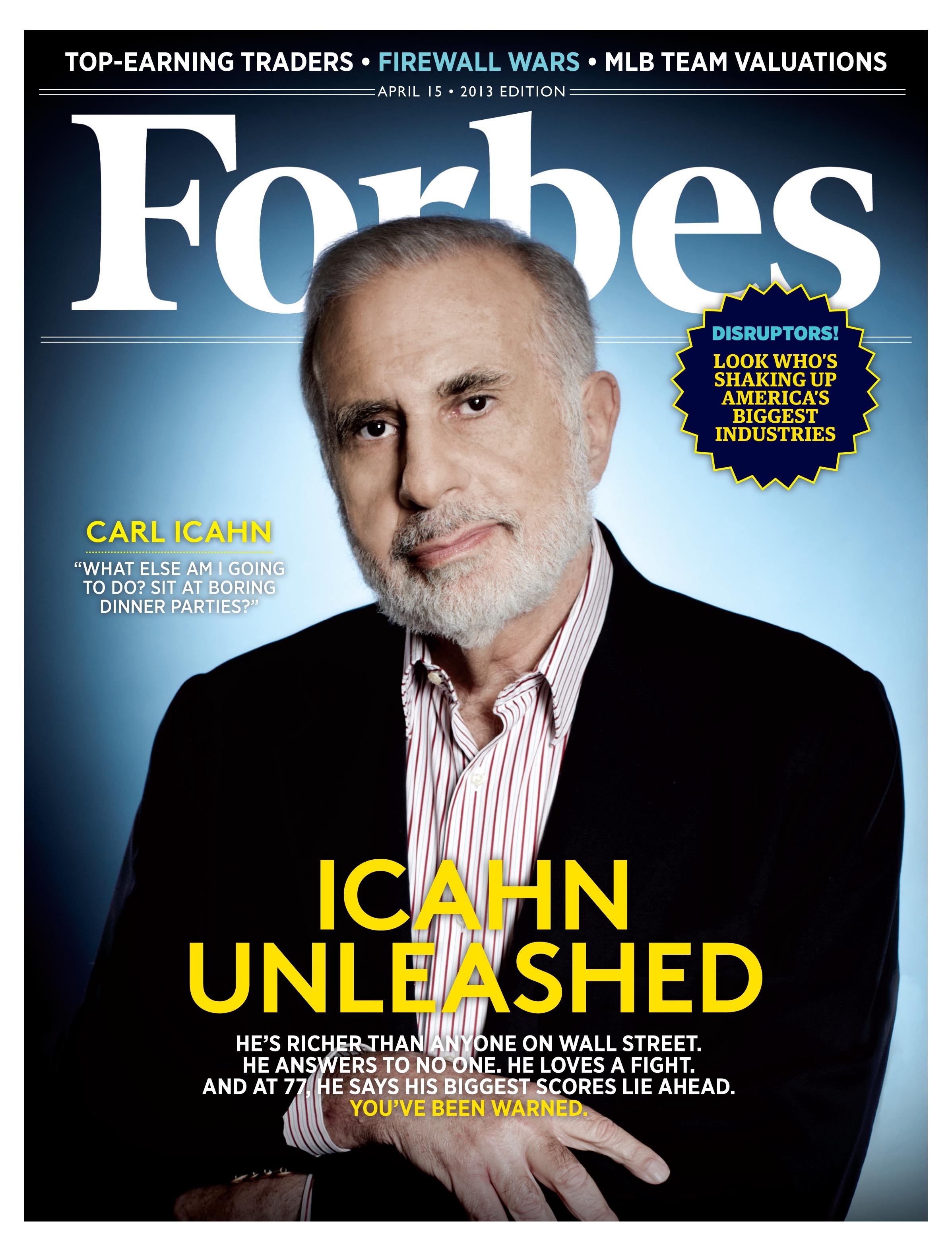
Carl Icahn must be big-time net short

Icahn.Cover_2

He always appears to show up on days when the market is in extreme stress and the viability of high yield is in question with something like this little gem: “The high-yield market is just a keg of dynamite that sooner or later will blow up.”  He did the same thing back on October 1, when he issued his “Danger Ahead” video (I commented in “Help! Plus more piling on”)

A few thoughts as we approach Fed-Day

  • The 10-year UST yield peaked in December of 2013 at 3% (the announced beginning of the “tapering” of Quantitative Easing). Recently with the threat of a potential rate increase it has been no higher than 2.5%. It closed at 2.13%, Friday December 11, as the “fear” trade was clearly in place. A quarter point bump in the FF rate at this point will only reinforce the fear trade. It is, therefore, very unlikely that this increase will have any major negative effect on long-term interest rates. WHEN THE MARKET FIGURES THIS OUT, AND IF THE STATEMENT IS “ONE AND DONE” / “SLOW AND LOW”, I BELIEVE THE ENVIRONMENT FOR STOCKS BECOMES VERY POSITIVE.
  • The dollar was supposed to strengthen when the Fed raised rates… making U.S. goods more expensive in international markets. Now, with this increase being viewed by many as a fait accompli, the dollar has declined over 4.5% from its recent high, even in the wake of Janet Yellin’s hawkish commentary two weeks ago.
  • The absolute positive that $35/$40 a barrel oil brings to everyone, but the producers, has been totally missed in the rhetoric. It is there and working for all individuals and the energy consuming economies they live in. Remember, the prices of oil and many other commodities are down because of oversupply, not because the global economy has ceased to grow.
  • Tax selling, some of which has been panic selling, has created significant opportunities in levered sectors of the market–MLPs, BDCs, REITs, Utilities and even Distressed Debt (don’t confuse illiquidity with viability).
  •  Since I began this post, another fund, a hedge fund Stone Lion ($1.3 billion in AUM, $400 million distressed debt), has suspended redemptions. This is not likely to play well Monday morning. It is important to remember the message in Fridson I and II. Default rates on high yield bonds are extremely low at present (2.9%). It would take a recession (which does not appear to be in the cards right now) to get to 6%, which means at a historical worst-case, 94% of the credits do not default. Ergo, this collapse may be setting the table with some real opportunities.

What Could Go Wrong?

Please Janet Don't disappoint us Janet
Please Janet
Don’t disappoint us Janet

If the Fed delays the rate increase because of the craziness going on in the high yield and commodity markets, we have a real problem. It will signal that the Fed thinks our economy and the world is too weak to withstand even a minor financial dust-up. Even worse, it will mean that the financial media and pundits with their fear mongering will have gained control of U.S. monetary policy. Please, Janet, say it ain’t so.

What are your thoughts?

The information presented in kortsessions.com represents my own opinions and does not contain recommendations for any particular investment or securities.  I may, from time to time, mention certain securities for illustrative purpose, names where I personally hold positions.  These are not meant to be construed as recommendations to BUY or SELL.  All investments and strategies should be undertaken only after careful consideration of suitability based on the risks, tolerance for risk and personal financial situation. 

Categories
Financial, Stock Investment

Conventional Wisdom Undone


Community_Noun_project_26111.svg

  • When rates do rise, the dollar will soar vs. other currencies, making U.S. goods more expensive in global markets and imports more affordable, thus further damaging the U.S. economy. This already happened and may be in the process of reversing, just as a Fed fund rate increase seems to be a fait accompli. The dollar actually took a significant hit on Janet Yellin’s recent comments before Congress, which appeared to indicate a strong inclination to raise rates at the December meeting. European Central Bank President, Mario Draghi, reinforced the move by stating Europe did not seem to be needing greater quantitative easing at this time. Of course, he is ready to intervene further, if conditions deteriorate. 

106px-500-Million-Dollar-Series-1934-Federal-Reserve-System-Federal-Reserve-Certificate-for-Bond-numbers

  • Bond prices will collapse causing yields to soar on ‘lift off’. Ergo, mortgage rates will soar, killing the U.S. housing market. On the eve of an increase in the funds rate this does not appear to be the case. December 18, 2013, the Fed announced they would begin to taper the bond-buying program ($86 billion per month) we all grew to love and fear as Quantitative Easing. The 10-year U.S. Treasury (Tsy) yield spiked to a bit over 3% (and has not been that high since). The 10-year closed 2013 at 2.88%. The S&P closed 2013 at 1848.36 (with a 1.9% yield). On Friday, December 4, 2015, the 10-year Tsy closed at a 2.27% yield. 30-year mortgages closed 2013 at a 4.46% yield. As of December 4, 2015, 30-year mortgages are available at a 3.63 % rate. It is doubtful the potential bump in the FF rate will take this rate anywhere near the previous two-year high. BTW, the S&P closed 12/4/2015 at 2191.61 (+18.3% over the two year period, still yielding about 1.9%).

93px-Child_labour_cartoon_Hine_no_3497

  • Finally, because of expected higher rates, investors need to avoid companies that use high degrees of debt in their capital structures (REITs, BDCs, MLPs, Utilities and high-dividend payers),  because debt will be more expensive in this rising rate environment. As it pertains to dividend stocks in general, higher fixed income rates will make fixed income more compelling versus stocks. Oh yes, Banks will be the big winners because higher short rates will allow them bigger interest spreads, much better earning power. Though the rate increase, de minimis as it may be, has not yet happened, a big downward move in the leverage plays has already taken place. Meanwhile, everybody loves banks. This creates a mismatch, which coupled with year-end tax-selling, could provide some real opportunities.

One Last Point on Interest Rates

They are going up. The question for many is, “How much?” Because sovereign 10-year rates in most of the major developed countries are very much lower than in the U.S. 10-year, the U.S. Tsy 10-year is the best house in a so-so neighborhood. If you check the table below, you will see why there should be a good, strong international demand for our debt, again keeping a lid on the potential upward move in long rates.

Ten-year Sovereign Debt rates (as of 12/4/2015–Source, Wall Street Journal)

US Tsy                 2.276%

France                 1.009%
Germany             0.682%
Italy                      1.551%
Japan                   0.332%
Spain                    1.730%
Portugal               2.470%
Hard to believe as it might seem, Portugal, with all its problems, only has to pay 20 basis points more in rates for 10-year money than the United States Treasury.
Hopefully this undoing of conventional wisdom helps you feel more comfortable with the market going into the new year.
How are you feeling?
The information presented in kortsessions.com represents my own opinions and does not contain recommendations for any particular investment or securities.  I may, from time to time, mention certain securities for illustrative purpose, names where I personally hold positions.  These are not meant to be construed as recommendations to BUY or SELL.  All investments and strategies should be undertaken only after careful consideration of suitability based on the risks, tolerance for risk and personal financial situation.
Categories
Financial, Stock Investment

“Eve of Destruction”

No 5 Army Film & Photographic Unit, Wilkes A (Sergeant) - This is photograph BU 8604 from the collections of the Imperial War Museums (collection no. 4700-30) Scene of destruction in a Berlin street just off the Unter den Linden. Permission details This artistic work created by the United Kingdom Government is in the public domain. This is because it is one of the following: It is a photograph created by the United Kingdom Government and taken prior to 1 June 1957; or It was commercially published prior to 1965; or It is an artistic work other than a photograph or engraving (e.g. a painting) which was created by the United Kingdom Government prior to 1965. HMSO has declared that the expiry of Crown Copyrights applies worldwide (ref: HMSO Email Reply) More information. See also Copyright and Crown copyright artistic works. Deutsch | English | suomi | français | italiano | 日本語 | македонски | മലയാളം | Nederlands | português | slovenščina | Türkçe | 中文 | +/− View more Public Domainview terms File:Destruction in a Berlin street.jpg Uploaded by Hohum Created: 3 July 1945
Berlin 1945
Apres Destruction
No 5 Army Film & Photographic Unit, Wilkes A (Sergeant) –Imperial War Museum

Eve of Destruction

“Eve of Destruction ” was the cheery title of Barry McGuire’s chart-topping single of September 1965, words and music by P. F. Sloan. This war protest song shot to the top of the charts almost overnight. Take a listen, and I bet you have to agree the more things change the more they stay the same … at least in the past 50 years (the past 75 years considering the visual above).

We had one of those “Eve of Destruction” moments Monday, August 24 (the recent low). In fact, things were so grim I felt compelled to post a counterpoint August 23, (though the title may not confer that intent), “Abandon All Hope Ye Who Enter Here.” It had appeared that on Friday, August 21, many had abandoned hope when panic set in, as oil had collapsed (breaking briefly below $40.00) and China melt-down fears erupted after a slight devaluation in the Yuan.  The Dow Jones Industrial Average is up nearly 15% from the panic low it hit that Monday. My final thought in the post:

Maybe I am missing something, but I am have trouble seeing the current situation as dire and warranting the panic that has surfaced in the market. Regarding everything that I know to be true and holy, bull markets do not end in panic. They are born in PANIC (which is what we have been seeing the last few days). Bear markets are bred and born in EUPHORIA, of which we have seen little, or none, since 2008/2009.

Ergo, I am not Abandoning hope. I am embracing it!

My Friend Allen

My friend Allen, who does me the honor of reading these posts, continues to puzzle over the lack of any long-term commentary on the part of the media, especially encouragement to those, not necessarily investing for growth, but those investing for income. He suggests that in the absence of good fixed income alternatives or the prospect of a strong resurgence in inflation (in this slow growth world) that there are many great income oriented equities out there.

These offer relative safety, modest growth in income and superior yield…stocks you don’t plan to trade…stocks that anyone with a long term outlook would be happy to hold. Who cares about $30. oil, a weak China or a quarter point bump in the Fed Funds rate when you are sitting on a domestic REIT with a 6% or 7% yield ? These events are just not material to their rent collections. Same holds true for master limited partnerships (MLPs) that do not produce energy (just transport it) yielding 7%+. And, there are scores of utility and good general equity names yielding way-in-excess of the 10-year treasury (whose dividends should also grow over time). All you have to do is be willing to accept volatility and hold over time.

My Answer (and Allen’s): It’s the media and their constant micro focus on the next big trade, inane news items speculated to be affecting the market, and what’s hot and what’s not… totally unproductive babble.

The stocks I listed above are just too dull to merit their attention. But, for investors looking for income, they are truly interesting.

My advice: Think about my friend Allen’s puzzlement. It presents you with an opportunity. 

What is your take?

The information presented in kortsessions.com represents my own opinions and does not contain recommendations for any particular investment or securities.  I may, from time to time, mention certain securities for illustrative purpose, names where I personally hold positions.  These are not meant to be construed as recommendations to BUY or SELL.  All investments and strategies should be undertaken only after careful consideration of suitability based on the risks, tolerance for risk and personal financial situation.

Categories
Financial, Stock Investment

HELP! Plus more piling on.

images-52

Help Me Understand this Market.

Maybe I’m missing something, but the way certain interest sensitive sectors of the market are acting, especially those with leverage (MLPs, REITs, Utilities and BDCs), you would think a major bump in interest rates (maybe even tightening by the Fed) is imminent. Can you tell me from whence this is coming? The Fed is not delivering this message. The economy is fine, but not red-hot. Inflation seems to be under control.

OK. If you can’t answer my first question, how about this one? What harm would a quarter point increase in the Fed Funds rate (from essentially zero) do to the economy? Or, for that matter, what damage would further gradual rate increases do, if taken over the next 12 to 18 months? Historically, a one or one and half percent fed fund rate would still be way below the level of Federal Funds that we have endured and prospered under over the past 6 decades. For those that doubt the veracity of my assertion, please check out this report from the St. Louis Fed on Effective Fed Fund Rates since 1954.  BTW, the Dow Jones Industrial Average closed out 1954 at 404.39. It closed Friday, October 2, at 16,472.37.

Another way to address these questions might consideration of two more questions:

1) What would be the impact of a 1.5% FF rate increase on longer bond rates (10-year U.S. Treasury rates)?

Based on recent history, a worse case estimate might be a one-to-one increase in the 10-year. Say to  3.50%. More likely, it would be much less than that (maybe even lower), due to the pervasive fear that exists in the market. There are those that believe even a small move in rates would throw us into a recession or worse (see comments below from Carl Icahn). Many are fearful that we are on the cusp of another 2008 event, even if they can’t exactly explain why … a flight to safety. Ergo, rates on the long-end could remain low for a long time.

2) Another looming question–What is the potential impact of higher rates on business capital spending, individual consumption and housing?

The impact of moderately higher interest rates, as it pertains to capital spending, should be de minimis. If you are operating on that tight a tolerance (i.e. where the additional 1.5% would make the project uneconomical), maybe the project should not be undertaken anyway. Also, as it pertains to capital projects and home ownership, maybe the threat of rising rates moves those who are ‘on the dime’ to take action … do it now before rates go up.

3) Finally, would 3.5% rate on a 10-year bond be stiff competition for a stock yielding 3%, a stock where dividends and earning might grow over time?

From a purely competitive standpoint, you don’t need fast growth to make the stock compelling. Four or five percent will do quite nicely. So, the answer to the bond being stiff competition for a stock would be,  probably not, especially as we hold the view that rates will not move up that rapidly (again, they could easily go lower).

So, why are we so obsessed by this?

It is because the media and punditry are obsessed. Of course, they do not provide history or perspective, except when they say this will be the first time in nine years that the Fed will raise rates! And, then they will leave you with the distinct impression that raising rates is a bad thing, and that the fate of the world hangs in the balance. This is how they get paid! If you go back, even in recent history, and see how many times they got it wrong, you will be appalled. Remember these world-ending events?

  • Passage of The Affordable Care Act (AKA, Obamacare)–It would put a lot of companies out of business and people out of work,
  • The Sequester–numerous government shutdowns and the dreadful end to Quantitative Easing. 

The market made new all-time highs after each of these, much-hyped events! The new ‘worse thing’ that could possibly happen is Lift Off, the Fed raising the Fed Funds rate 1/4 point. Give me a break, or as I requested earlier, “Help!” me understand why this time it will be different.,,why the media might have it right.

‘Piling on’ part II

Icahn.Cover_2

Jeffrey Gundlach T
Jeffrey Gundlach

With the market on the ropes earlier last week, two well-known pundits (hedge fund operators), Carl Icahn and Jeffrey Gundlach, tried to give it their best shots to take the market lower. Mr. Icahn is seeing “danger ahead”, the potential of another 2007 bubble bursting, was out warning about the evils of debt, financial engineering (something he is expert at). He has great things to say about Apple (a very large Icahn position), while badmouthing others using similar policies. So, he likes AAPL and must be short other equities and junk bonds. This is ‘talking your own book’ in the highest order. William Watts, a contributor to MarketWatch, takes Icahn to task in “Why Icahn’s Danger Ahead video is funny, not scary.” Then there is Doubline Capital’s Jeffrey Gundlach, essentially out doing the same thing in this little piece, “Doubleline’s Gundlach: Expect ‘another down wave’. “ This is not new news. It is just a couple of guys with big reputations talking their own books … piling on.

What’s your take?

The information presented in kortsessions.com represents my own opinions and does not contain recommendations for any particular investment or securities.  I may, from time to time, mention certain securities for illustrative purpose, names where I personally hold positions.  These are not meant to be construed as recommendations to BUY or SELL.  All investments and strategies should be undertaken only after careful consideration of suitability based on the risks, tolerance for risk and personal financial situation.