Categories
Financial, Stock Investment

Sesssion 94–Rootin’, Tootin’ Putin


images

What a guy.  His continued saber rattlin’/pistol packin’ stance over the Ukraine, plus continued worries about a Chinese debt crises and, voila, you have a mini market meltdown.  It always amazes me how quickly the market can turn tail and run on little or no new news.  On the other hand, yesterday may have been more about a long, overbought market in need of a good thumping correction.

As we go into the weekend with the market on pins and needles, I thought you might like a little perspective.

Ukraine: A big country with a small economy

120px-LocationUkraine.svg

The Ukraine’s land mass is about the size of Texas(Ukraine=233,820, sq. miles Texas 268,000 sq. miles).  The population is about 44 million, most of those Ukrainian with about 17% ethnic Russians and most of those live in the Crimean Peninsula at the Southern end of the country. GDP is about $180 billion (less than the GDP of Connecticut). Economically, the troubles in the Ukraine should have little or no impact on the West.

Even though the U.S. has been talking tough with regards to a potential annexation of Crimea by the Russian Federation (which could happen), this talk appears to relate to economic sanctions and not military action.  Think about it, we have had it up to our gills with foreign military action (Iraq and Afghanistan), plus we have the ongoing issues of Iran, Syria and our friends in North Korea).

The capitalist genie is out of the bottle in Russia and it will hard to get it back in.  Putin has to be getting tremendous pressure from business interests in Russia, and he has to be aware of the effect his macho routine is having on the equity markets in his country (“Russia stocks tumble ahead of weekend vote”).  His actions in this crisis could have a very chilling effect on foreign investment in the Federation, as well as trade. This becomes very problematic for Vlad at home.

China: The New Eurozone

Okay, so the Ukraine may not be the start of a new U.S. military conflict.  What about China?

I believe China has become the media’s new Eurozone.  You remember the Eurozone.  Every day there was some new crisis afoot.  We waited with baited breath for the results of the next Italian, Spanish or Greek debt sales.  Would Germany, the de facto central banker for Europe, go for the terms of the next Greek bailout?  What a soap opera.  They muddled through, even though their union was only monetary and not fiscal.

China has become the new Eurozone with a potential big credit bubble on the verge of busting.  China was in the news over the past week, posting less-than-stellar economic results…ergo, the bubble talk begins to boil again.  The important difference between China and the Eurozone is that, like the United States, they are a fiscal/monetary union.  They, like the U.S., can print their way out of a tight spot.  They can inflate.  My bet is that, to insure the ‘domestic tranquility’, they will resort to these methods.

So, as we go into the weekend, we have Russian troops back massing on the Eastern Ukrainian border, Asian stocks under pressure on a weak U.S. market (as traders hit the exits versus potential bad outcomes this weekend–the Crimean referendum) and continued China fears.

Exit Question: If you were the sole owner/ proprietor of any company stock you owned, would you even be thinking about selling, as a result of the geopolitical/ world economic backdrop posted here?

P.S. Four days after our post “10 things the gun industry won’t tell you”, the article continues to rank in the top five searched titles on MarketWatch.com.  Unbelievable!!!

The information presented in kortsessions.com represents my own opinions and does not contain recommendations for any particular investment or securities.  I may,  from time to time, mention certain securities for illustrative purpose, names where I personally hold positions.  These are not meant to be construed as recommendations to BUY or SELL.  All investments and strategies should be undertaken only after careful consideration of suitability based on the risks, tolerance for risk and personal financial situation.


Categories
Financial, Stock Investment

Session 91–“Born Under A Bad Sign”

Bill“Born under a bad sign.

I’ve been down since I began to crawl.

If it wasn’t for bad luck,

I wouldn’t have no luck at all.”

120px-Cream_Clapton_Bruce_Baker_1960s

This is one of my favorite tunes from one of the finest rock bands to come out of the 1960’s, “Cream”, music and lyrics by William Bell and Booker T. Jones, Jr.   “Born…” is a quintessential example of the blues and being REALLY DOWN.  What brought “Born Under a Bad Sign” to mind, was a post-close segment on CNBC’s Closing Bell having to do with the lack of enthusiasm a new, all-time closing  high on the S&P 500 met.

Hoist by my own petard

800px-Petard

To make my point today I was hoping that the on-line edition of CNBC would post a copy of the video to back up my comments.  It was evidently so stupid and irrelevant that the editors decided not to put it on the site.  Not only that, but they couldn’t even edit to give it some semblance of intelligence.  Well, I’m writing about it anyway, even though I can’t provide direct proof of this less-than-stellar exchange.

In a nutshell, the discussion question was “Why, with the S&P 500 at a new all-time high, is no one happy or celebrating the event?” The answer from the panel (especially our old foil, Jeff Cox, “The Bad News Bearer”) was that things really weren’t that good.  Why should we be celebrating? I mean these guys were negative, “Born Under A Bad Sign.”

The panel was obviously asleep for the past five years, or they require nirvana to make them happy.  By the way, it is safe to say that this panel, CNBC and most of the financial media have been arguing against this bull market upturn since its inception, five years ago.  They have provided a perfect ‘wall of worry’ for the market to scale. I am thankful that they are still negative, a good sign that the market advance remains on solid footing, sentiment-wise.

I’m no Pollyanna.

Pollyanna-still

But, it looks to me like an environment that is more a ‘glass half full’.  Plus, fixed income alternatives are not providing adequate competition for equities.  It is encouraging that the media is subdued, cautious and in some cases, downright bearish.  “There is no joy in Mudville” and Casey didn’t even strike out.  He hit a homer!

Watch out when the fans in the stands start cheering!

What do you think?

The information presented in kortsessions.com represents my own opinions and does not contain recommendations for any particular investment or securities.  I may,  from time to time, mention certain securities for illustrative purpose, names where I personally hold positions.  These are not meant to be construed as recommendations to BUY or SELL.  All investments and strategies should be undertaken only after careful consideration of suitability based on the risks, tolerance for risk and personal financial situation.


Categories
Financial, Stock Investment

Session 88–“The Boy Who Cried Wolf”

BillYou know the story about the shepherd boy who thought it was a kick to, on a whim, cry “wolf” alerting his village to a wolf attack on the flock that wasn’t really happening.  When a wolf finally did attack, no one paid any attention to his pleas for help.

I think we have recently seen a comparable situation in the stock market, and it has to do with the weather.  For years we have heard weather used as an excuse for poor corporate or economic performance, and like cries of “wolf” market participants have begun to ignore it as a lame explanation. Back in January, when the first really-below-par jobs number was issued, the market tanked.  Weather was ignored as the culprit and everyone started speculating on the beginning of a U.S. economic slowdown. Like the boy’s cries, weather was dismissed as a causal factor.  Bill Saporito was one voice crying for calm and reason in “Why Today’s Miserable Job Numbers Are Probably Wrong” (Time-Business and Markets-January 10,2014).  I think Saporito had it right and had it early.

At any rate these economic fears were magnified by threats of certain emerging market countries (a la Turkey) being on the ropes.  As we melted, those emerging markets, as well as, China and Japan melted…Voila, the long-awaited correction begins!

“Is That All There Is?”

A very young Peggy Lee

I’m not sure.  Since the market break at the beginning of the year, the Dow trimmed of 7%, the S&P 6% and NASDAQ 6%.  All have bounced significantly off their lows.  In fact, the NASDAQ made a new 52-week high today.  If the market holds true to recent form, not giving really attractive entry points to those with money to invest, while crushing the shorts, with due deference to Leiber and Stoller and Ms. Peggy Lee, this may be “All There Is.”

The Yellen Factor

480px-Janet_Yellen_official_portrait

I am willing to accept the weather as a primary culprit in the recent soft economic data, but there was one other uncertainty facing the beleaguered  market, the new Fed Chair, Janet Yellen. We had to start to worry about what her policies were and how she would acquit herself during her first House and Senate Finance Committee hearings.  She aced the House examination. Her Senate grilling was postponed (weather related).  I’m sure she will do just fine in front of that illustrious body.

Ms. Yellen basically said …’No change’.  The economy is OK, could be better. The taper will continue as planned, barring any unforeseen economic or geopolitical event that might call for re-examination of the policy (pretty much what Mr. Bernanke would have said).  As of this post (2/14/14), the ten-year U.S. Treasury note is at a 2.75 % yield…and they said tapering would drive rates up.  Here we are two turns ($10 billion turns) into the taper and rates are down.  When the first round of tapering was announced (12/18/13), the Ten-Year was trading at 2.88%, 13 basis points higher in yield.

One of these days, like “the Boy Who Cried Wolf,” these guys are going to be right.  Let us hope we are paying attention.

What do you think?

The information presented in kortsessions.com represents my own opinions and does not contain recommendations for any particular investment or securities.  I may,  from time to time, mention certain securities for illustrative purpose, names where I personally hold positions.  These are not meant to be construed as recommendations to BUY or SELL.  All investments and strategies should be undertaken only after careful consideration of suitability based on the risks, tolerance for risk and personal financial situation.


Categories
Financial, Stock Investment

Session 87–One Foot Out the Door, One Finger on the Panic Button

BillI think this describes the mindset of many market participants, suspicious of how far we’ve come since the crash of 2008.  The ghost of that era still haunts investors; so much so, many cut their equity holdings dramatically or totally avoided stocks (sideline money=buying power).  The recent mini-correction has reinforced this skepticism and the media has seized upon this to continue to foment fear and trepidation.  It keeps eyes on the paper, the web sites and, of course, the tube…corrections being a gift that jars investors from the easy complacency of a gradually up-trending market.

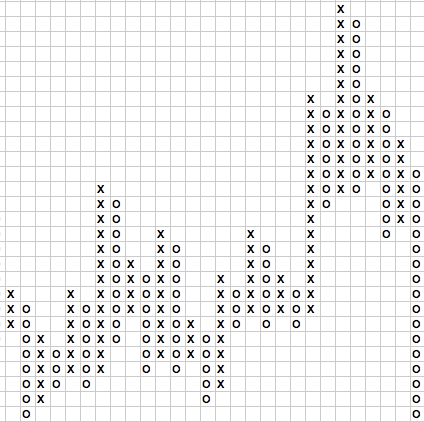
Recently, I spotted a couple of particularly egregious reports, specifically designed to draw investors closer to the panic button. Pieces, that if you did not know the background or track record of the presenter, could be very disconcerting.  One of these features the always convivial, always ranting, always negative and never right, CNBC ‘Bond Maven’, Rick Santelli.

The Chartist

SamplePNFillustration1

Even though Santelli is supposed to be the ‘Bond Maven’, his commentaries and guests range far afield (including heavy political overtones).  On January 27, Rick’s guest was technician, Tom DeMark.  Chartist DeMark is well-known and a consultant to many high-powered institutional investors and he has had some good calls in his long career.  Having said this, his methods are extremely complex and require many things to fall into place before he makes a call (not always correct).  The reason Santelli had him on was that DeMark recently published a negative piece comparing the chart formation of 1929 to that of 2013.  You see where Santelli is going with this.  The market is down 5% or 6% after a great run and, all of a sudden, we are looking down the barrel at a 40% correction.  This is scary stuff.  Get ready to hit the exits!  Then again, maybe it is just ‘fair and balanced’.  But, wait a minute, Santelli is always negative. (DeMark clip)

800px-Panic_button

The Old Timer

Art Cashin epitomizes the class guys who used to populate the floor of the non-automated New York Stock Exchange.  Although Art has been a cautionary voice for the past few years, he usually is a moderate voice and a voice of market wisdom and experience.

It was very disappointing to me when, at the height of Monday’s (2/3/2014) sell off, Art decided to compare the recent ‘flight to safety’ demonstrated by the strong upward move in the 10-year U.S. Treasury Note to the moves we saw in 2008/2009.  That he made this analogy was bothersome, and that he did while the market was under severe selling pressure was even more disconcerting.  Methinks he’s been hanging with the CNBC crowd too long.

Art’s concern was that rates were supposed to go up after the Fed began its taper of Quantitative Easing.  Instead, they were going down.  Ergo, something really bad was happening under the surface.  What Art seems to have forgotten or may not know, is that QE, even at its height, was just a small part of the daily trading in long-dated treasuries; and, oh by the way, they are still buying $65 billion per month (1/2 treasuries, 1/2 AMBS).  We detail this in session–52.  Anyway, Art was overwrought.  He cautioned if we broke 2.6% on the 10-year it might signal real problems ahead. We did break to 2.58% later that day and closed today (2/5/2014) 2.67%.  It is the safety trade Art, not Armageddon!

I still believe that most investors are not, nor have they been euphoric, that they have one foot out the door and one finger on the panic button. This is a constructive psychological backdrop for the market.

What do you think?

The information presented in kortsessions.com represents my own opinions and does not contain recommendations for any particular investment or securities.  I may,  from time to time, mention certain securities for illustrative purpose, names where I personally hold positions.  These are not meant to be construed as recommendations to BUY or SELL.  All investments and strategies should be undertaken only after careful consideration of suitability based on the risks, tolerance for risk and personal financial situation.


Categories
Financial, Stock Investment

Session 85–“When will they stop talking about ‘the taper’?”


BillChina is growing.  The ‘Dreaded Taper’ is growing.  Several emerging market currencies are sinking and the media finally has things to obsess on after a very dull fourth quarter, where most of the popular indices (save the NASDAQ) have made new all-time highs.

One of the key points that has developed out of this bearish bill-of-particulars is today’s Fed decision to take an additional $10 billion per month from the Quantitative Easing program.  In February, the Fed will only be buying $65 billion worth of Treasuries and agency mortgage backed securities (vs. $85 billion in December).

Now, common wisdom, pre-taper, was: ‘If you do this, rates will rise’.  This clip from CNBC’s “Closing Bell” gives a taste of that point of view from two of my favorite (NOT) purveyors, Peter Schiff and “bad news bearer”, Jeff Cox.  Incidentally, both claimed today’s taper action was not going to happen because the ‘economy was too weak’.  I am not sure, based on their track records, why either gets any air time.

What’s wrong with tapering?

According to the bears, rates will go up, not only hurting our economy; but it would really be bad for emerging countries, weakening their currencies as our higher rates would draw funds to the dollar.  Ergo, these countries would have to raise rates to counter our increase, thus weakening their economies.  Voila!  A world-wide downward spiral begins.  Well, tapering is not tightening.

Low and behold, rates did not rise!!

ZAP_lightning_bolt_icon

The U.S. Treasury 10-year note closed at a 2.69% yield Wednesday, January 29, down from 2.88% December 18, 2013.  Although I am certain that rates will go up over time, the taper of QE just may not be the trigger.

Having made this case, the market still went down today, and that downturn carried over to Asia, where the actual Chinese PMI was reported this evening at 49.5 (below 50 is considered a negative number).  My take on this is that you should not allow the media’s read on these events to press your “Panic Button.”  This may just be the normal correction that we have all been waiting for, not he end of the world.

Polite dinner conversation

Polite Dinner Conversation

I was out to dinner this weekend with friends. My friend Allen asked: “When will they stop talking about ‘the taper’?”  My answer: “I don’t know.”  It is hard to say because, even with rates down since the first (and now second) installment, they are still obsessing about it.

What do you think?

The information presented in kortsessions.com represents my own opinions and does not contain recommendations for any particular investment or securities.  I may,  from time to time, mention certain securities for illustrative purpose, names where I personally hold positions.  These are not meant to be construed as recommendations to BUY or SELL.  All investments and strategies should be undertaken only after careful consideration of suitability based on the risks, tolerance for risk and personal financial situation. 


Categories
Financial, Stock Investment

Session 84–“The Sell-Off Heard Round The World”

BillI assume that this bit of hyperbole brought to us last Thursday (1/23/14) by CNBC’s “Fast Money” anchor, Melissa Lee, referred to the .48% drop in the Shanghai Market and the 1.51% fall in Hong Kong of that date. This bled over into Europe and subsequently into our markets.  There was piling on Friday with the Dow Jones down almost 2% and the S&P and NASDAQ off over 2% each.  Interestingly, on Friday the Shanghai market was up over half of one percent and nobody mentioned it.

What were the culprits?

720px-Criminal_Silhouette_L.svg

Chinese GDP for the 4th quarter was one and the other was a 6/10ths of one percent drop in the Chinese Purchasing Manager’s Index (PMI) into a negative reading. Mind you Chinese GDP rose 7.7% (better than Chinese government forecast) and Chinese industry production rose 9.7%, but that was disappointing to some.  Oh yes, GDP growth was flat vs. the previous quarter.

One article Friday stated, “While growth last year topped government targets, China’s economy is stagnating after a downward-revised 7.7% GDP in 2012 versus 9.3% in 2011.”  GIVE ME A Break!!!

One last item, there were rumors circulating on a possible default that might cause a financial breakdown of China’s shadow banking system, plus derivative calls on emerging markets.  I will address these in the next section.

Perspetive: China

Based on the numbers, there appears to have been no major slowing in Chinese economy.  It was flat vs. the previous quarter, better than Chinese Government expectation and it was 7.7% growth….this is not a collapse or stagnation.   Importantly, it has been an ongoing policy of the Chinese government to slow growth from the unsustainable, double-digit levels of a few years ago.  As to the PMI number being under “50”, it is one month.  It was a tiny drop that put us at that level.  It really tells us nothing.

As mentioned earlier, there was a sub-plot working on the China story.  This is concern over some high-yield trust bank products offered through the Commercial Industrial Bank of China, secured by the assets of a shaky Chinese coal mining company.  It is speculated (mentioned several time on CNBC Thursday without corroboration) that $500 million principal outstanding of these securities could default at maturity, January 31.  This is de minims versus total Chinese Trust bank industry assets of $1.67 trillion.

Again, we find The Street and investors on high alert for another “Lehman” event, the next domino to fall, precipitating a world-wide financial crisis.  I am just not sure that the Chinese economy sputtering along at 7.7% (the U.S. would give anything to sputter at that level) or a trust bank certificate default would represent such catalysts.  Also, when people are peering around every corner looking for the next Armageddon, it is probably no where near to close at hand.

Emerging market currencies plummet.

submerging currency 1929 Reichsmark

Let me add one more twist to the tale of woe facing emerging currencies, U.S. Federal Reserve Policy.  The concern is that ‘the taper’ of Quantitative Easing (or increasing the taper) will put upward pressure  on U.S. rates, acting as stronger magnet for funds to exit emerging market currencies.  Thus far, since the announcement and implementation of the first round of tapering, this has not been the case.  Rates on the ten-year U.S. Treasury are down 16 basis points from 2.88% to 2.72%.  I would venture to guess if this correction continues, more money will find its way into bonds (the old ‘safety’ trade) giving us even lower rates.

The Bottom Line

This may be the “BIG ONE”, as Fred Sanford used to say, but it is nothing to get overwrought about. It will be the normal correction we have been looking for.  The media continues to do its thing.  When fear bubbles up, It’s Showtime!  They will do everything in their power to stoke it, keeping the maximum number of butts in the seats, glued to the tube.

What do you think?

The information presented in kortsessions.com represents my own opinions and does not contain recommendations for any particular investment or securities.  I may,  from time to time, mention certain securities for illustrative purpose, names where I personally hold positions.  These are not meant to be construed as recommendations to BUY or SELL.  All investments and strategies should be undertaken only after careful consideration of suitability based on the risks, tolerance for risk and personal financial situation.  
Categories
Financial, Stock Investment

Session 83–Whatever Happened to “The Great Rotation?”

BillYou know “The Great Rotation” out of bonds, which investors feasted on during and after the ’08/’09 crash, into stocks?  According to BlackRock CEO, Larry Fink, “It has been a rotation out of  bonds into bonds (long-term bonds into short-term bonds).  In fact, Fink (on CNBC- 1/17/2014) indicated BlackRock had many institutional clients rebalancing in the second half of 2013, selling stocks and buying bonds…this in response to the big run up the market experienced in the past few years.

“Risk Off!

As much as I dislike the trite “Risk On, Risk Off” terminology, it is a quick way to say that a bit of fear has slinked back into the market. A disappointing (to some) employment report, some in-line earnings numbers (not beats), weak retail sales reports and (all of a sudden) the pundits are worried about the viability of the economic recovery.  A tip off may be the fact that prices on the 10-year Treasury are now above the level they were trading at December 18 (Fed Taper announcement day).  On that day a month ago, the 10-Year closed at a 2.88% yield.  Friday January 17th, 2014 the rate had dropped to 2.82%.

Economic slowdown/disinflation (deflation) stories are beginning to appear, like this little ditty from Barron’s Randall Forsyth: “Next: A Deflationary Bust.”

"A Deflationary Bust"
“A Deflationary Bust”

“Drowning Our Deflation Fears”

“The risk of falling prices and rising financial speculation. Surprise:

bonds get off to a good start in 2014.”

As we have said in the past, the potential for a stiff correction definitely exists and is certainly warranted.  But, this proclivity toward safety and a public that continues to be weary of the market, gives me confidence on a longer-term basis that this secular bull market has further to go.  We are nowhere near ‘irrational exuberance.’

They “could have had a V8!”

V8_vegetable_juice

And now for something completely different: Barron’s Magazine brags about the performance of its stock recommendations in 2 013.

“Barron’s stock picks outpace the market” Not sure which market they mean.  I usually mean the S&P 500, which was up nearly 30% (before dividends) in 2013…but read on.

“Our bullish 2013 stock picks rose an average of 17%, compared to a 13% gain for their benchmark” (some sort of melded index Barron’s concocted). “Negative selections, however, did not pan out, rising an average of 55% versus a 39.2% increase in the benchmark.” Maybe we should be buying their short ideas!

Now, for the “V8 moment”, instead of doing all the work it took to make some 134 long recommendations (they did not disclose the number of shorts that they wrote up), they could have owned an S&P index fund and, of course, had a total return (including dividends) in excess of 30%.  I mean why make yourself crazy? Stock-picking is hard, even for the pros. Broad-based index funds allow participation without the headaches.

As we have said in the past, and has been proven here once again, paying too much attention to the financial media can be hazardous to your wealth!

Caveat Emptor!

What do you think?

The information presented in kortsessions.com represents my own opinions and does not contain recommendations for any particular investment or securities.  I may,  from time to time, mention certain securities for illustrative purpose, names where I personally hold positions.  These are not meant to be construed as recommendations to BUY or SELL.  All investments and strategies should be undertaken only after careful consideration of suitability based on the risks, tolerance for risk and personal financial situation.
Categories
Financial, Stock Investment

Session 82–“A Correction Is Coming!” Part II

BillLest I appear to be a complete “Pollyanna,” I thought it would be useful to point out that, yes, there are many negatives facing the market: some real, some imagined and some not yet foreseen.  I subscribe to the old saw, “no tree grows to the sky.”  I am acutely aware that the current, unabated move in the market is overdue for some real corrective action.  The question is not if, but when?

“A Correction Is Coming!…”

Back on April 5, 2013 we published session 20 “A Correction Is Coming! When And How Bad?”  The Friday before the S&P 500 had closed at 1614.42 (14% below its close of this last Friday January 10, 2014).  The title was a reflection of the common media wisdom of that time: The market had moved too far, too fast.  Stocks were overvalued.  You should be selling, not buying!

My position back then, as it is now, was that corrections were normal and they should not be feared.  I also asserted that versus the ten-year U.S. Treasury yield of 1.77% stocks were attractive.  This is the case today, even though the ten-year is yielding closer to 3.0%. I believe we should view the market through the prism of moving out of a thirteen-year period of ZERO returns from stocks, rather than focusing on the sharp recovery we have had from the panic lows of 2008/2009.  In other words stock fundamentals have improved dramatically since the ‘bubble’ top of 2000, while the S&P is up, in total, 20% over that 13-year span (about 1.5% per year).  The PE on the index is down from 29  to 16.  Plus, corporate balance sheets have never been stronger. To me stocks still look interesting, even as ten-year rates approach 3%.  Having said this, in light of the uninterrupted move we have had, it is hard for me to push people up to buy stocks right this minute.

Predicting is a very tough game.

For example, I believe as outlined in session 7 (“My Biases…”), we will have to deal with significantly higher inflation somewhere down the road.  When?  That is hard to pinpoint; but, I believe you should be prepared.  Preparing for inflation calls for owning assets (common stock being one alternative); and, if you have good economic purpose, borrowing money long-term at low rates.  You do not want to be a lender.  As to owning stocks (i.e. owning businesses) there is considerable empirical evidence favoring this asset class as a long-term hedge against inflation.

As it pertains to a correction, I can with great certainty tell you we are overdue for a major one.  Forecasting the catalyst, when or how deep it will go is impossible.  Also, we might move even higher before any downdraft sets in.  Seasonality might play a role here as we move into the spring of the year…you know ‘sell in May and go away’.  Whatever the cause, it will be scary, normal and may present investors with opportunities to deploy funds.

The Stopped Clock Syndrome 

2010-07-20_Black_windup_alarm_clock_face

The naysayers of a year ago are still the naysayers.  One in particular, Jeff Sommer with the New York Times continues to pop up on my radar.  “A Streak Has Ended, but the Echoes Haven’t” (NY Times 10/12/2014) captures his current negative slant, which really has not changed much in the last year. For reference on Sommer’s past dire pronouncements see session 8 (“a Masterpiece of Uncertainty…”) and session 22 (Latecomers Flocking…).  His most recent work comments on the coincidence that the market closed the first trading day of 2012 and 2013 (both very good years for the market) on a positive note (a string).  For shame, that string was broken in 2014.  Oh yes, and he quotes a source stating that the market had gone from undervalued last year to overvalued. Of course, Sommer was saying that last year too. Oh well, even a stopped clock is right twice a day.

What do you think?

The information presented in kortsessions.com represents my own opinions and does not contain recommendations for any particular investment or securities.  I may,  from time to time, mention certain securities for illustrative purpose, names where I personally hold positions.  These are not meant to be construed as recommendations to BUY or SELL.  All investments and strategies should be undertaken only after careful consideration of suitability based on the risks, tolerance for risk and personal financial situation.

Categories
Financial, Stock Investment Uncategorized

Session 78–Apres Taper, What’s Next?

BillThe confused nature of media reaction to the market’s move higher on last Wednesday’s Fed announcement on the taper of Quantitative Easing (QE), indicates they are totally lost. They can’t figure out why the market responded as it did, up nearly 300 points on the Dow.  In my world it makes total sense.  Here is how I see it:

QE was not a conduit for $85 billion per month making its way into the stock market!

Half the money did, in large part, fund much of treasury debt issuance over the period.  The balance of the dollars made their way  into agency mortgage-backed securities (AMBS).  The AMBS purchases were designed to keep downward pressure on mortgage rates.  In terms of average trading volume in both longer-dated treasuries and AMBS, QE on a daily basis represented less than a 1.5% daily over bid from what would have been normal trading (sifma trading data).  Less than 1.5% on a daily basis may have kept some pressure on rates, but the effect should not have been extreme.  QE was not a heavy IV drip of money into the equity market; but, QE did suppress rates, which did make equities a more attractive investment alternative.

A sub-1.5% rate on the 10-year Treasury was not all about QE.  It was FEAR!

El Grito--business News Anchor In Training
El Grito–business News Anchor In Training

Remember in the fear-ravaged summer of 2012 the 10-year yield bottomed at 1.43% (July 25th).  It was Greece, the Eurozone in shambles and the United States in the middle of its presidential brawl.  Remember the political rhetoric… according to Mort Zuckerman we were in the “worst economic environment since the Great Depression.”  China was reining in its economy and many feared a hard landing was in the making.  The media was saying that things were going from bad to worse, as second quarter 2012 GDP came in at a meager +1.2% (vs. a +3.7% print in the 1st quarter).  These front page news items caused the flight to safety that marked the low in the 10-year treasury…. not QE!

What was the impact of QE?

If fear played a part in the low rates and the actual volume impact on Treasury and AMBS securities was somewhat de minimis, one can only conclude that, other than providing liquidity to the banking system, Quantitative Easing was a psychological bolster to the market…an offset to the considerable barrage of bad news and negative sentiment.

What amazes me now

It would seem that most reasonable people would agree that we are not only well past the crisis in our economy, but well past our crisis of confidence.  Ergo, the need for QE is over and its withdrawal is normal and necessary.  I am amazed at the reaction of surprise by most in the media at the market’s very positive reaction.

In this entire episode, a very simple principal has been forgotten.  The Market is a discounting mechanism. It has been working on discounting ‘the taper’ for months.  You would think so-called “professionals” reporting on these matters would have some calculus for this in their work.  Obviously they don’t.  For the past five years, The Market has been telling us things are much better than the media and pundits have been leading us to believe.  When we rallied off the 2008/2009 lows it was telling us the ‘end of the world’ was not nigh.  For the past three years, it has been indicating the economy was better, company balance sheets were healing and earnings improving. I guess I should not be surprised that the same voices are now baffled by the market’s ebullient reaction to the Fed decision to begin tapering Quantitative Easing.  It was worry “Numero Uno” until 2 PM EST Wednesday(12/18), then it was not.

“Apres Taper,” what’s the next big thing?

What do you think?

P.S. The beat goes on.  The attached clip from CNBC (Monday 12/23/13) not only provides a good laugh, but a reminder of just how irrelevant they can be.  Rick Santelli does not disappoint.  His message, ‘the market has got it all wrong’ and it has been getting it wrong for the last 173% on the upside .  If Santelli ever turns positive,  SELL EVERYTHING and move immediately to your bomb shelter!!!

The information presented in kortsessions.com represents my own opinions and does not contain recommendations for any particular investment or securities.  I may, from time to time, mention certain securities for illustrative purpose, names where I personally hold positions.  These are not meant to be construed as recommendations to BUY or SELL.  All investments and strategies should be undertaken only after careful consideration of suitability based on the risks, tolerance for risk and personal financial situation.


Categories
Financial, Stock Investment

Session 77–What Made The Media Salivate In 2013

BillI started my blog to give clarity and perspective to the daily barrage of hype and misinformation from the mainstream and financial media.  I hope my work has been helpful in that respect.  As we approach the New Year, I thought a retrospective on kortsessions might be useful, a look-back on the issues that the media obsessed on and my responses….a trip through short-term memory lane.

What really got the media’s animal spirits roaring in 2013

LobisomemRF

 THE “FISCAL CLIFF”

SESSION 3, February 3, 2013–The media was obsessing on the “fiscal cliff” (the expiration of the Bush Tax cuts and end of the social security tax holiday.  CNBC was running a Fiscal Cliff countdown clock in the corner of the screen and there were many dire pronouncements about what would happen if the Congress let us go over the edge.  At the time, the S&P was up about 10% from its post-election lows (many after the election were forecasting that the market would tank on an Obama re-election). However, as soon as the election was over, with the market moving up, the media began a laser-focus on the Fiscal Cliff. To compound this, we had concern about “The Sequester”, a weak 4th quarter GNP report (down 1/10th of one percent) and the “debt ceiling debate” (i.e. potential government shutdown #1)..

We weren’t buying this negativity and session 3 (“Current events”) gave perspective on other factors that might be bolstering the market–Ultra low interest rates, 13 years of a zero return market and reasonable valuations.

“The Dreaded Sequester”

By February 13th, we’d resolved the Fiscal Cliff and moved on to the Sequester as the prime Boogieman facing the market.  In session 5, we took an in-depth look at the sequester and came away with the conclusion that although it was a dumb way to implement fiscal policy (in this case a budget), it probably would not be a disaster, throwing the economy back into recession.

“Dow 14296.26, A New All-Time High…Does Anybody Care?” (Mach 7, 2013)

The market just keeps chugging along, but there is no “joy in Mudville.” Very few believe or trust the market and many are waiting for the bottom to fall out (see session 12).  The day of this new record high, CNBC ran a story after the close, “Threats to the market lurking in the shadows.” The piece questioned the quality of our economic recovery, cited potential geopolitical  shocks, complacency about Europe ( a recurring trouble spot for U.S. Stocks), the (then) upcoming change in the Chinese government and continued worry about the impact of the Sequester.  We were nonplused!

Session 15 “FBFH–Fed Bolt From Hell”

ZAP_lightning_bolt_icon

In session 15 (3/16/13), we talked about the potential tapering, a removal of Quantitative Easing (QE) as the next big media obsession.  We felt this would be good news, not bad, but the market action of last week ( week ending 12/13//13) would indicate this still to be negative ‘Topic #1’. We still think it will not be end of the world, but maybe an excuse for that long-awaited 10% correction.

“CYPRESS”

“A Media Measured Response?…Caveat Santelli!

March 21st 2013, the pundits continue to look for a Eurozone born disaster and the Cypriot banking debacle does not disappoint.  Rick Santelli in one of his quintessential reports thinks, maybe Cypress is an “Archduke Ferdinand financial moment” for the Euro and the world economy (note the outrage from Mr. Santelli).  You know, just like the assassination of Austrian Archduke Franz-Ferdinand was the match that lit the conflagration known as World War I.  We spoke of this in session 21 and here is the video.   Talk about fear mongering…this is unbelievable!

The late Franz Ferdinand

“This market, I don’t get it”  (5/10/13-session-32)

In May, with the market continuing its march to new highs, “The Wall of Worry” continues to build with a front page headline citing a pundit calling for an eminent  8% to 10% correction.  We are still waiting (and are probably way overdue for such action). Most people in the media, continuing to take the short-term view, cannot understand the market’s strength.  Sentiment continues negative.  Nobody wants to swim in the equity pool, though it is precisely the best time to swim.

“FBFH–Fed Bolt From Hell III & IIIb“ (5/20/13–session 35)

Taper fear and taper talk continues to run high (a media favored topic) with the bond market reacting.  Rates on the 10-year U.S. Treasury note had moved from about 1.5% after the November election to just over 2% May 20th. They were near 3% in June (2.87%-12/13/2013).  In these posts we discussed the potential supply and demand ramifications of “the taper” and withdrawal of Quantitative Easing (QE) and concluded that QE represented a slight overbid in today’s market and that tapering would reduce that overbid and eventual removal would not be a big deal. No taper yet but, bond prices as we have seen, started to discount the process back in the spring.  Ergo, when taper does come it may largely be in bond prices.

“Buying stocks, is it too late?” Session 49 (7/10/2013)

I said back in July that it was probably still OK with one proviso: If you have funds you want to invest, average in over time…NO Plunging!  I am still looking for that big correction (as is most everybody).   Since we’ve come so far without a pause, so it could be a humdinger.  This not to say that buying stocks, even at these levels, will not be quite rewarding on a longer term basis.  I just want you to be aware of the short-term risk.

“Don’t fight the Fed, fear it!” session 66 (10/22/13)

Yet another cautionary note is cast about the dangers of QE, this one suggesting that it was Fed QE that was currently fueling a potential “bubble” in stocks.  Bubble talk continues to run rampant.  My experience is that the bubbles everyone sees are not the ones that kill you.  Also, I still don’t see a lot of bond money (created by QE) moving into stocks.   The rise in equity prices may be more a result of the low interest rates fostered by QE providing poor competition for equities.  If I had a choice today between a hypothetical 10-year U.S. treasury yielding 4% (currently 2.7%) and General Electric yielding 3.3% (they just bumped there quarterly payout 16% to $.22) , I’d still go with the GE, because with GE you have the chance for an increasing dividend in the next 10 years.  With the treasury you are stuck at 4%.

What’s ahead?

Crystal_ball_(1)

Your guess is as good as mine, but I will leave you with a few points worth considering:

  • We are due for a really good correction in what I believe to be a secular Bull Market. Experience tells me it could be ugly, scary and out of the blue.  No one will see it.  Over time whatever does occur will be resolved.
  • In the meantime no one expects a repeat of the great market we have had in 2013 which leads me to believe that the market may surprise us again.  Remember since the S&P 500 peaked in 2000 at 1552.81, as of the close 12/13/2013 at 1775.32, it has only gained 15% total over the last 13 years…well below historical returns.
  • What might be the catalyst for a good 2014?  The U.S. economy has been in recovery (albeit slow) mode since 2009.  Asia and Europe may kick in as the afterburners in 2014.

What do you think?

P.S. I own GE common and purchased additional shares on 12/16/2013.

The information presented in kortsessions.com represents my own opinions and does not contain recommendations for any particular investment or securities.  I may, from time to time, mention certain securities for illustrative purpose, names where I personally hold positions.  These are not meant to be construed as recommendations to BUY or SELL.  All investments and strategies should be undertaken only after careful consideration of suitability based on the risks, tolerance for risk and personal financial situation.