Categories
Financial, Stock Investment

Janet, you’ve really stepped in it this time!

King Rant Rick Santelli
Bond Maven?
Rick Santelli

That was the word from a trio of experts (?) Friday on CNBC’s Closing Bell. The ‘three wise men’ were: Guy Adami trader, Art Cashin, Manager of Floor Operations for UBS and CNBC bond maven, Rick Santelli. To a man, they were blaming the current market swoon on the Fed’s move to raise the the Fed Funds rate one quarter point. This is absolutely ridiculous in light of the fact that the markets seem to be marching in lock-step to the decline in the price of crude oil, a decline that not based on a recessionary drop in world-wide demand, but rather on a Saudi, supply-induced glut … a glut that benefits everyone but the producers. But, I digress.

Back to Janet and the Fed stepping in it

Janet, oops!
Janet, oops!

What a quarter point increase in the Fed Fund rate (equating to a quarter point increase in the prime rate) has to do with the most recent decline is baffling. It adds only a tiny amount to borrowing cost. Even if thy raised it a full point, it would only add $10 to the annual cost of borrowing $1000. This will not stop people or businesses from borrowing. If a business project wouldn’t fly under this type of increase, chances are it would not be economically viable anyway. If you are barrowing $20,000 to buy a new car, it is an extra $200 per year ($17). Again, they only bumped it a quarter point. The consistent fed mantra has been future increases will be data dependent. If things turn down in the economy, future increases will be put on hold.

Meanwhile, because of the abject terror this tiny rate increase has created, a direct result of irresponsible media hype, actual longer-term rates have declined. You know, these are the rates that determine consumer mortgage rates and the long-term, borrowing cost of corporations and the Federal Government. In December, when the Fed Funds rate was increased, the yield on the 10-year treasury jumped to 2.36%. Although the yield jumped, it was still well below the level it attained when it was the tapering of Quantitative Easing that was announced. That was 3.00% in December of 2013. Friday January, 15, 2015, the 10-year closed at 2.0365% (at one point during the day the yield was under 2%) … defying the continual, conventional wisdom that rates would spike, killing the economy. It just has not happened.

Not only did Janet step in it, but December retail sales were awful!

Not a pretty picture

It is unbelievable how the media refuses to give perspective in their reporting of financial data. For example, December retail sales were reported down 0.1%, pretty much as expected. Now the spin was that this was more bad news, a sign of a weakening economy. Of course, nobody bothered to point out that year-over-year (YOY-Dec ’14 vs. Dec. ’15) were up 2.2%. You also did not hear much about the fact that Christmas 2015 (Oct-Nov-Dec) sales were up 1.8% vs 4Q2014. Oh yeah, I forgot to mention the tremendous supply-glut-induced drop in gasoline prices, plus continual declines in consumer electronic prices. In both cases, units were up: but to the benefit of consumers, prices were down more. Here is the government report for your perusal. 

Oh, I forgot, China also got pummeled on Friday.

China-flag-snd.svg

Shanghai was down 3.5%. We have addressed China in numerous kortsession posts. Our view is that China is in a government-mandated economic slowdown and a strategic shift away from being an export driven economy to greater consumer orientation. A transition of this nature is bound to have its pitfalls. I believe China makes it. But, even in a worse case, the blowback to our economy would be relatively small. See the ‘Back to China’ section of the ‘The Market’s Gonna Do what The Market’s Gonna Do’.

The Takeaways

320px-Khau_kaduk_mu_yam_plathu

All of the reporting on and media reaction to Friday’s market melt-down was made in a vacuum, without context or perspective.

  • They failed to mention oil demand was growing and gave the impression that world economic weakness was to blame, more than the Saudi’s flooding the market to punish their enemies and suppress US shale oil production. I saw nothing about the tremendous positive that inures to the rest of the world that consumes oil on a net basis … China being one of those countries.
  • They exaggerated the effect of a tiny increase in rates without pointing out the positive (and unexpected) effect this rate hike has on longer-term rates.
  • They focused attention on one month of negative  retail sales without going into the causes — lower gasoline prices, lower (tech-driven) electronic price. Most importantly, they really failed to state that the Christmas (4th) quarter sales were positive, even in the face of a sharp, YOY decline in gasoline retail store sales (19%).
  • All of the above, pretty unconscionable I think!

But, Janet, you really stepped in it this time! GIMME A BREAK!

What’s your take?

P.S. If we open up in a real panic Tuesday morning, it might be a real indication that the worst of this correction may be in the rear view mirror. The S&P 500 closed Friday (1/19/2016) –1906.9.

The information presented in kortsessions.com represents my own opinions and does not contain recommendations for any particular investment or securities.  I may, from time to time, mention certain securities for illustrative purpose, names where I personally hold positions.  These are not meant to be construed as recommendations to BUY or SELL.  All investments and strategies should be undertaken only after careful consideration of suitability based on the risks, tolerance for risk and personal financial situation. 


Categories
Financial, Stock Investment

Stock Market or Stewpud Markit?

450px-Museum_of_Lincolnshire_Life,_Lincoln,_England_-_DSCF1724

My take: hands down, it is the ‘Stewpud Markit’. I have never, ever seen the expenditure of intellectual energy that has gone into the stupid pursuit of the meaningless questions, ‘when will the Fed begin to raise rates for the first time after an 8 year hiatus and what will be the resultant economic impact?’ It is amazing, especially since the messaging coming out of the Fed has been, ‘whatever we do, whenever we do it, will be low and slow.’ How many times do you have to hear it? There is no question that this will NOT be a tightening or precipitous event. It may even be a complete non-event, very much akin to the much dreaded end of Quantitative Easing (See “The dreadful end of Quantitative Easing” 8/17/2014).

Why is this so difficult for the market to get its arms around?

It seems as hard as the Fed works to beam this message out, loud and clear, the media is working even harder to portray it as a big deal, dangerous occurrence or mistake. The attached clip/argument is typical of the constant carping on the topic. Kudos to Brian Sullivan, CNBC anchor, for being the voice of reason in this mini melee (his message is, ‘Just do it!’). “U.S.Stocks drop sharply as jobs report intensifies Fed rate debate” .. this headline from MarketWatch (9/4/15), exemplifies the angst-building process going on in media land.

My Perspective


After much complaining last year over the lack of volatility in the market and a meaningful correction not having happened in over two years (10% or better), we are finally getting both. Again, it is that old admonition, ‘be careful what you wish for.’ All of a sudden market participants and the media are trying to pin the decline on something more onerous: China imploding or a Fed rate increase throwing us and the world into recession. You can observe this fear in the action of the 10-year US Treasury note. The yield should increase and the price should drop on bullish economic news. That did not happen yesterday.

In the face of another drop in the unemployment rate (to 5.1% from 5.3%), ostensibly good news that might trigger a 1/4 point Fed Fund rate increase in September, the 10-year price/yield remained virtually unchanged (although the yield did jump to 2.16% right after the employment data was released) at 2.1314%. Stocks dropped, yields dropped on a flight to safety. But, again, I ask the question, if you thought rates were heading North with any speed, why would you buy anything with a long-dated maturity? It is just plain stewpud!

The market will figure this out one of these days and come to realize that Pfizer with a 3.57% yield or GE with a 3.83% (for that matter the S&P 500 with a 2% yield) might be pretty good deals versus those treasuries. If rates do increase, those treasuries will drop in market value, only to retrieve their full value at maturity.

Let’s talk China (the other bugaboo)

 Ben Stein The "Bugaboo Buster"
                 Ben Stein The “Bugaboo Buster”

What do actor/economist/social commentator, Ben Stein and the government of the People’s Republic of China have in common? They have both tried to clear the air about China recently. In the case of the Chinese Government, they ordered hundreds of high-polluting factories around Beijing to be closed several weeks ago, so that the massive military parade they staged in Tiananmen Square, Thursday September 3, could be viewed against the backdrop of a crystal-blue sky.

Ben Stein, in a commentary on CBS Sunday Morning (8/30), attempted to clear the air about the potential fallout from a much-feared economic slowdown (collapse to some) in China. Stein made two points: one addressing the economic impact of a slowing China not importing as much from the US as in past years, the other China, under economic duress, being forced to liquidate its $1.23 trillion horde of US Treasury securities.

Point One — In 2014 we exported to China $120 billion in goods and services. This represents .0066% of our nearly $18 trillion GDP. Certainly, we would not want to lose it. The number might be less in future years; but, truly, this is just not a big deal.

Point Two — China owns about 8% of US sovereign debt ($1.23 trillion). At 2.134%, we are one of the most attractive liquid rates available in the world, versus Japan (.364%), Germany (.80%), plus we have a big enough market to handle that type of liquidation, which is probably a very low probability event. We continue to be the best house in a bad neighborhood.

Maybe I’m stewpud, but this seems to be ‘Much Ado About Nothing.’

What’s your take?

The information presented in kortsessions.com represents my own opinions and does not contain recommendations for any particular investment or securities.  I may, from time to time, mention certain securities for illustrative purpose, names where I personally hold positions.  These are not meant to be construed as recommendations to BUY or SELL.  All investments and strategies should be undertaken only after careful consideration of suitability based on the risks, tolerance for risk and personal financial situation. 


Categories
Financial, Stock Investment

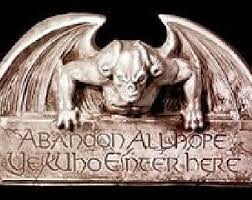
“Abandon All Hope Ye Who Enter Here”

images-37

This welcoming admonition, according to Dante, was prominently displayed on the gates of Hell (the Inferno). Certainly Dante had no concept of capital markets or the stock market; however, after this week’s action at the corner of Broad and Wall, his dire warning might be a fitting inscription atop the portal of the New York Stock Exchange. Last Friday, August 21, it appeared many had ‘abandoned all hope’. Panic has finally set in. We are finally getting that 10% (maybe more to come) correction many have been pining for over the past few years, and we are getting it with a vengeance. What the Greek situation failed to trigger two months ago, China and $40 a barrel oil appear to have accomplished in about two weeks.

Dante Alighieri
Dante Alighieri

Fear of a Chinese economic melt-down, fostered by a slight (3%) Yuan devaluation (after a 25% increase vs. the $ since 2006) and the bursting of a speculative bubble in now-cratering Chinese stocks (brought about by government stimulus to turn an intentionally-slowed Chinese economy around). Reinforcing China fears was a six-year low on WTI at $40. The market seems to be viewing this as a further sign of a global economic slowdown. My view is extreme oversupply vs. growing (but no spectacularly) demand. All of this was brought about by the U.S. shale oil revolution and the Saudis producing full-bore to retain market share and punish their enemies (US shale, Iran, Russia and ISIS).

Regardless, nothing was sacred this week

Stocks with good stories and earnings to back them up, value stocks, high PE/ supposed hi growth, REITs, Utilities, high-tech, bio-tech, all were given a drubbing. Friday saw the Dow -3.12%, Nasdaq -3.52%, S&P 500 -3.19%, all in correction territory. The panic was highlighted by the action in the CBOE volatility index, VIX. It was at 13 Tuesday and hit 24 Friday. This indicates people were buying put options to protect their downside in a panic frenzy. They did not care what the protection cost. I’d say they were scared. Oh yes, they are even selling the dollar, which at its strongest vs. the Euro was trading at $1.05 back in March. It went out Friday at nearly $1.14 to the Euro.

What were they buying?

But of course, the old standards for the ‘end times’ … they were buying gold, up 7.4% since August 4, half that in the last three days. They love the U.S. Treasury 10-year note at 2.045% (down in yield from 2.5% in June) vs. the S&P 500 with a 2.1% dividend yield. Which do you think will be the better investment over the next 10 years? Regarding the drop in the TSY yield, this is in the face a potential move by the fed to increase rates in September (1/4 of 1% from near zero). Based on this action, my bet is that if the Fed does move in September, the 10-year yield will move even lower … so much for Fed moves to normalize rates causing a spike in longer rates, killing the economy.

This is a good segue into what you might want to look at here. If you believe, like me, that interest rates are NOT headed into the stratosphere any time soon (maybe not for years), this threat of a small potential uptick has created a good opportunity in interest-sensitive yield stocks, REITs, MLPs and utilities — anything where a perceived rise in rates would cause financial stress because of leverage. All of the above have significant debt; not because they are big risk-taking enterprises, but because of the stable, predictable nature of their business models … rental income on a diverse package of properties; with MLPs fees on storage, oil, gas and petroleum product passing through their pipeline and treatment infrastructure (most MLPs do not produce energy and are not dependent on commodity prices), and; finally people paying their utility bills to avoid being cut off. Good yields and potential dividend growth would be available from each of these sectors. For those not wanting to pick stocks, ETFs, closed-end exchange traded funds and mutual funds are available in all three asset classes. This is by no means an exclusive list. There are lots of good dividend plays out there in other sectors. All of this free advice is subject to our customary disclaimer below.

Final Thought

Maybe I am missing something, but I am have trouble seeing the current situation as dire and warranting the panic that has surfaced in the market. Regarding everything that I know to be true and holy, bull markets do not end in panic. They are born in PANIC (which is what we have been seeing the last few days). Bear markets are bred and born in EUPHORIA, of which we have seen little, or none, since 2008/2009.

Ergo, I am not Abandoning hope. I am embracing it!

What do you think?

The information presented in kortsessions.com represents my own opinions and does not contain recommendations for any particular investment or securities.  I may, from time to time, mention certain securities for illustrative purpose, names where I personally hold positions.  These are not meant to be construed as recommendations to BUY or SELL.  All investments and strategies should be undertaken only after careful consideration of suitability based on the risks, tolerance for risk and personal financial situation.

Categories
Financial, Stock Investment

“Nasdaq surge is triggering tech-bubble flashbacks”

Arghh! It's bubble time again.
Arghh! It’s bubble time again.

This was Barbara Kollmeyer’s ‘if it bleeds, it leads’ banner headline, Friday, July 17 (MarketWatch). Ms. Kollmeyer goes on to say, “some strategists are starting to think either history could repeat itself for technology stocks, or we could be opening a nastier chapter in the book of bubbles.” For all the gory details, click HERE. Actually, don’t waste your time.

It is beyond comprehension that 15 years after the tech bubble (actually Dot.Com Bubble) burst anyone with half a brain would be worried about the fact the Nasdaq has finally eclipsed (in a very small way–78 points) that ‘bubble’ high (5132.25). Come on. We’ve had 15 years to burn off the valuation excesses, purge the junk and see the real companies in the index come to the fore. I’m not going to detail the progress we’ve made. But if you are interested is an update, Dan Gallagher’s “Heard On the Street” WSJ entry from March 2, 2015 is a good reference piece (Nasdaq Math: 5000 Doesn’t Equal 2000). If you are at all concerned, this is a good read.

Piling On

piling on
piling on

Piling on Kollmeyer’s frightening banner is Mark Hulbert’s (Hubert Financial Digest) commentary (“Greed is trumping fear and that’s bad for stocks“). Why not, the market had just made another new all-time closing high the day before. This article is somewhat tangential to ‘tech bubble’ talk in that it concerns a recent set of seminars held in San Francisco, called “The Money Show”.  Hulbert attended and was much chagrined to find only a small number of the sessions dealing with managing risk and avoiding losses. This was in stark contrast to  similar sessions held several years ago(post 2008/2009), where risk and loss avoidance were the main focus. Ergo, he postulates that the Bay Area appetite for risk equals the national appetite for risk, which would be a bad thing. There is a flaw in Hulbert’s thinking and that is extrapolating the epicenter for wealth creation in the U.S. (the home of Apple, Google and Facebook) to the rest of the country.

I find it hard to square this with the rest of the country and the immediate ‘flight reaction’ one sees in the treasury market any time there is a dust-up over Greece, a bad Chinese economic number or comments indicating a certain quick upward bias by the Fed to increase interest rates. In spite of the fact that a Fed Funds rate increase looks imminent in the next few month and the market has moved to new highs, the yield on the ten-year US Tsy note remains pretty close to where it began the year, currently 2.35%. Most people are still very cautious with many continuing to look for what has been a most-elusive correction in modern times.

Where’s the correction?

In my limited experience, the market tends to do what confounds most people, especially those with short-term viewpoints. As it pertains to corrections, this market may not give us the conventional 10 or 15 percent move down in one fell swoop. Why? That’s what everyone is looking for. Don’t get me wrong, this could happen any time. But, it will come as a result of some sort of exogenous event, a blindside. These events are just not predictable.

In the meantime, we may have been going through what many might call a Rolling Correction. In a rolling correction a stock may make a new high, then over a period of months (maybe a year or longer) it moves lower, creating a correction. This repeated over time and over a large number of issues can provide a correction without a major, overall market break. For example, Google (GOOGL) peaked in February of 2014 @ $615 over the next 11 months it hit a low of $491 (a 20% correction from the previous high). It broke out of that range 7/16/2015 and closed 7/17 at $699.62. Bank of America (BAC) peaked at $18.21 in December of 2014, fell to $15.63 in a month’s time, January of 2015 (a 14% correction). BAC closed 7/17 @ $18.10.

These are examples of stock price action in a rolling correction. I have observed a lot of this going on in my own portfolio over the last year. It may also be observed in the action of groups –recent strength in transports gave way to tech and biotech picking up the banner. Again, no guarantees that we are not going to get a big, market-wide correction, but the market seems to like to do what confounds the most people, most of the time!

“Nasdaq surge is triggering … flashbacks.” Gime a break!

What do you think?

The information presented in kortsessions.com represents my own opinions and does not contain recommendations for any particular investment or securities.  I may, from time to time, mention certain securities for illustrative purpose, names where I personally hold positions.  These are not meant to be construed as recommendations to BUY or SELL.  All investments and strategies should be undertaken only after careful consideration of suitability based on the risks, tolerance for risk and personal financial situation.    


Categories
Financial, Stock Investment

“Groundhog Day”

Goundhog Day
Goundhog Day

My title references the 1993, Bill Murray movie of the same name, where Murray plays an egotistical, obnoxious weatherman assigned to cover Punxsutawney Phil’s annual winter trip out of his burrow … very demeaning stuff. The problem for Murray’s character, Phil Connor (how ironic, another Phil) is that he becomes trapped in a time warp. Each morning he wakens to another Groundhog Day in Punxsutawney, PA.

I am beginning to feel that I am in some sort of time warp. Every morning I awaken to the financial media worrying about the impending (potential disaster) Fed move to begin to raise (i.e. normalize) interest rates; and, of course, the Greek tragedy (a.k.a. “the Grexit”). Will this circle ever be broken?

A few Words on The Dreaded Interest Rate Lift-OFF and The “Grexit”

Regarding Lift-Off, I am pretty sure that when the Fed moves to begin normalizing interest rates (ever-so -slowly) it will not be traumatic. Instead, it will be liberating, as the uncertainty as to when and the market effect of tis action will be lifted, equating to a better environment for stocks. We discussed this at length in our post “The Great Interest Rate Mystery–Solved.”

As to a potential Greek default and exit from the Eurozone (Grexit), let me see. This is probably the most anticipated, best telegraphed global economic problem of the past decade. Ergo, as Greece is a tiny economic entity and most banks and fiduciaries have had plenty of time to analyze their issues, only the most hearty of risk-takers would experience the brunt of this hit. In other words, a Greek default does not appear to be a global systemic issue.

There is an argument that a “Grexit” might give other Euro weak sisters (Italy, Spain and Portugal) license to pursue the same course. I don’t buy this, because the Greek people will have to endure significant pain in the process, which would be a deterrent to others, whose economies may be struggling, but not nearly as badly as Greece’s economy. Also, if contagion were and issue, why are the sovereign credits of Italy, Spain and Portugal not forced to pay a lot more for money these days? Accept for Portugal, which is a slight outlier below, US, Spanish and Italian ten-year debt yield pretty much in line … no panic here, accept these low rates would still indicate an extreme preference for safety of principle. This not the kind of market psyche you normally see at bubble tops (at least not in equities, maybe fixed income).

Sovereign 10-year rates

US               2.24%

Spain          2.30%

Italy            2.28%

Portugal     3.03%

Will my Groundhog Day ever end?

My sense is that it will. And, it will be resolved to the upside. Things are just not that bad out there!

What do you think?

The information presented in kortsessions.com represents my own opinions and does not contain recommendations for any particular investment or securities.  I may, from time to time, mention certain securities for illustrative purpose, names where I personally hold positions.  These are not meant to be construed as recommendations to BUY or SELL.  All investments and strategies should be undertaken only after careful consideration of suitability based on the risks, tolerance for risk and personal financial situation.    
Categories
Financial, Stock Investment

Fed Policy Statement: A Change of Heart?

For some time now I have been advocating for a more normal short term interest rate policy from the Federal reserve vs. the ZIRP (Zero Interest Rate Policy) that they have been pursuing. My reasoning was, although the US GDP was not humming along at a more normal 3% real trend-line growth rate, things were not that bad at 2%+ with unemployment at 5.5% (down from 10.5% in 2009) … we could stand a one or two percent Fed Funds rate. Sooner or later rates would have to move back up. Why not move now, to slowly raise rates, rather than wait for an emergency?

But wait! OMG! They dropped the word “patient!”

OMG! They dropped the wortd "patient"
OMG! They dropped the wortd “patient”

Indeed they did, but the Fed inserted some really open-ended guidance when they indicated that the unemployment rate wasn’t to be a key determinant of their policy. Remember 5.5% was always, in the past, considered to be ‘full employment’ (as there would always be a portion of the population in transition). Below that level was considered to be inflationary, as it would put upward pressure on wages, causing employers to pay up for qualified employees.

This gets into the nuances of what unemployment really means. The Bureau of Labor Statistics has several gradations above the ‘unemployment rate (U3)’–U4, U5 and U6. The ne-plus-ultra is U6, which adds to the unemployment rate discouraged workers, marginally attached workers and part-time workers for economic reasons. Louis Efron, in Forbes, 8/24/14, gives a good account (“Tracking the Real Unemployment Rate … “). At that time the U6 unemployment rate was 12.6%, more than double the U3 rate of 6.2%. Why this huge disparity exists is not certain. Maybe it is a residual effect of the great recession and crash of 2008; or, possibly globalization. Whatever the reason, it appears that the Fed has decided to zero in on the quality of jobs and wage growth (which has been very scant) and not the old standard U3 unemployment rate, as benchmarks for setting rates. Who can know with certainty what is on their mind? This is what I surmise. Bottom line: Rates look to be lower longer. These comments from Fed governor Charles Evans may back up my contention– “Fed statement doesn’t rule out lengthy stay at zero (for rates) …”.

My change of heart: Rates lower longer is not such a bad thing

A changed heart
A changed heart

I heard a presentation last week by a very successful fixed income money manager, whose name will remain anonymous, since much of his thought process may not have been disseminated to his own firm and clients. None-the-less the thought process rang true.

Why no need to rush higher rates:

  • The US economy is not setting the world on fire. Europe is still a mess and Asia continues to grow, but at a moderating rate … no signs of overheating globally.
  • Inflation does not appear to be an issue as we are, and have been, in a commodity bear market for the last six years.  “The typical commodity bull market lasts about 13 years followed by a 21 year bear market” — Tony Caldero, “the ELLIOT WAVE lives on”. Another source pointed out that a 13 year bear market in commodities was shortest on record. Assuming the current bear goes 13 years, we still have a long way to go without a lot of commodity price inflation. This is very pro stock market, pro equity, as raw material costs are lower and will remain in check for some time if these metrics hold true.
  • One of the Fed’s concerns is the lack of wage growth, a continued sign of low inflationary bias.
  • Europe, after years of resistance to quantitative easing and a strong adherence to economic austerity, is just beginning to grudgingly loosen up. The past austerity may make it very difficult to reignite growth. This is very much akin to what happened in the United States during the Great Depression. The New Deal (a massive stimulus program) beginning in 1933, pulled us out of the worst of the depression; but in 1937 we slipped back in as the Fed began to tighten. This was in part due to the damage the economy suffered in the early 1930’s via austerity. Importantly, interest rates here in the US (even at today’s pitifully low level) are still very attractive. Raising them now would further harm Europe, syphoning funds from their economies. These numbers are really stunning (just take a look at this table from Bloomberg Business).

I have seen the light!

The Light
The Light

And, it is not that of a freight train coming at me from the other end of the tunnel. Our economy is not in perilous straights. Rates may be lower longer because of qualitative judgements on the part of the Fed regarding employment quality issues, wage growth and distressed Europe. Also, inflation, the other part of the Fed’s dual-mandate seems to be well in check (and may remain well in check).

Yes, rates will eventually head North, but based on the way the Yellen Fed couched its comments last Wednesday, it could be much later than many expect. Ergo, stocks continue to be the place to be. And, unless inflation comes roaring back, they may continue to be attractive well after rates begin to rise in the ‘Great Lift-off’.

What do you think?

The information presented in kortsessions.com represents my own opinions and does not contain recommendations for any particular investment or securities.  I may, from time to time, mention certain securities for illustrative purpose, names where I personally hold positions.  These are not meant to be construed as recommendations to BUY or SELL.  All investments and strategies should be undertaken only after careful consideration of suitability based on the risks, tolerance for risk and personal financial situation.    

Categories
Financial, Stock Investment

“Everyone is scared …”

This is our national psyche according to Nobel Laureate, Robert Shiller, a practitioner of the “dismal science” of economics.

Robert Shiller
Robert Shiller

What are they scared of?

The human race has deep underlying fears about technology and the lives their children will lead and this can be seen – in all places — in the negative yields in bond markets, Nobel Prize-winning economist Robert Shiller told CNBC.

“I think fears have been growing for years that represent the willingness of people to bid up bond prices,” he told CNBC Wednesday.

“They are worried about their future. They are worried not just about next year, they are worried about the next twenty years, the next forty years. So they are desperately trying to provide for that, they’ll even accept negative yields.” (Everyone is scared: Nobel Prize winner Shiller).

This cheerful pronouncement was made by Professor Shiller, 2:00 pm EST, January 28. No wonder the market fell out of bed that afternoon, forget the real news (which was not that earth-shattering). If shillers assertions strike a chord, maybe it is time to start honing your survivalist skills.

Shiller’s dark analysis has a silver lining

120px-Storm_clouds_over_Saltney_Ferry_-_geograph.org.uk_-_1023082

For if he is correct in his assertion that “everyone is afraid,” our current secular bull market probably has much further to go. Why? Because, bull markets are born in periods of extreme pessimism and fear. They die in periods of extreme optimism and euphoria. If Professor Shiller is correct, the game is not nearly over. It still may be in the earlier innings.

This is not to say we are immune to sharp, downward, scary moves in the market … or even a cyclical bear market. But, in the long-run, the secular bull market that began in March of 2009, may have a lot further to go before the euphoria really sets in. Distrust of the market brought about by the ’08 / ’09 collapse will not be easily banished. 

Thank you Professor Shiller for validating a point I’ve made in past Kortsessions

Hyper-low rates are about fear. 

But, it may not necessarily be about fear among U.S.-centric investors. It is also about fear in Germany and Japan, where their 10-year sovereigns closed at .27% and .28% yields respectively, and with Italy 1.58%, U.K. 1.34% and Spain 1.45%. Our 10-year, still at 1.64% (1/30/2015), provides the most competitive, safe yield in the world.

Are you scared yet?

P.S. The folks at CNBC, I’m sure, were absolutely delighted to get this scoop. They make a living on the negativity. Remember, ‘if it bleeds it leads.’

The information presented in kortsessions.com represents my own opinions and does not contain recommendations for any particular investment or securities.  I may, from time to time, mention certain securities for illustrative purpose, names where I personally hold positions.  These are not meant to be construed as recommendations to BUY or SELL.  All investments and strategies should be undertaken only after careful consideration of suitability based on the risks, tolerance for risk and personal financial situation.    

Categories
Financial, Stock Investment

Session 135–If you can’t say something good … ,

Say something really negative, something really stupid or ‘saw sawdust.’ Today’s headline opinion column in MarketWatch (“The Fed has boxed U.S. into a tough easy-money corner”) hit the trifecta.

a Trifecta
a Trifecta

As it pertains to saying something really negative, the article really hits the bull’s-eye, suggesting that when (and if) the Fed moves to reverse Quantitative Easing (QE), shrinking the balance sheet by selling off positions in Treasury and agency mortgage-backed securities, rates will rise, causing the Fed to lose massive amounts of money on their positions. This is possible: but so far, those who have attempted to forecast the rate impact of the removal of QE have come-a-cropper. I cannot recall anyone, who one year ago, was forecasting rates would drop on the taper and end of Quantitative Easing…but they did, big time, from near 3% on the TSY 10-year to a current read of 2.32%. So far the opposite has occurred with the Fed being profitable on many of the bonds purchased this year.

Guru/Banker  Satyajit Das
Guru/Banker
Satyajit Das

And now for something really stupid; the commentator in the above article, Satyajit Das, states: “Despite a conspicuous lack of success, central bankers persist with the same policies” (i.e. QE). “Conspicuous lack of success …” what galaxy does Mr. Das hail from?” If I’m not mistaken, the Fed started in with QE1 in November of 2008. Since that time, the unemployment rate has fallen from a peak of 10.5% to 5.8% and real GDP growth is estimated by The Conference Board to come at around 2.2% in 2014. Although this number doesn’t knock the cover off the ball, it is respectable versus those countries, especially the Eurozone, who did not aggressively pursue these policies. Remember, we continue to hear concerns about Europe slipping back into recession.

We ‘saw the sawdust’ again … another incident of slogging over the same well-traveled road on the evils of QE and the disasters it will spawn. Voila! The trifecta.

I might point out, for those who worry about bonds becoming good competition for stocks, the main conclusion of this tale of woe is that the Fed can’t raise rates any time soon or they will generate huge losses on their balance sheet. This is very positive for equity valuations!

What’s your take?

The information presented in kortsessions.com represents my own opinions and does not contain recommendations for any particular investment or securities.  I may, from time to time, mention certain securities for illustrative purpose, names where I personally hold positions.  These are not meant to be construed as recommendations to BUY or SELL.  All investments and strategies should be undertaken only after careful consideration of suitability based on the risks, tolerance for risk and personal financial situation.    


Categories
Financial, Stock Investment

Session 131–Adieu Q.E.–Rest in Peace

That is my fervent prayer. But it seems like the media has other plans. Today’s special coverage on CNBC and MarketWatch gives me the feeling, in fact, the much-maligned Quantitative Easing isn’t going to get a rest, even though its long past its prime as a topic. I’m not certain why this is. Maybe it’s because they have nothing else to worry us with; like no new cases of Ebola in the “Big Apple.” To capture the hyperbole today I quote Australian stunner, co-anchor Mandy Drury, who summed up her segment today by saying, “We had a very big day today–the end of Q.E., history in the making.” I’m not sure what she was talking about (it’s not about what she says anyway). At one point after the Fed minutes were released we were down on the Dow about 100 points (less than one percent), finishing down only 32 points.

 the Australian stnner

the Australian stnner

OMG!!! Things are getting better!

This is not bad, considering the negative feeding frenzy the media went into on a small change in tone taken in the Fed’s message about the economy. OMG! They were more positive on their outlook for the economy. Things are getting better out there! And, you know what that means–the Fed will run rates up and ruin everything. I’m not sure this argument really washes, but this a topic for a future post as we approach that awful day of reckoning. But, I digress. To show you how ridiculous this emphasis on the negative aspects of the withdrawal of Q.E. is, a little history lesson might be in order. Up until January 2014, the Fed had been buying a total of 85 billion dollars worth of long-dated Treasuries and agency mortgage-backed securities each month, about four billion per day. As a result of the “dreaded taper” that daily buy was running at the paltry sum of $600 million daily this month.  This versus markets that trade, on average, at least (sometime much more) $150 billion daily. As Q.E. ended, the Fed was a tiny overbid in the market place. Also, the statement indicated no immediate plans to shrink the Fed balance sheet that Q.E. expanded. Since the beginning of the ‘taper” in January of this year, interest rates which peaked a tad over 3% on the UST 10-year, have been as low as 2.15% (mid October 2014); and, today, the 10-year went out at 2.32%. Nobody, including me, saw this as a potential outcome of tapering and closing out Quantitative Easing.

Point / Counterattack (Santelli in Rant)

Wrong-way Rick Santelli

Bottom line, Q.E. and the tapering thereof have had minimal market impact this year, despite what screamer, Rick Santelli, has to say in the attached clip (Bouroudjian,” Let Janet Yellen alone!”). It must be horrible to have been so completely wrong for so long. Santelli’s life must be reminiscent of the movie, “Groundhog Day.” In the meantime, his foil in the clip, Jack Bouroudjian, was spot-on in his comments.

Jack Bouroudjian
Jack Bouroudjian

Here are a few more snippets from CNBC and our friends at MarketWatch to give a flavor of how stupid this got. Brace yourself:

Parsing the parsers:

CNBC--“Surprisingly hawkish Fed ruffles markets”

MarketWatch–“Economists react to Fed statement–Signs of hawkishness”

And here is the best (old News)–CNBC–“As the Fed leaves the bond market, here’s who will step in”

What do you think of this stuff?

The information presented in kortsessions.com represents my own opinions and does not contain recommendations for any particular investment or securities.  I may, from time to time, mention certain securities for illustrative purpose, names where I personally hold positions.  These are not meant to be construed as recommendations to BUY or SELL.  All investments and strategies should be undertaken only after careful consideration of suitability based on the risks, tolerance for risk and personal financial situation.

Categories
Financial, Stock Investment

Session 129–The House of Pain

That’s what I call the small and mid-cap segment of my portfolio. BTW, “House of Pain” is a term most Cramer fans are familiar with. He did not invent it, but I think it is appropriate. I mean it has really gotten ugly out there, not to mention the return of volatility that some were bemoaning the loss of just a few short months ago. Truly this may be the “Big One”, that 10%+ correction many have been saying was ‘just around the corner’ for the past two years.

 House of Pain
House of Pain

What a difference a day made

From up 275 p0ints on the Dow Jones Industrials Wednesday, on nuanced Fed Speak stating their decision process would include consideration of global economic conditions (Europe comes to mind). Fast forward to Thursday, and due to some additional disappointing numbers out of Germany, comments by ECB Chief Mario Draghi and Fed Vice Chair, Stanley Fisher, the Dow reverses field and drops 335 points (1.97%). The damage in the small and mid-cap Russell 2000 was more extensive, down 2.66% (down almost 12% from its March peak).

Why the fuss?

Seems to me it’s all about Europe and fear that recent signs of weakness over there will undo our recovery, even if the weight of the evidence is less than compelling. It is a good excuse to sell things.

One thing that puzzles me is why the U.S. has to pay more than Spain (2.31% vs. 2.06%) to borrow money for ten years and why does Italy enjoy the same rate for 10-year money that we pay. You would think if things had gone so awry over there they would have to pay more. Remember, these are two of the PIGS …Ireland and Greece complete the quartet.” These were the sickest of Europa’s sisters two years ago.

Here is how CNBC contributor, Art Cashin, summed-up today’s action.  Not only did he cover Europe, but he threw in Ebola and ISIS for good measure. BTW, Art failed to mention more good news on the employment from earlier in the day, ignoring the fact that the initial Jobless claims rate came in for the 4th straight week under 300,000 (first time this has happened since 2006). The 287,000 number was 21% below the year-ago number.

“The only thing we have to fear is fear itself “

FDR
FDR

These words were spoken by our 32nd President, Franklin Delano Roosevelt, in his first inaugural address (1933) in the depths of the Great Depression. Those were really tough times. Before this, or future corrections end, the media will be working hard to convince you that these, too, are dire times. Roosevelt’s quote on fear is very applicable when investing in today’s media afflicted world. It is fear that makes us sell low and buy high. So, to finish this session, in a period of rising fear and agitation, I thought I would conclude with a bit more of this wonderful quote;

“….let me assert my firm belief the only thing we have to fear is fear itself –nameless, unreasoning, unjustified terror which paralyzes needed efforts to convert retreat into advance.” 

ONE LAST ITEM: The stock market is the only place that I know of where the concept of ‘The Price Elasticity of Demand” seems to fall apart. Normally lower prices increase demand. However, in the stock market lower prices often create supply, while higher prices create demand. For whatever it is worth, no matter how many solid reasons one can present for higher or lower valuations, these anomalies can persist some time without resolution.

So, enjoy the House of Pain the best you can. It may be with us for a spell.

The information presented in kortsessions.com represents my own opinions and does not contain recommendations for any particular investment or securities.  I may, from time to time, mention certain securities for illustrative purpose, names where I personally hold positions.  These are not meant to be construed as recommendations to BUY or SELL.  All investments and strategies should be undertaken only after careful consideration of suitability based on the risks, tolerance for risk and personal financial situation.